The Ribchester Helmet: a Roman parade helmet found by a boy at play
Famous find Made in the late 1st or early 2nd century AD · Found in 1796 See it on the timeline →
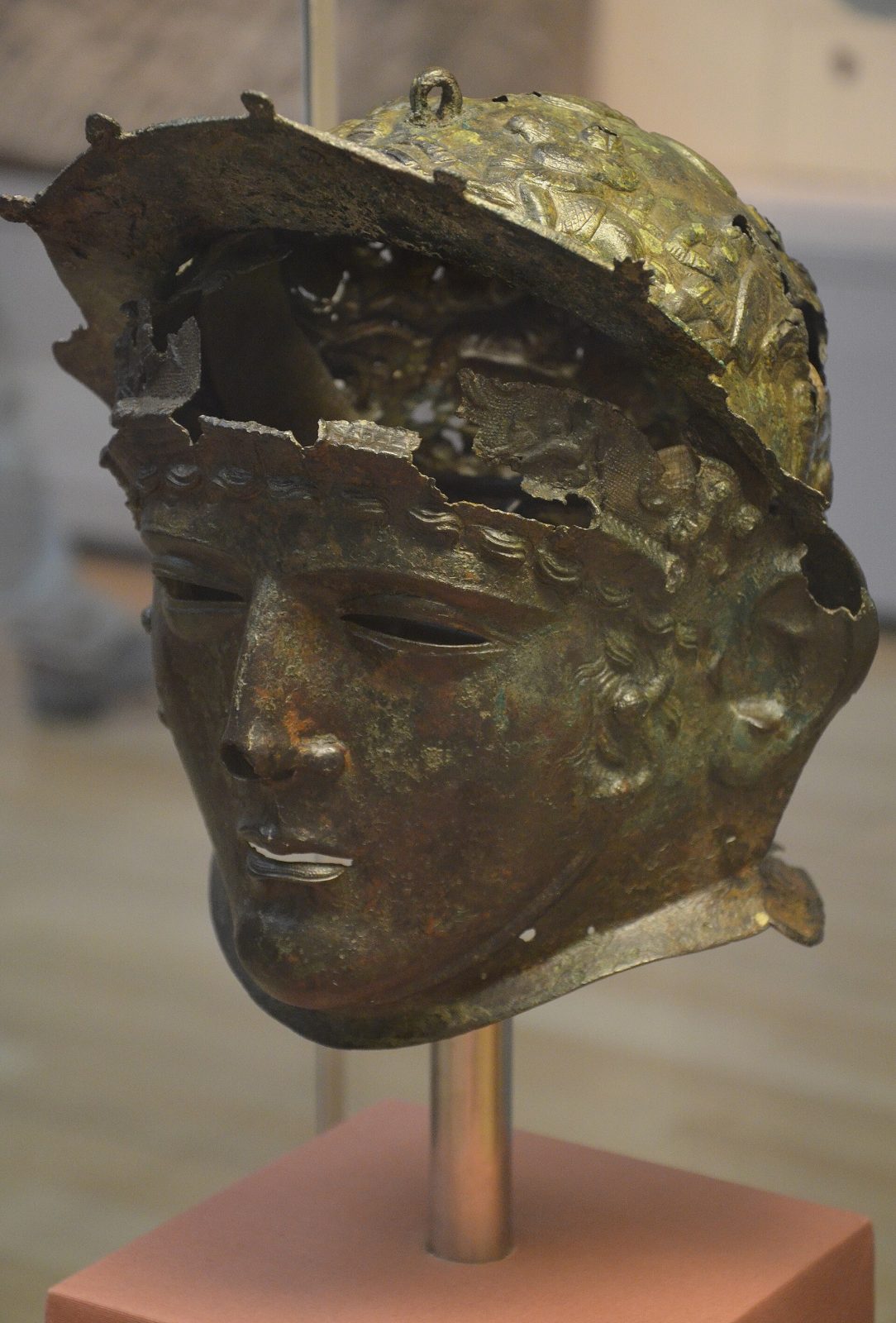
In the summer of 1796 a clogmaker's son playing near the Roman fort at Ribchester in Lancashire found a hoard of Roman cavalry equipment, including one of the finest Roman helmets ever found in Britain.
In the summer of 1796, the son of Joseph Walton, a clogmaker in the Lancashire village of Ribchester, was playing on waste ground behind his father's house, near the church and the River Ribble, when he found a hoard of Roman metalwork. The village stands on the site of a Roman cavalry fort, Bremetennacum. The boy's name was not recorded.
The finest piece was a bronze cavalry sports helmet in two parts: a cap embossed with a battle between soldiers on foot and on horseback, and a face mask with the features of a young man, the two once joined by a leather strap. It is about 28 centimetres high. The rest of the hoard was mainly cavalry sports equipment and military awards. By local tradition, a small bronze sphinx that may once have sat on top of the helmet was given to the Walton children as a toy and lost.
Helmets like this were worn by Roman cavalrymen in displays of horsemanship and mock battles, not in war. The British Museum dates it to the late 1st or early 2nd century AD. Inside, dots punched into the metal spell CARAVI, "property of Caravus", the name of a soldier who is otherwise unknown.
In 1797 the collector Charles Townley of Towneley Hall bought the hoard, and he published the helmet in the Society of Antiquaries' Vetusta Monumenta in 1799. After his death, his collection was sold to the British Museum in 1814. The helmet is on display there, and a replica can be seen at the Ribchester Roman Museum, close to where it was found.
Written for Global Finds from the British Museum, Roman Inscriptions of Britain, the Society of Antiquaries of London and other published accounts. Photo: the Ribchester Helmet in the British Museum, Carole Raddato, Wikimedia Commons, CC BY-SA 2.0.
Approximate location53.86, -2.53View on map
Source: Roman Inscriptions of Britain