The Ashwell Hoard: a Roman temple treasure that revealed an unknown goddess
Famous find Buried in the later 3rd or 4th century AD · Found in 2002 See it on the timeline →
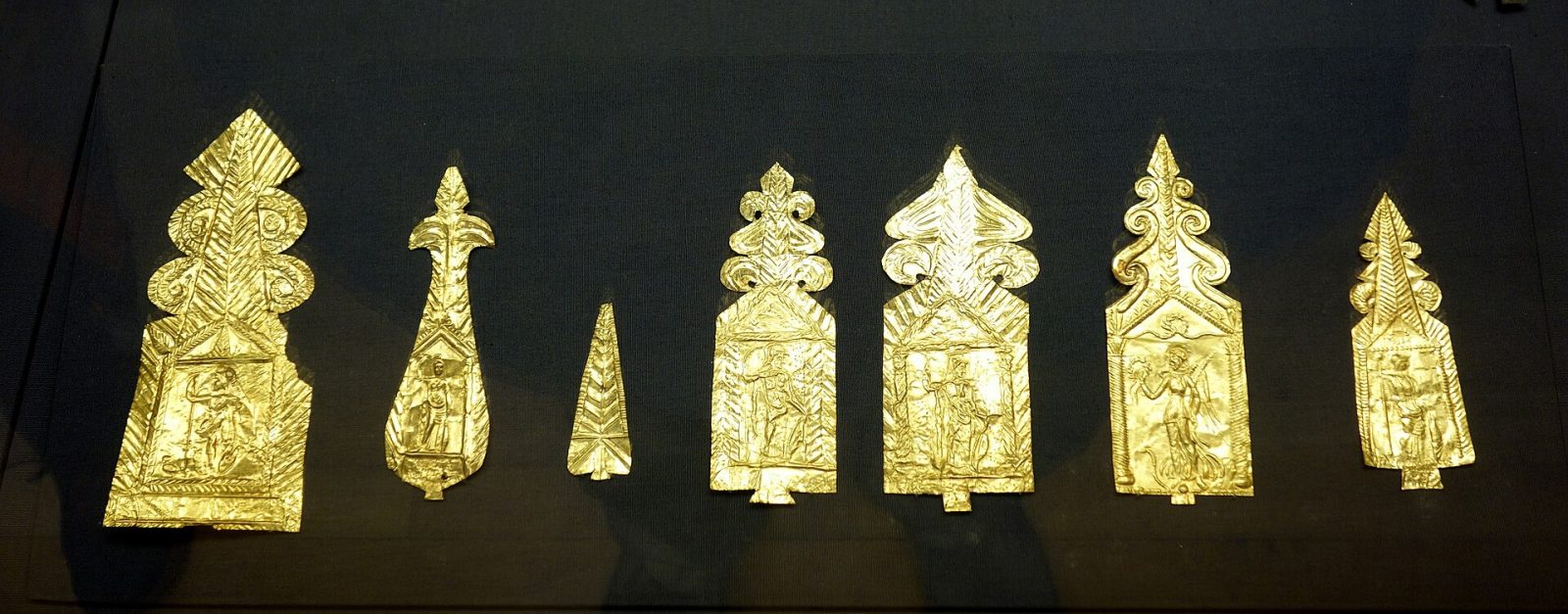
In 2002 a detectorist in Hertfordshire found Roman gold and silver votive plaques, jewellery and a silver figurine. Their inscriptions named a goddess nobody knew had existed: Senuna.
In September 2002, Alan Meek, a member of the North Herts Charity Detectors Group, was searching a ploughed field at Ashwell End, near Ashwell in north Hertfordshire, when he found a cluster of Roman gold and silver objects. He reported it straight away. To protect the site, the British Museum at first described the hoard only as coming from near Baldock.
The hoard contains a silver figurine of a goddess, about 15 centimetres tall though missing its face, arms and feet; gold jewellery, including a pair of disc brooches set with blue glass and a gold clasp set with a red stone; and around 20 gold and silver votive plaques shaped like leaves or feathers, of the kind offered at Roman temples. Counts vary slightly between sources.
Several of the plaques carry inscriptions to a goddess called Senuna, sometimes read as Senua, whose name had never been recorded before. One records a vow fulfilled by a man called Firmanus. She seems to have been a British goddess linked with the Roman Minerva, and perhaps with a local spring or river. The hoard was buried in the later 3rd or 4th century AD.
The find was declared Treasure in March 2003, and the British Museum acquired it for £35,000 with help from the Art Fund and the British Museum Friends. Because it had been reported promptly, archaeologists were able to excavate the site over several seasons, and they found an open-air shrine with hearths and the remains of feasting: the place where the goddess had been worshipped.
The Ashwell Hoard is on display in the British Museum's Roman Britain gallery, and the village museum in Ashwell has a replica of the figurine.
Written for Global Finds from Ashwell Museum, the Roman Finds Group, the Art Fund and other published accounts. Photo: gold votive plaques from the Ashwell Hoard in the British Museum, Daderot, Wikimedia Commons, CC0.
Approximate location52.04, -0.17View on map
Source: Ashwell Museum