The Timboholm Hoard: seven kilograms of Migration Period gold from a Swedish field
Famous find Migration Period, about AD 400 to 550 · Found in 1904 See it on the timeline →
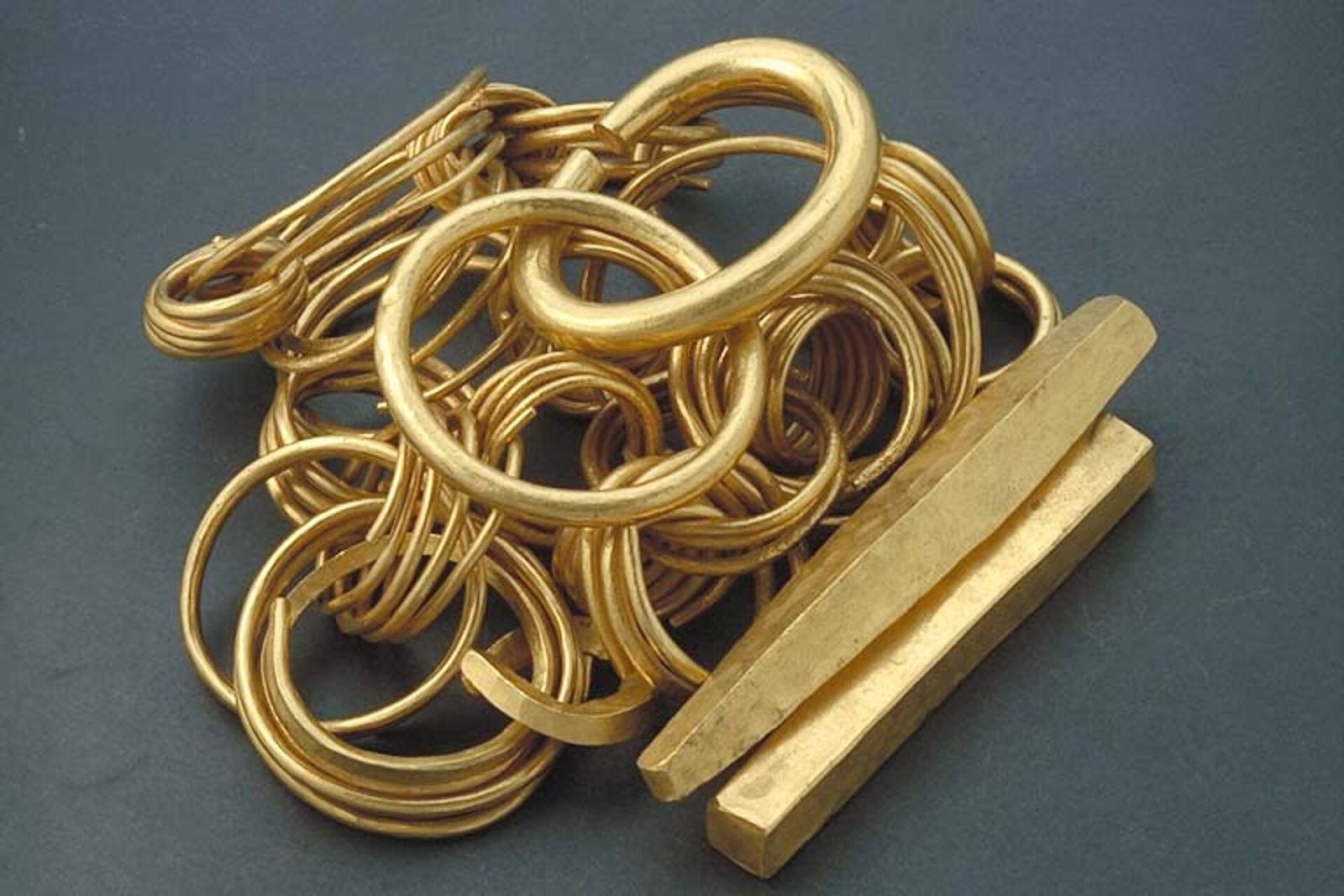
In 1904 workers levelling a small hill on the Timboholm estate near Skövde in Sweden found over seven kilograms of almost pure gold: ingots, spiral rings and heavy arm rings. It is still the largest gold hoard ever found in Sweden.
In 1904, a small group of workers on the Timboholm estate, about three kilometres east of Skövde in Västergötland, was levelling a low hillock to make a field larger. As they dug, gold began to appear. First came two chains of spiral rings; the next day, two heavy gold bars. Over a few days the full hoard came to light.
It weighs just over seven kilograms, and the gold is almost pure, 23 to 24 carat. There are 28 objects in all: two long, narrow ingots, two chains made of coiled spiral rings, one of eight rings and one of sixteen, and two massive, plain rings, one with thickened, club-shaped ends. According to Sweden's national encyclopaedia, it is the largest gold hoard ever found in Sweden, and it is often described as the largest gold hoard in the Nordic countries to survive intact.
The hoard belongs to the Migration Period, the restless centuries after the fall of the western Roman Empire, and is usually dated to about AD 400 to 550. Scandinavia at that time was flooded with gold from the Roman world, much of it paid out as tribute, wages or bribes to warriors and their leaders. Historians think the gold in the Timboholm hoard came from melted-down Roman gold coins, solidi; at about four and a half grams each, it would have taken more than 1,500 of them. The spiral rings and ingots were a convenient way to store wealth and to pay it out, gold that could be cut or uncoiled to the weight required.
The finders were promised a reward, but it was slow to arrive. In July 1905 they complained in writing, and their wait for payment made the newspapers.
Not every Swedish hoard was so fortunate. The even larger Tureholm hoard, found in 1774, was broken up and mostly melted down. Timboholm survives complete, in the Gold Room of the Swedish History Museum in Stockholm. A replica is on show at Skövde City Museum, and since 2008 a sculpture of the rings has stood on a roundabout at Timboholm, now an industrial district of Skövde.
Written for Global Finds from Nationalencyklopedin, Dagens PS and the Swedish History Museum's catalogue. Photo: the Timboholm hoard, Swedish History Museum (Historiska museet), Wikimedia Commons, CC BY 2.5.
Approximate location58.38, 13.88View on map
Source: Nationalencyklopedin