The Kaiseraugst Treasure: Roman silver spread round a Swiss village by a digger
Famous find Made AD 294 to 350, buried about AD 351 · Found in 1961 See it on the timeline →
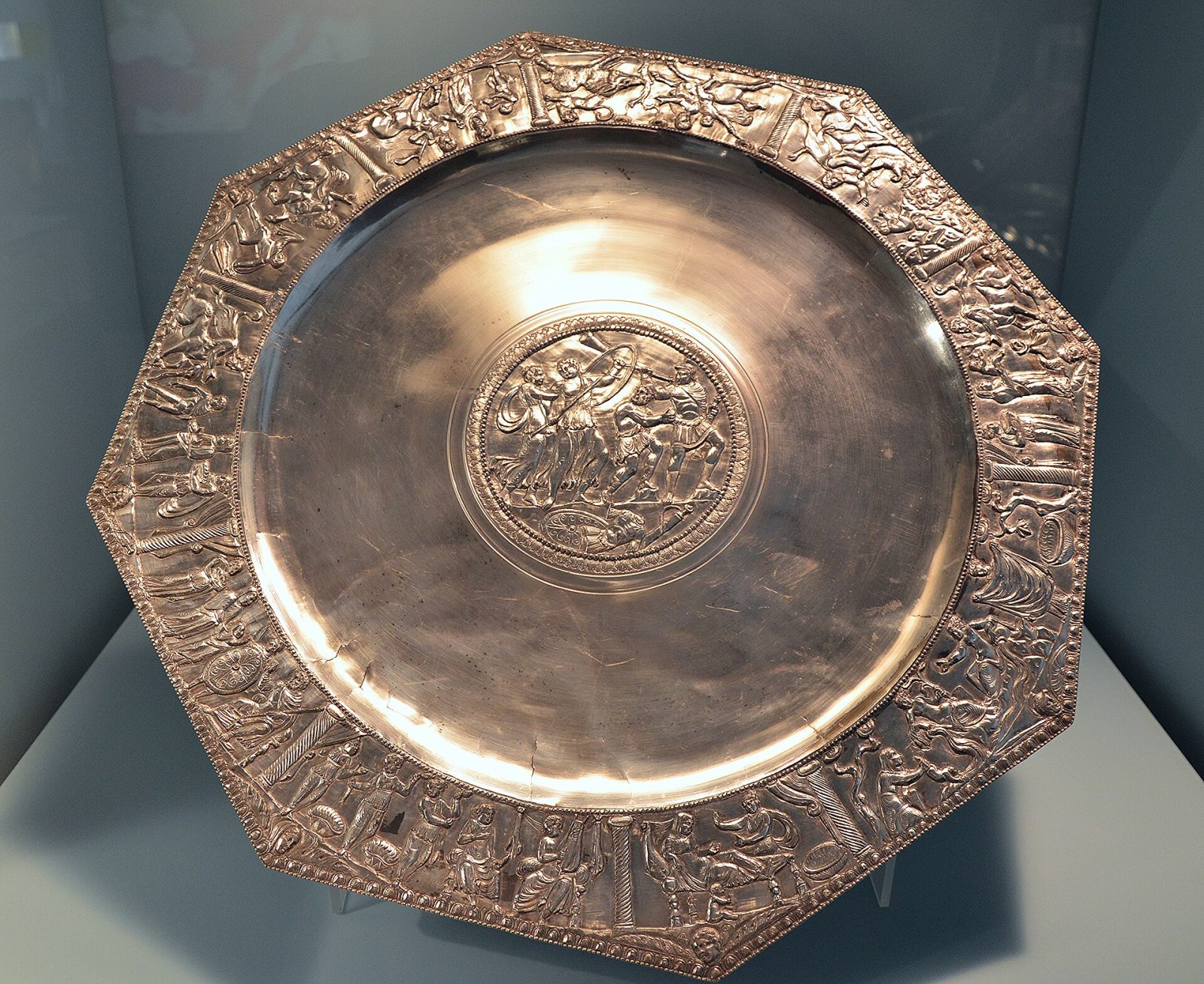
In December 1961 a digger levelling a school sports field beside a Roman fort on the Rhine cut through the largest late Roman silver hoard ever found. Nobody noticed, and the plates turned up for months afterwards in dumps, dung pits and an inn's wash-house.
On 27 December 1961, the digger driver Willy Füchter was levelling ground for a new school sports field at Kaiseraugst, on the Rhine east of Basel, close to the walls of the late Roman fort of Castrum Rauracense. His bucket cut straight through a buried hoard of Roman silver. Nobody realised. The shiny metal was taken for rubbish, and the spoil was spread around the village: over open ground, at a fish farm and in dung pits.
Over the following weeks the treasure surfaced in the strangest ways. In January 1962 a 12-year-old boy took a decorated plate to his teacher, who told him to throw it away; it was later rescued from the school rubbish dump, a tray showing Ariadne. A family out walking took home another plate. The local innkeeper, Marie Schmid, wrote down the number of their car, then searched the spoil herself and kept five plates in her inn's wash-house. When the archaeologist Rudolf Laur-Belart was finally alerted in February, he is said to have celebrated by serving meringues on one of them. In March a mass of spoons, cups, a statuette of Venus, a gilded candelabrum, coins and silver ingots came out of the ground.
It turned out to be the largest late Roman silver hoard known: about 270 objects weighing some 58 kilograms. The finest piece is the eight-sided Achilles plate, decorated with scenes from the hero's childhood and signed in Greek by its maker, Pausylypos of Thessaloniki. Another large plate shows a city by the sea. Two of the three ingots are stamped with the name of Magnentius, who seized power in the western empire in 350, and the latest coins date from about then. The museum believes the silver belonged to one or two high-ranking officers and was buried around 351 or 352, when the Alamanni were attacking the frontier. It was worth roughly a year's pay for 230 legionaries.
The story did not end there. In 1995, 18 more plates, dishes and bowls, about 22 kilograms of silver, were handed in through a notary from the estate of a person who has never been named. Someone had kept them hidden for more than thirty years. Among them was the centre of a plate whose rim had been found in 1962, made for the tenth anniversary of the emperor Constans' reign in 342 or 343.
The treasure belongs to Augusta Raurica, the museum of the Roman town at Augst. It is not on display at present; a new presentation is planned for 2027.
Written for Global Finds from Augusta Raurica's own pages on the treasure and an article by the museum's director in arCHaeo Suisse (2025). Photo: the Achilles plate from the Kaiseraugst treasure, at Augusta Raurica, Carole Raddato, Wikimedia Commons, CC BY-SA 2.0.
Approximate location47.54, 7.72View on map
Source: Augusta Raurica