The Berthouville Treasure: Roman silver for Mercury, turned up by a Normandy plough
Famous find Made in the 1st to 3rd centuries AD · Found in 1830 See it on the timeline →
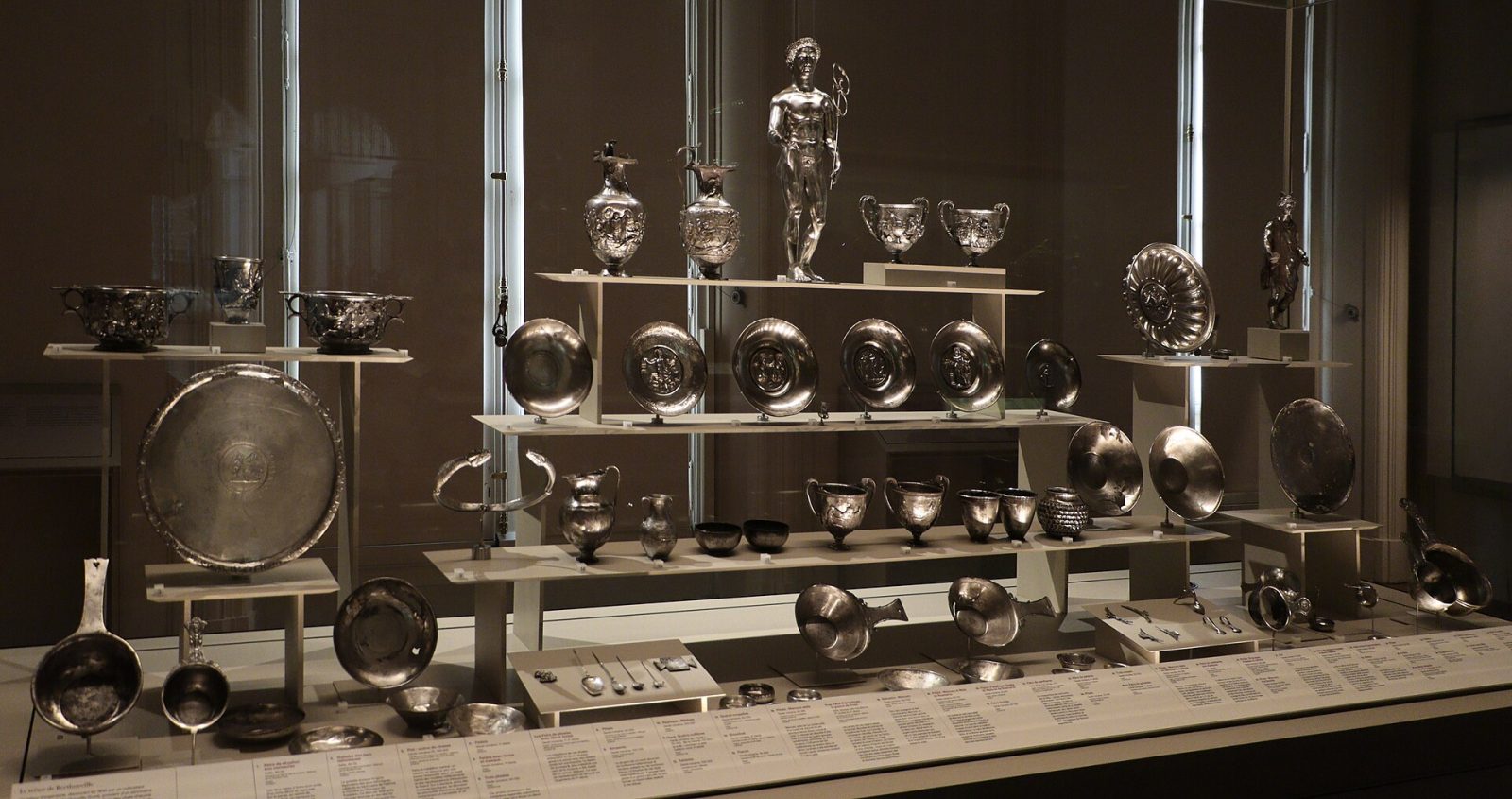
In 1830 a farmer ploughing his field in Normandy struck a Roman tile covering about 90 pieces of silver: cups, jugs, bowls and statuettes offered to the god Mercury. Two Paris museums bid against each other to buy it.
In 1830, Prosper Taurin was ploughing a field at the hamlet of Le Villeret, at Berthouville in the Eure, in Normandy, when his plough struck a Roman roof tile. Underneath, in a small brick-lined pit just below the reach of the plough, lay a mass of Roman silver.
There were about 90 objects, weighing more than 23 kilograms. They include statuettes of the god Mercury, the largest about 60 centimetres tall, and a magnificent set of tableware: drinking cups decorated with scenes of the god Bacchus and the Trojan War, jugs, bowls, dishes, ladles and spoons. Some of the cups are older than the rest, made in the time of the emperor Augustus, but most of the treasure dates from the 1st to the 3rd centuries AD. Many pieces carry Latin inscriptions recording their dedication to Mercury, and the finest were given by one man, a Roman citizen called Quintus Domitius Tutus, probably over many years.
Taurin's first thought was to sell the silver for its metal. Instead, word reached Paris, and the Louvre and the Bibliothèque nationale's Cabinet des médailles competed to buy it. The Cabinet's curator, Désiré Raoul-Rochette, won by offering more than he had been authorised to spend, and the treasure has been in the French national collection ever since.
Later excavations at Berthouville, in 1861 and 1896, showed that the silver had come from a Gallo-Roman sanctuary, with two temples, one of them dedicated to Mercury Canetonensis, a local form of the god, and a theatre. The treasure was evidently the temple's store of offerings, probably buried for safe keeping.
Between 2010 and 2014, the treasure was conserved at the Getty Villa in California. The work removed old repairs and grime, revealing original gilding and inscriptions that had not been read before. It then toured the United States, including the Getty Villa, San Francisco, Kansas City, Boston and Houston, before returning to Paris. It is now displayed in the Department of Coins, Medals and Antiques of the Bibliothèque nationale de France, at its Richelieu site.
Written for Global Finds from the J. Paul Getty Museum's exhibition announcement (2014) and the Institute for the Study of the Ancient World, New York University. Photo: Roman silver from the sanctuary of Mercury at Berthouville, in the Bibliothèque nationale de France, Francesco Bini, Wikimedia Commons, CC BY-SA 4.0.
Approximate location49.17, 0.62View on map
Source: J. Paul Getty Museum