The Vasa: a Swedish warship that sank on her maiden voyage, found by an amateur with a coring tool
Famous find Built 1626 to 1628; sank 10 August 1628 · Found in 1956 See it on the timeline →
The Swedish warship Vasa sank in Stockholm harbour on her maiden voyage in 1628. In 1956 an amateur researcher, Anders Franzén, found her with a coring device, and in 1961 she was raised almost intact. She is now the best-preserved 17th-century ship in the world.
On 10 August 1628, the new royal warship Vasa set sail from Stockholm on her maiden voyage. She was 69 metres long and armed with 64 cannon, the pride of King Gustav II Adolf's navy. After about 1,300 metres a gust of wind heeled her over, water poured in through her open lower gunports, and she sank in 32 metres of water in front of the watching crowds. About 30 people died, though the exact number is not known.
The wreck was partly salvaged in the 17th century, when most of her bronze guns were raised, and then forgotten. In the 1950s Anders Franzén, an amateur researcher fascinated by old wrecks, began searching for her in the archives and in Stockholm harbour, using a home-made coring device that he dropped onto the seabed to bring up samples. On 25 August 1956, about 120 metres from the island of Beckholmen, it came up with a plug of black oak. Navy diver Per Edvin Fälting went down and confirmed that it was a large, two-decked warship.
Raising her took years. Between 1957 and 1959 navy divers dug six tunnels under the hull for steel cables, and she was lifted in stages, still underwater, into shallower water. On 24 April 1961, watched on live television, Vasa broke the surface for the first time in 333 years. The cold, brackish water of the Baltic, too low in salt for the shipworm that destroys wrecks in other seas, had preserved her almost complete.
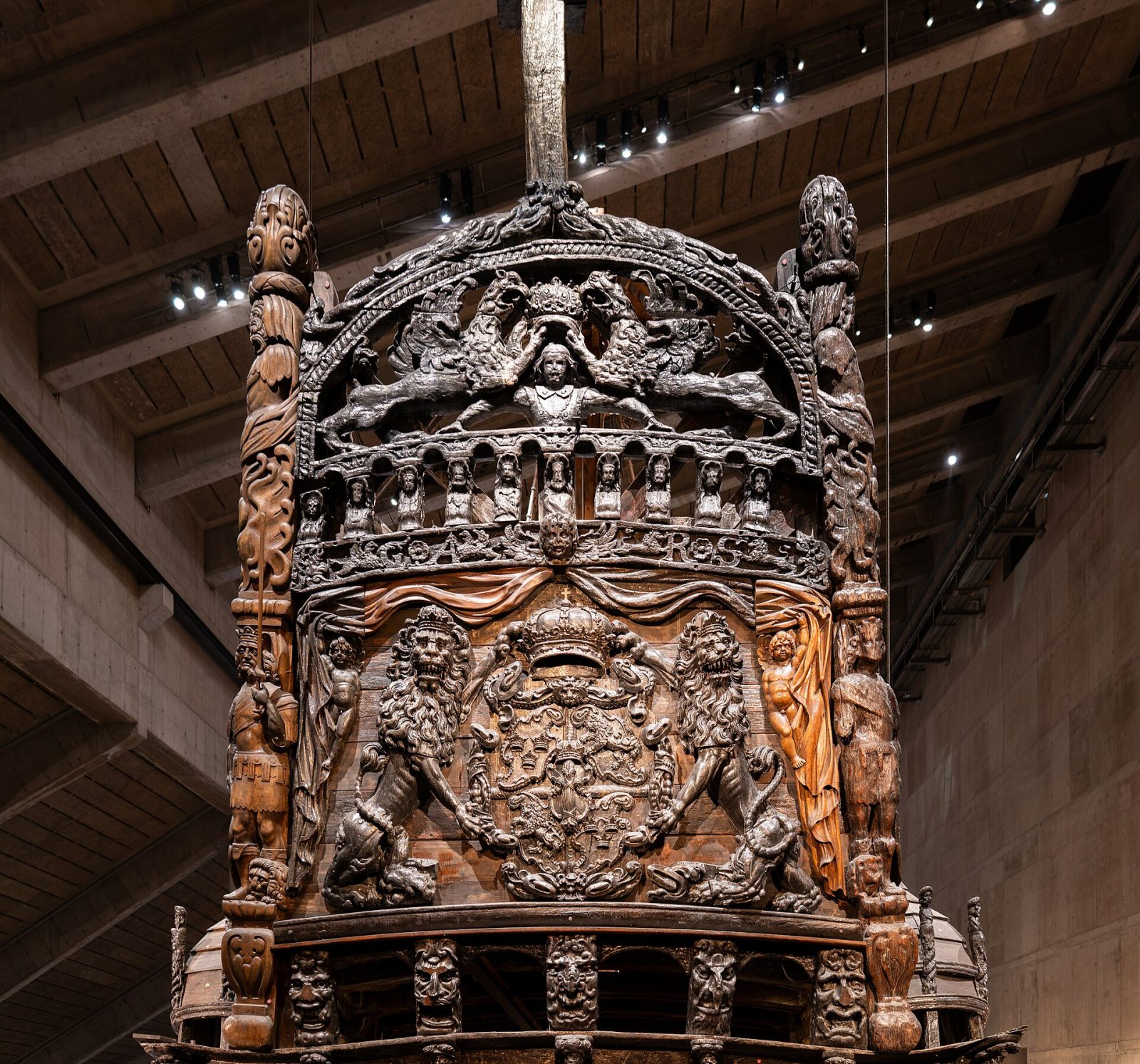
Inside and around her were more than 700 carved sculptures, the remains of at least 17 people, and more than 4,000 coins, most of them the small change carried in the sailors' pockets. Today the ship is about 98 per cent original. She is displayed in the Vasa Museum in Stockholm, opened in 1990, where a new steel support cradle is being built to hold the hull in shape by her 400th anniversary in 2028.
Written for Global Finds from the Vasa Museum, Stockholm, and the Swedish county administrative boards. Photo: the carved stern of the Vasa in the Vasa Museum, Stockholm, Jules Verne Times Two, Wikimedia Commons, CC BY-SA 4.0.
Approximate location59.32, 18.10View on map
Source: Vasa Museum