The Vettersfelde Treasure: Scythian gold ploughed up in a field 1,500 km from home
Famous find Made about 500 BC · Found in 1882 See it on the timeline →
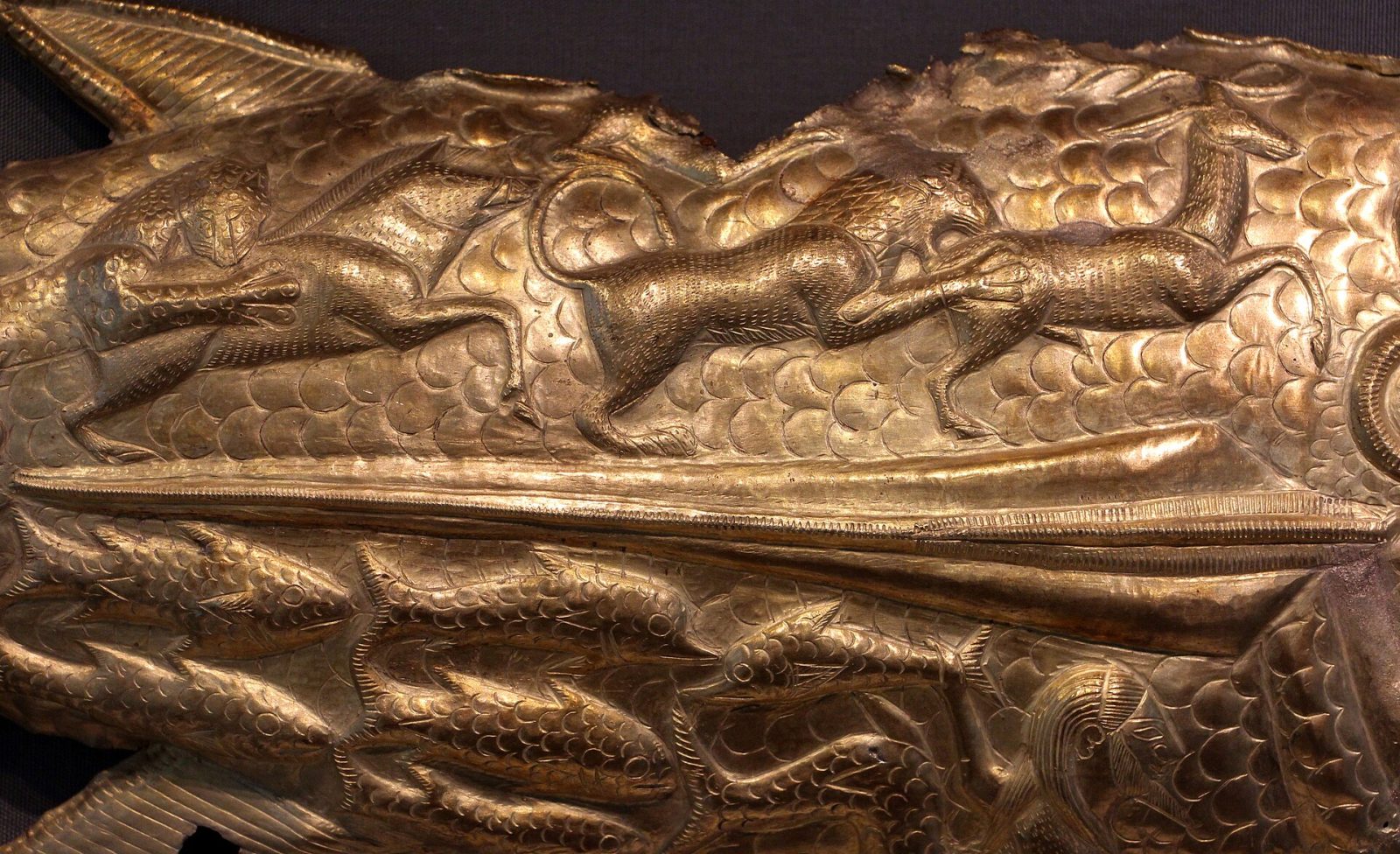
In 1882 a farmer ploughing a field at Vettersfelde, now Witaszkowo in western Poland, turned up Scythian gold, including a great golden fish covered with hunting animals. It had been made by Greek craftsmen on the Black Sea around 500 BC, far from where it was found.
In the autumn of 1882, a field was being ploughed at Vettersfelde, a village then in Germany and now Witaszkowo, near Gubin on the Polish side of the border with Germany, when the plough turned up objects of gold lying just beneath the surface, with fragments of a coarse pot. The finds were reported to the local landowner and soon reached Berlin. Polish local historians name the farmer as August Lauschke.
The treasure, weighing between four and a half and five kilograms, is the most westerly great find of Scythian gold. Its masterpiece is a large ornament in the shape of a fish, 41 centimetres long and made of electrum, an alloy of gold and silver. Its body is covered in animals in relief: a panther seizing a boar, a lion bringing down a deer, birds and fish, and its tail is formed of two rams' heads. With it were a gold plaque from the sheath of a Scythian short sword, an ornament of four discs, perhaps worn on the chest, pendants and a heavy neck ring. The pieces seem to have been made by Greek craftsmen working for Scythian nobles on the shores of the Black Sea, around 500 BC.
How Scythian gold came to be buried more than 1,500 kilometres from the steppes is still debated. The scholar Adolf Furtwängler, who published the treasure in 1883, thought it came from the grave of a Scythian chief killed on a raid. The exact findspot was later lost, but in 2001 Polish and German archaeologists relocated it, using old maps and geophysical survey, and excavations showed that the gold had been placed beside a spring, probably as an offering rather than in a grave. A small minority of scholars have argued that some pieces are 19th-century forgeries, but most accept the treasure as genuine.
The Vettersfelde Treasure is in the Antikensammlung of the Berlin State Museums, displayed in the Altes Museum. Copies of the golden fish can be seen in Guben and in Poland.
Written for Global Finds from the Berlin State Museums, archaeology.wiki and published accounts of the 2001 to 2004 excavations. Photo: the golden fish from the Vettersfelde Treasure in the Altes Museum, Berlin, Sailko, Wikimedia Commons, CC BY 3.0.
Approximate location51.87, 14.77View on map
Source: Berlin State Museums (SMB)