The Skaill Hoard: Scotland's biggest Viking silver hoard, pulled from a rabbit hole
Famous find Buried about AD 950 to 970 · Found in 1858 See it on the timeline →
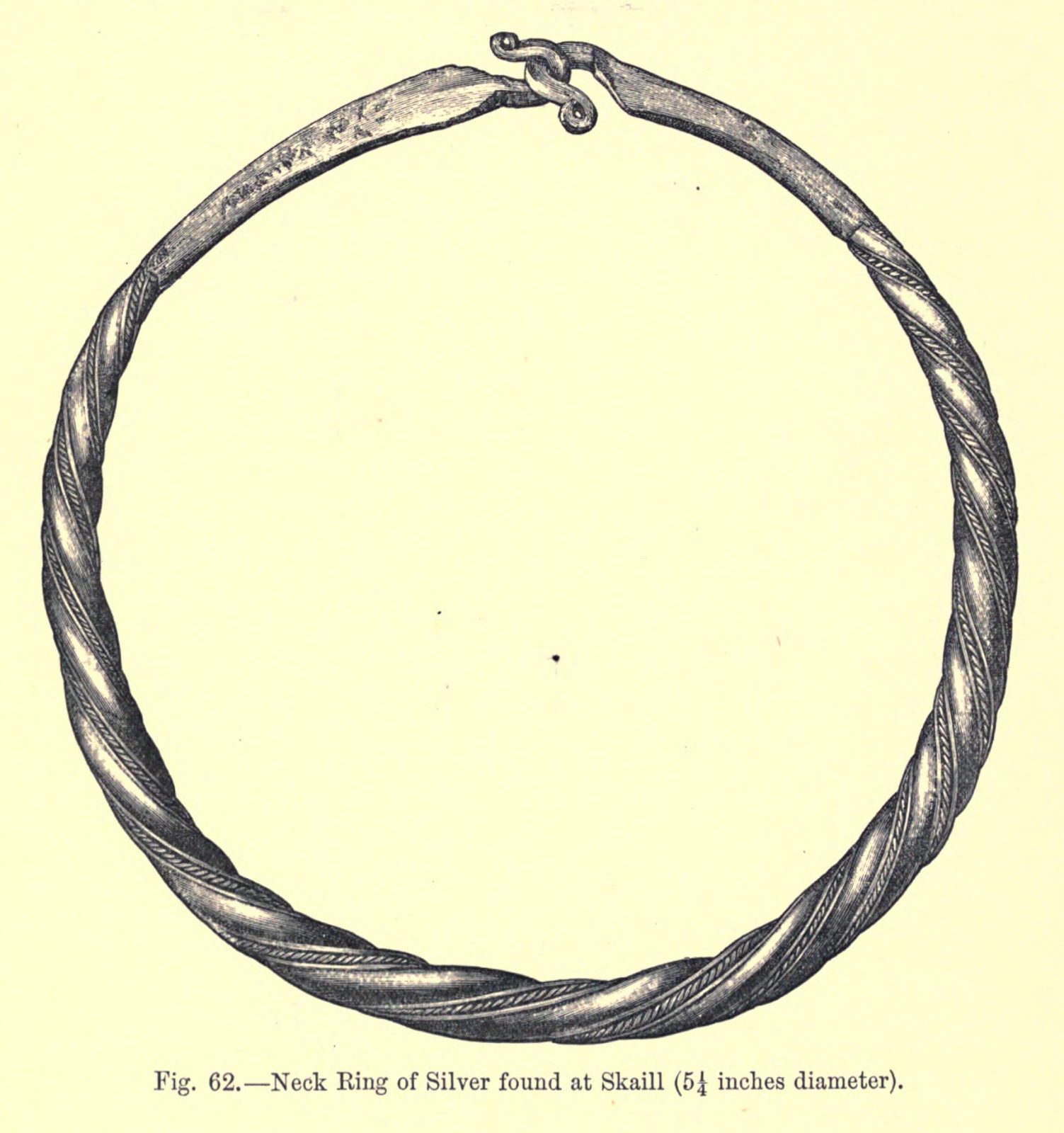
In March 1858 a boy picked up silver beside a rabbit hole on the Bay of Skaill in Orkney. A week later seaweed gatherers dug in with a fork and pulled out a mass of Viking silver brooches, neck rings and arm rings: the largest Viking hoard ever found in Scotland.
In early March 1858, a boy picked up pieces of silver beside a rabbit hole near the parish church at Sandwick, on the north side of the Bay of Skaill on Mainland, Orkney. About a week later, on 11 March, a group of people gathering seaweed went to the spot. One of them pushed a seaweed fork into the rabbit hole and pulled out a tangle of silver rings, which he took at first for seaweed. The others joined in, and there was a scramble for the treasure. Boys came back afterwards to sift the sand for fragments.
The antiquarian George Petrie, acting for the sheriff, tracked down the finders and, paying them out of his own pocket, recovered as much of the silver as he could. One finder's small son had scattered pieces around the family garden, and most of them were found again. Petrie listed the hoard on 5 April 1858, and it was shown to the Society of Antiquaries of Scotland a week later. It weighed 16 pounds, more than seven kilograms, and was originally probably about eight kilograms, as large as the greatest Viking hoards of Scandinavia.
The Skaill Hoard is the largest Viking silver hoard ever found in Scotland. It contains large penannular brooches, among them a group of thistle brooches with ball-shaped terminals found in no other Scottish hoard, twisted neck rings and arm rings, solid armlets, silver ingots and cut-up hacksilver. With them were coins from England and from the Islamic world, including Baghdad and Central Asia. The latest coin, a dirham struck in Baghdad in AD 945 or 946, shows that the hoard was buried no earlier than the middle of the 10th century, and National Museums Scotland dates it to about AD 950 to 970.
Pieces that escaped Petrie's net kept turning up for more than a century afterwards; some were acquired in the 1930s, and parts of a brooch as late as 1981. The Skaill Hoard is in the National Museum of Scotland in Edinburgh, and part of it was lent to the Shetland Museum in 2013 and 2014.
Written for Global Finds from J. Graham-Campbell's study of the hoard and J. Anderson's earlier account, both in the Proceedings of the Society of Antiquaries of Scotland, and the Shetland Amenity Trust. Photo: a twisted silver neck ring from the Skaill Hoard, engraving from Joseph Anderson's Scotland in Pagan Times (1883), Wikimedia Commons, public domain.
Approximate location59.06, -3.33View on map
Source: Proceedings of the Society of Antiquaries of Scotland