The Szilágysomlyó Treasure: gold of the Gepid kings, found twice, a century apart
Famous find Hidden in the early 5th century AD · Found in 1797 See it on the timeline →
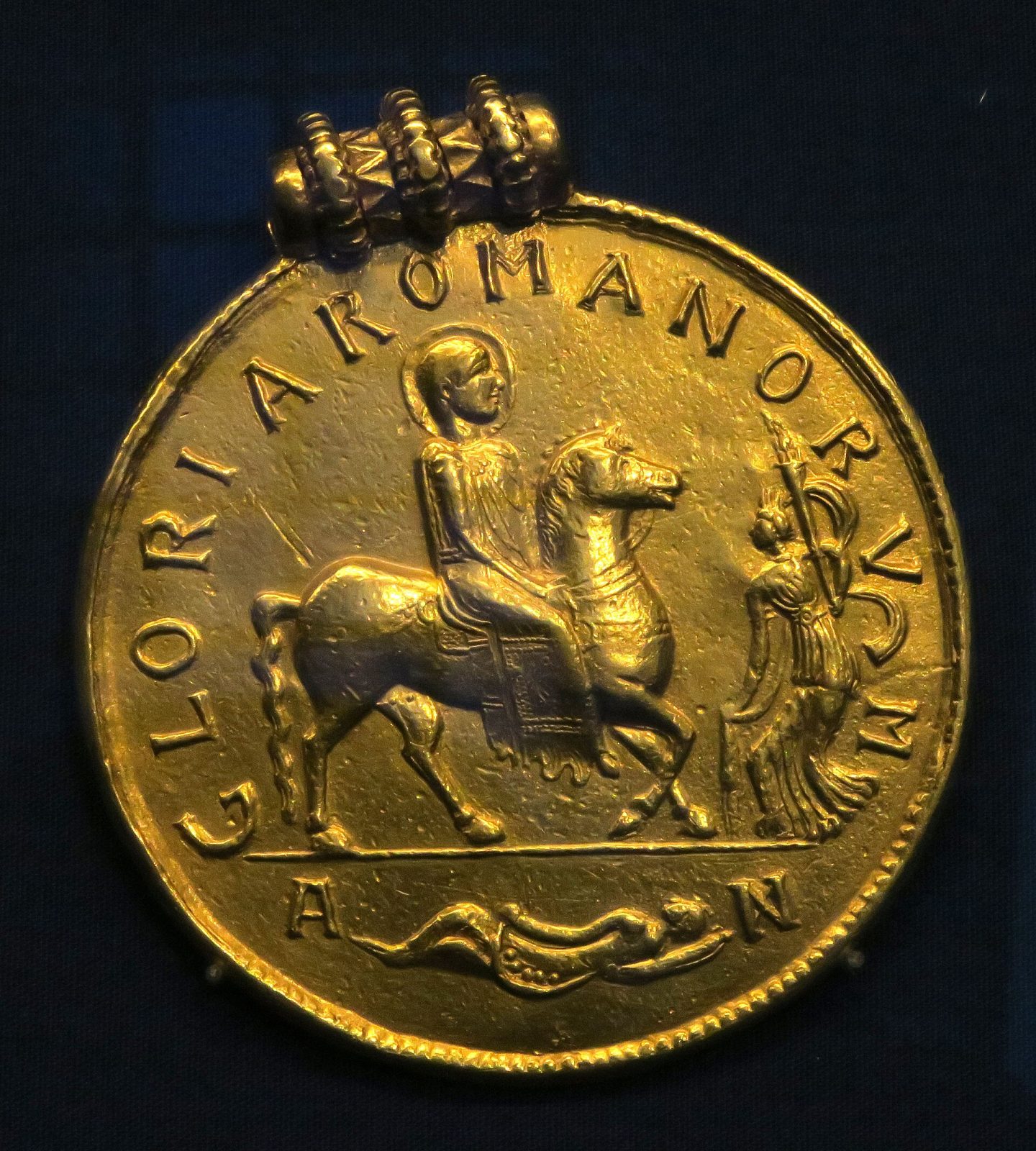
In 1797 two boys at Szilágysomlyó, now Șimleu Silvaniei in Romania, found Roman gold medallions and a chain of gold pendants. In 1889 labourers planting potatoes on the same hill found a second treasure of garnet brooches and gold cups. The two halves are now in Vienna and Budapest.
On 3 August 1797, two young goatherds on the slopes of Măgura hill above the town of Szilágysomlyó, in the north-west of what is now Romania and was then part of the Habsburg lands, found a hoard of gold. It contained Roman gold medallions, a heavy gold chain hung with 52 tiny amulet pendants, gold foil discs, a ring and other ornaments. The treasure was acquired for the imperial collection in Vienna.
The medallions are extraordinary. They were struck for Roman emperors from Maximian, around 293, to Valens and Gratian in the 370s, and were the kind of gift Rome gave to foreign rulers and allies. The largest, a medallion of the emperor Valens, weighs over 400 grams and is nearly 10 centimetres across.
Almost a century later, on the evening of Holy Saturday, 20 April 1889, two labourers were planting potatoes on a plot lower down the same hill when they turned up a second treasure, about two feet down. One account says their employer pocketed a piece and lost it through a hole in his pocket, and that one of the labourers washed the treasure in the nearby river before it was handed to the town's mayor. This second hoard held garnet-set gold brooches, gold cups, a ring and, finest of all, a gold brooch set with a large carved sardonyx, which the Hungarian National Museum describes as the only surviving brooch of a Roman emperor, made in Rome in the second half of the 4th century.
Together the two finds contain more than seventy objects weighing about eight kilograms. They are thought to be the treasury of the rulers of the Gepids, a Germanic people who settled in this region as the Roman Empire weakened, and to have been hidden in the early 5th century, perhaps as the Huns advanced. The first find went to Vienna and the second to Budapest, so the treasure has been divided ever since. It is now shared between the Kunsthistorisches Museum in Vienna and the Hungarian National Museum in Budapest. The two halves were shown together for the first time in 1999.
Written for Global Finds from the Hungarian National Museum, the Kunsthistorisches Museum's collection records, F. Pulszky's report of the second find in Archaeologiai Értesítő (1889) and I. Bóna's History of Transylvania. Photo: the gold medallion of Valens from the Szilágysomlyó Treasure in the Kunsthistorisches Museum, Vienna, Burkhard Mücke, Wikimedia Commons, CC BY-SA 4.0.
Approximate location47.24, 22.80View on map
Source: Hungarian National Museum