La Belle: the lost ship of La Salle, dug out of Texas mud inside a steel cofferdam
Famous find Built 1684; wrecked in the winter of 1686 · Found in 1995 See it on the timeline →
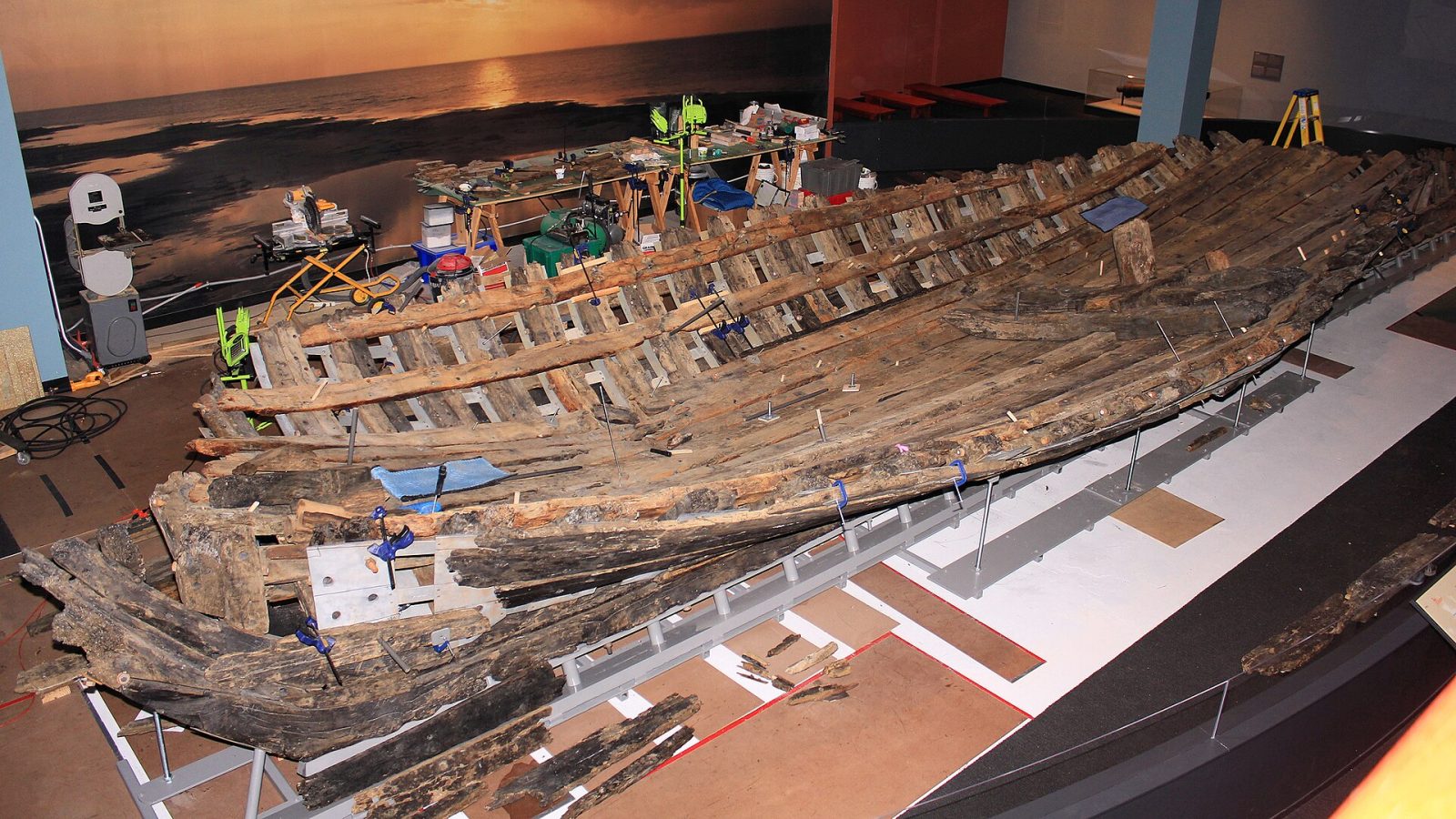
In July 1995 divers searching Matagorda Bay in Texas found a bronze cannon bearing the arms of the French navy. It came from La Belle, a ship of the explorer La Salle, wrecked in 1686. Archaeologists built a dam around the wreck and excavated it as if on dry land.
In 1684 the French explorer René-Robert Cavelier, Sieur de La Salle, sailed from France with four ships and about 400 people to found a colony at the mouth of the Mississippi. One of the ships, La Belle, was a gift from King Louis XIV. She was a small, light vessel built at Rochefort, about 16 metres long, shipped partly as a kit with her timbers marked for assembly. La Salle missed the Mississippi and landed far to the west, on the coast of what is now Texas. In the winter of 1686 La Belle, the last of his ships, was driven aground in a storm in Matagorda Bay and sank. The colony collapsed soon after, and La Salle himself was killed by his own men.
The Texas Historical Commission searched for the wreck from 1978, towing a magnetometer to detect buried iron. On 5 July 1995 a new survey with better equipment and GPS picked up a target, and diver Chuck Meide found a bronze cannon. It bore the crowned L of Louis XIV and the arms of the Comte de Vermandois, Admiral of France.
To excavate the wreck properly, the archaeologists built a double-walled steel cofferdam around it in about 3.5 metres of water, and pumped it dry. From September 1996 to the spring of 1997 they dug the ship almost as if on land, the first excavation of its kind in the Americas. They recovered the lower hull and well over a million objects: three bronze cannon, more than 785,000 glass trade beads, over 1,600 brass hawk bells, brass rings and pins, hundreds of axe heads, and the skeleton of a crewman lying on a coil of rope.
France claimed the wreck, and in 2003 the United States and France signed an agreement: France keeps ownership, while Texas holds and displays it. The sailor was buried in the Texas State Cemetery in 2004. After years of conservation at Texas A&M University, the hull was reassembled in public view, and La Belle is now displayed at the Bullock Texas State History Museum in Austin.
Written for Global Finds from the Bullock Texas State History Museum, Texas Beyond History (University of Texas), Texas A&M University (2016) and the 2003 French-American agreement. Photo: La Belle's conserved timbers being reassembled at the Bullock Museum, Austin, in 2016, Larry D. Moore, Wikimedia Commons, CC BY 4.0.
Approximate location28.45, -96.32View on map