The San Diego: a Spanish galleon that sank in battle off Manila in 1600, found 52 metres down
Famous find Sank on 14 December 1600 · Found in 1991 See it on the timeline →
On 14 December 1600 the overloaded Spanish galleon San Diego sank off Fortune Island in the Philippines after a battle with a Dutch ship, taking hundreds of men with her. In 1991 Franck Goddio's team found her 52 metres down and recovered thousands of objects.
In December 1600, Dutch ships under Olivier van Noort, the first Dutch expedition to sail around the world, were raiding shipping near Manila, the capital of the Spanish Philippines. The Spanish authorities hastily requisitioned a merchant ship, the San Diego, armed her with 14 cannon, and sent her out under Antonio de Morga, the colony's lieutenant governor and chief justice, a lawyer with no experience at sea. She was badly overloaded with soldiers, guns and supplies.
On 14 December 1600, off Fortune Island at the mouth of Manila Bay, the San Diego met van Noort's ship Mauritius. The Spaniards grappled and boarded her, but van Noort set his own ship alight, and the San Diego cut herself free. Badly overloaded, she sank like a stone, taking hundreds of men with her. De Morga survived, and later wrote an account of the battle that put himself in the best possible light.
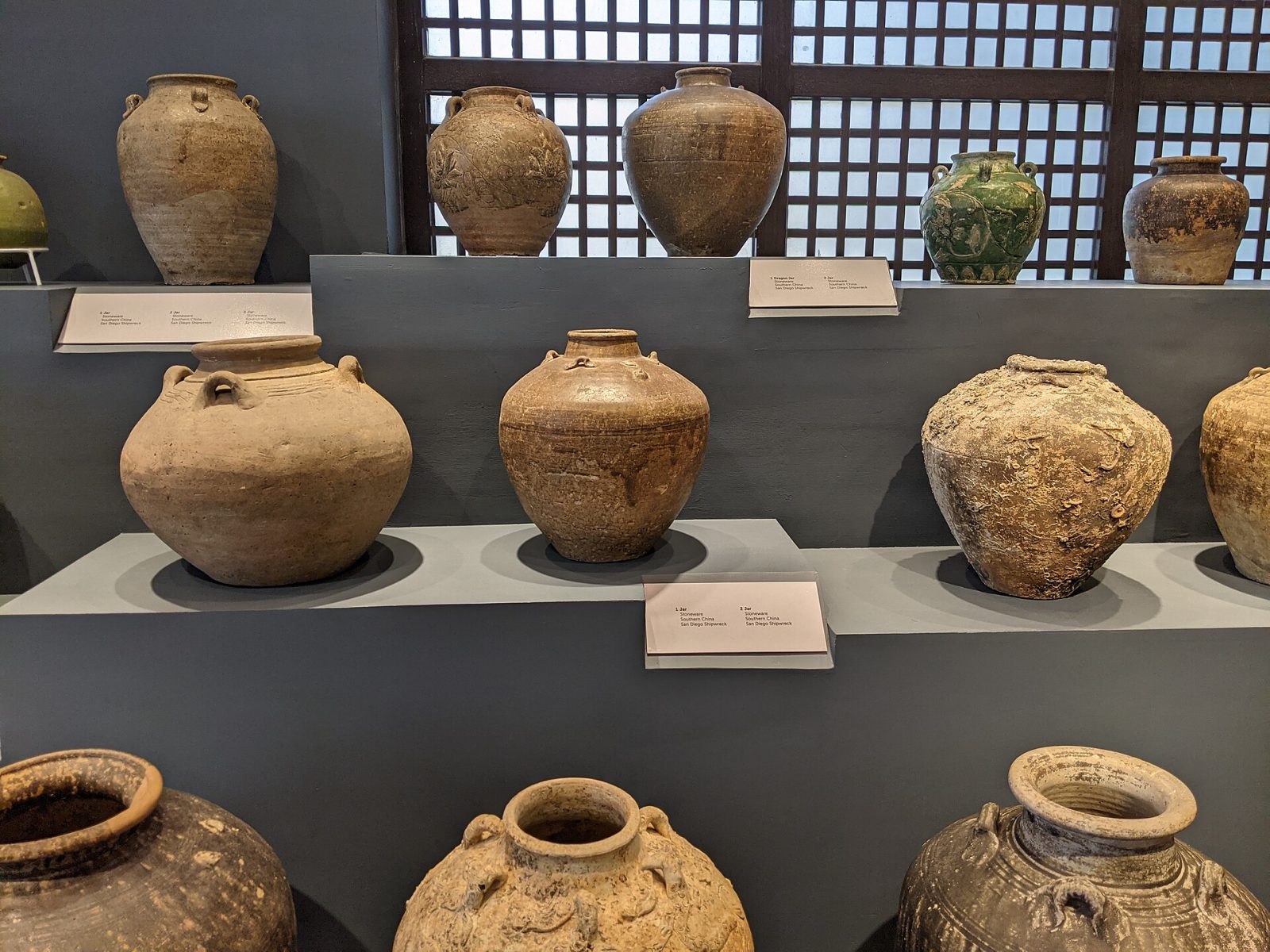
In 1991 the French underwater explorer Franck Goddio, working with the National Museum of the Philippines, began searching for the wreck using archive research, a magnetometer and a sub-bottom profiler, which looks beneath the seabed. He found her about 900 metres north-east of Fortune Island, at a depth of 52 metres, a mound of wreckage about three metres high. The excavation that followed recovered more than 5,000 objects: hundreds of stoneware storage jars from China, Vietnam, Thailand and Spain, Ming blue-and-white porcelain, cannon, Japanese sword guards, navigational instruments including an astrolabe, silver tableware brought aboard by noblemen who had come to watch the victory, and gold and silver coins and jewellery. Among them was de Morga's own gold seal, which proved that the wreck was the San Diego.
The finds toured Paris, Madrid, New York and Berlin before returning to Manila. The collection belongs to the National Museum of the Philippines, and objects from it are displayed in the museum's branches, including in Cebu.
Written for Global Finds from the National Museum of the Philippines, the Franck Goddio Society and the Maritime Stepping Stones database. Photo: stoneware jars recovered from the San Diego shipwreck at the National Museum of the Philippines, Cebu, Filipinayzd, Wikimedia Commons, CC BY-SA 4.0.
Approximate location14.06, 120.50View on map
Source: Franck Goddio Society