The Faddan More Psalter: a 1,200-year-old book scooped out of an Irish bog by a digger
Famous find Written about AD 800 · Found in 2006 See it on the timeline →
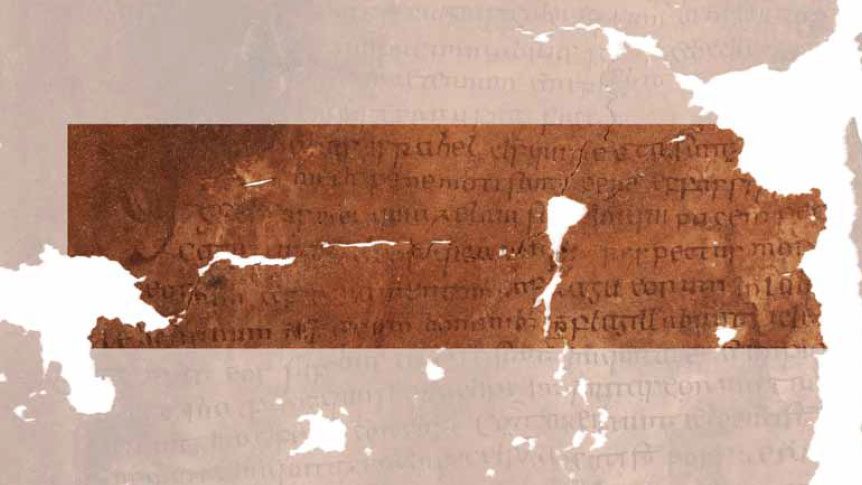
On 20 July 2006 a digger cutting peat in Faddan More bog in County Tipperary scooped up an early medieval book of psalms, still in its leather cover. It was the first manuscript of its age found in Ireland for some two centuries.
On the afternoon of 20 July 2006, Eddie Fogarty was cutting peat with a mechanical digger in a commercial bog at Faddan More, near Birr in north County Tipperary, Ireland, when he noticed something in the bucket. It was a book. As it came up it fell open, and then dropped into the trench. The bog's owners, the brothers Kevin and Patrick Leonard, gathered up the pieces, covered them with wet peat to stop them drying out, and called the National Museum of Ireland.
The book is a psalter, a copy of the 150 psalms in Latin. It has 60 leaves of vellum, each about 26 by 30 centimetres, written in a single column in iron-gall ink, with decorated openings at Psalms 1, 51 and 101 in yellow, red, black and white. It was kept in a wallet-shaped leather cover with a flap and horn buttons. Inside, the cover was lined with papyrus, a material from Egypt and the eastern Mediterranean. On the outside a scribe had tried out designs, and there are traces of gold.
The script dates the book to about AD 800, the age of the great Irish monasteries and of the Book of Kells. When it was found, the page it had fallen open at contained the words in ualle lacrimarum, in the vale of tears. It was the first early medieval Irish manuscript to be discovered in about two hundred years, and the first ever found in a bog. Why it was in the bog is unknown.
Conserving it took years. The museum's conservator, John Gillis, studied the waterlogged mass for months before beginning, then dried it slowly in a vacuum chamber, and finally pieced together thousands of loose fragments, some no bigger than a single letter. The museum's director, Pat Wallace, called the find the most important day in the museum's history since the Ardagh Chalice arrived in 1868.
The Faddan More Psalter has been on display at the National Museum of Ireland, Kildare Street, Dublin, since 2011.
Written for Global Finds from BBC News (2006), The Guardian (2021), Archaeology magazine (2011) and R. Kelly and M. Sikora's Reading the Faddan More Psalter (National Museum of Ireland, 2011). Photo: a page of the Faddan More Psalter, from a National Museum of Ireland display, public domain.
Approximate location53.05, -8.00View on map
Source: BBC News