The Hemyock Gold Penny: a detectorist's first outing with a new machine found Henry III's lost gold coin
Famous find Struck in or after 1257 · Found in 2021 See it on the timeline →
On 26 September 2021 Michael Leigh-Mallory took his new metal detector out for the first time near Hemyock in Devon and found a gold penny of Henry III within fifteen minutes. Only eight are known. It sold for £648,000.
On Sunday 26 September 2021, Michael Leigh-Mallory, a 52-year-old retired ecologist from Cullompton, took his new metal detector out for the first time, the day after it arrived. He had returned to the hobby after promising his children a detecting trip. Within fifteen minutes, on cultivated farmland near Hemyock in Devon, he found a small gold coin about ten centimetres down.
He did not know what it was and posted a photograph online, where a numismatist at the London auction house Spink recognised it. It was a gold penny of Henry III, England's first gold coinage since Anglo-Saxon times, and only eight are known.
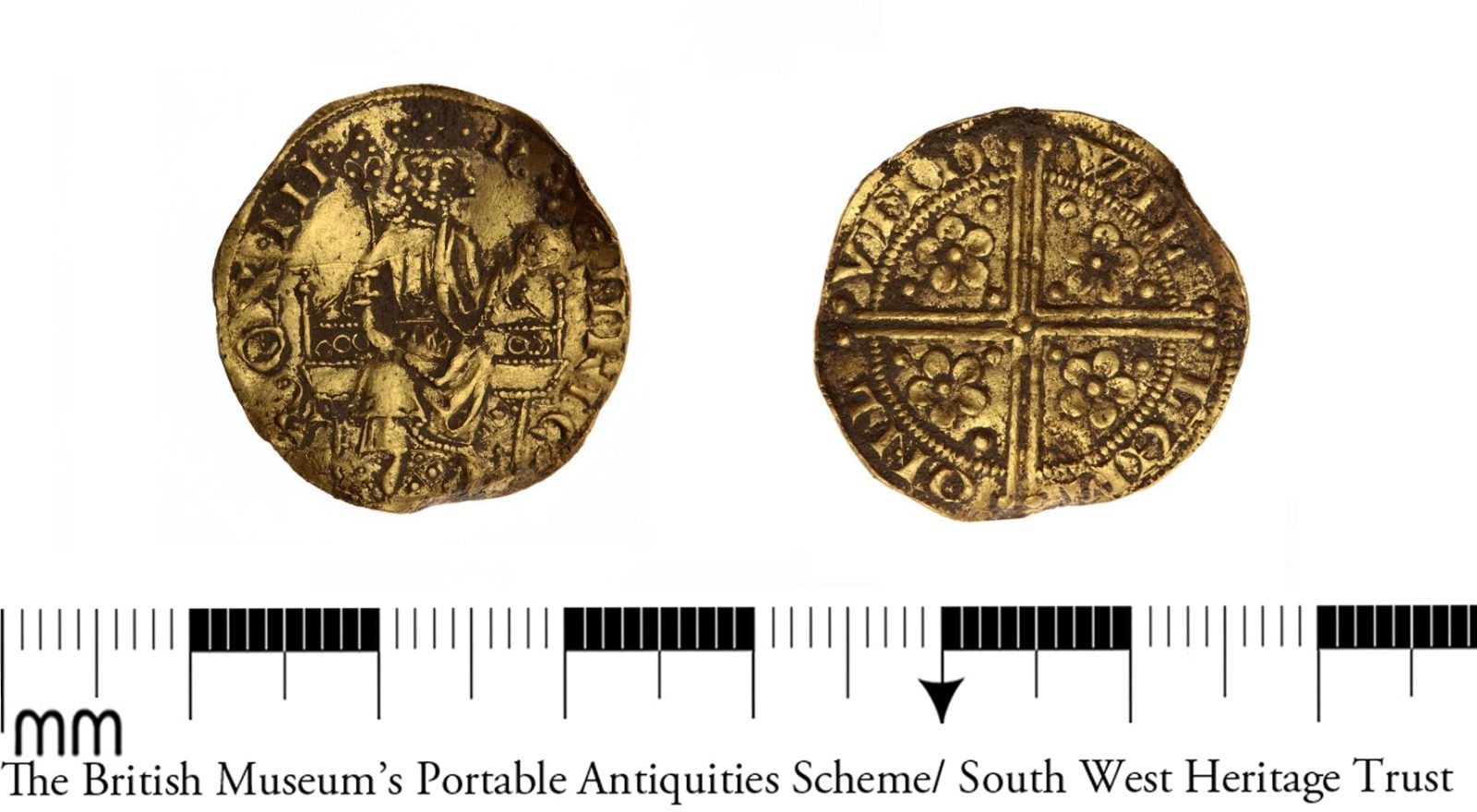
Henry III authorised the gold penny on 16 August 1257, valued at twenty silver pennies. It was made in London by the king's goldsmith, William FitzOtto, and about 52,000 were struck. The value of gold soon rose, the coins became worth more as metal than as money, and almost all were melted down; England did not strike gold for circulation again until Edward III in 1344. The penny shows the king enthroned with orb and sceptre, and on the back a long cross with rosettes. It weighs 2.95 grams and is 23 millimetres across, and its front die is the same as that of a gold penny in the British Museum since 1810.
How it came to be in a Devon field is a puzzle. Historians, among them Professor David Carpenter of King's College London, have linked it with John de Hyden, lord of the manor of Hemyock, who paid the king in gold to be excused from jury service and later served in Wales, where gold pennies were paid out.
The coin was recorded with the Portable Antiquities Scheme. As a single coin it was not Treasure, and on 23 January 2022 Spink sold it for £540,000, or £648,000 with the buyer's premium, the money shared equally with the landowner. Spink called it the most valuable single coin find in British history. The buyer, an anonymous British collector, said they intended to lend it to a museum, but it is not known to be on public display. Mr Leigh-Mallory visited Henry III's tomb in Westminster Abbey to give thanks.
Written for Global Finds from Spink (2022), The Guardian (2022) and Medievalists.net (2022). Photo: the Hemyock gold penny of Henry III, recorded with the Portable Antiquities Scheme, The Portable Antiquities Scheme, Wikimedia Commons, CC BY 2.0.