The Winfarthing Pendant: a student detectorist stopped at the rim of a bowl and saved an Anglo-Saxon woman's gold grave
Famous find Buried about AD 650 to 675 · Found in 2014 See it on the timeline →
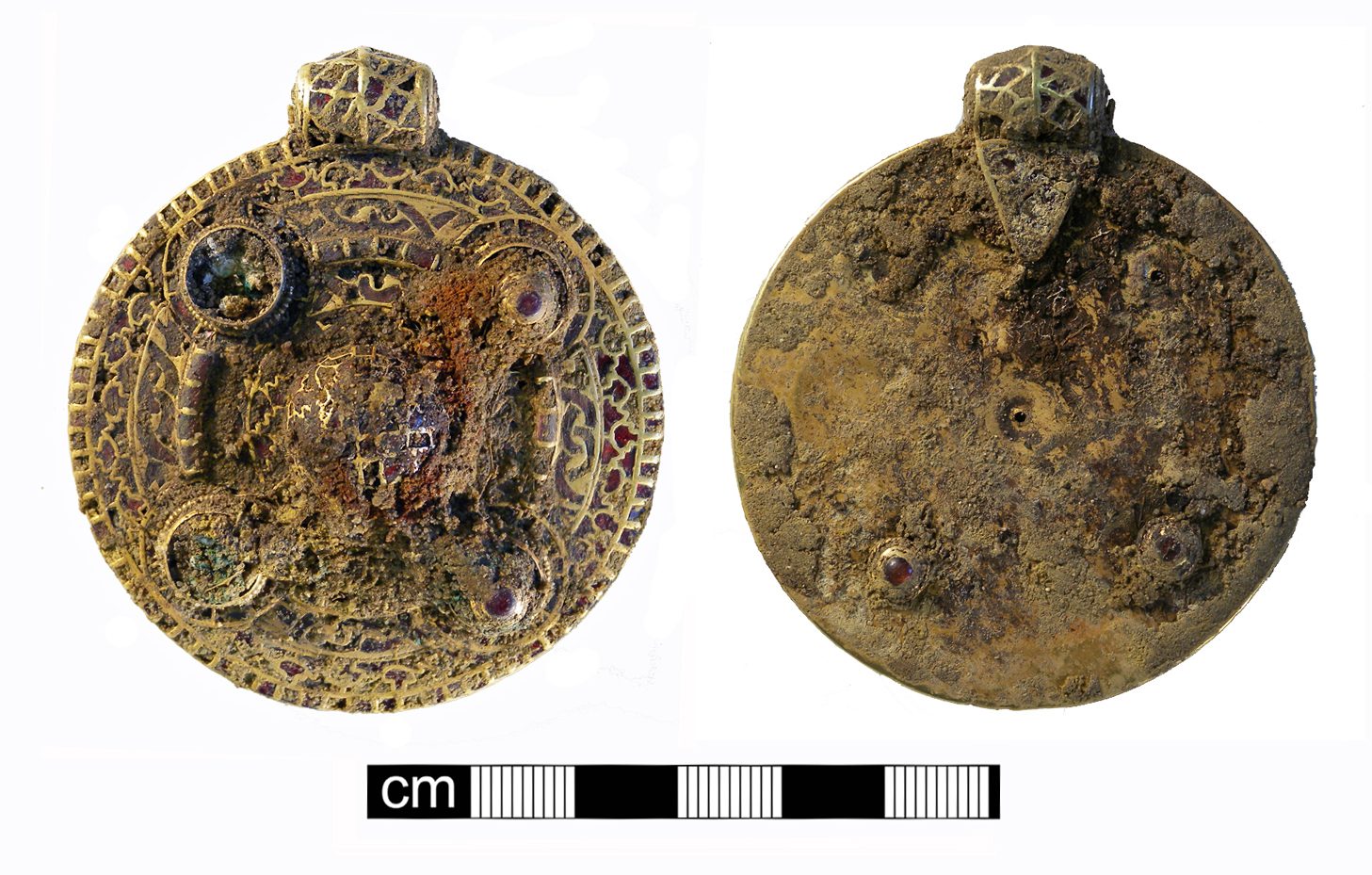
On 21 December 2014 student Tom Lucking hit the rim of a bronze bowl in a Norfolk field, stopped and called the archaeologists. Beneath it was the undisturbed grave of a 7th-century woman wearing a gold and garnet pendant, now voted Britain's favourite museum acquisition of 2018.
On 21 December 2014, Tom Lucking, a University of East Anglia student from Felixstowe who had been detecting since he was eleven, was searching a field in the parish of Winfarthing, near Diss in south Norfolk. A strong signal turned out to be the rim of a bronze bowl. Instead of digging it out, he stopped and called Norfolk County Council's finds service, and in January 2015 its archaeologists, with Lucking, excavated what lay beneath: the undisturbed grave of a wealthy Anglo-Saxon woman.
At her neck was a pendant of gold and garnets. The garnets are set in tiny gold cells, cloisonné work, laid out in six rings around the centre, among them interlacing snakes made from slivers of garnet, and four bosses with a large central one form a cross. Hatched gold foil beneath the stones catches the light. It is 57.8 millimetres across and weighs just over 50 grams.
She was buried with a necklace carrying two pierced gold coins of the Frankish king Sigebert III, struck at Marseille from the same dies, gold spacer beads, a small gold openwork cross pendant, a large bronze bowl, an imported pottery bowl, an iron knife and the rings that hung from her belt. The coins are worn, and she was probably buried in about 650 to 675. The crosses suggest that she was one of the first Christians in East Anglia.
The whole grave group was declared Treasure in 2015 and valued at £145,050, with the reward shared between Lucking and the landowner. Norwich Castle Museum and Art Gallery bought it in 2018 with help from the National Heritage Memorial Fund, Art Fund and the Friends of Norwich Museums. It was lent to the British Library's Anglo-Saxon Kingdoms exhibition, and in December 2018 it won Art Fund's public vote as Britain's favourite museum acquisition of the year.
The pendant and the rest of the grave are in the collection of Norwich Castle Museum and Art Gallery.
Written for Global Finds from Art Fund, the Norfolk Historic Environment Record and the Diss Express (2018). Photo: the Winfarthing pendant before cleaning, front and back, Portable Antiquities Scheme, Wikimedia Commons, CC BY 2.0.
Source: Art Fund