The Eucratides Stater: the biggest gold coin of the ancient world, smuggled to London in an armpit pouch
Famous find Struck about 170 to 145 BC See it on the timeline →
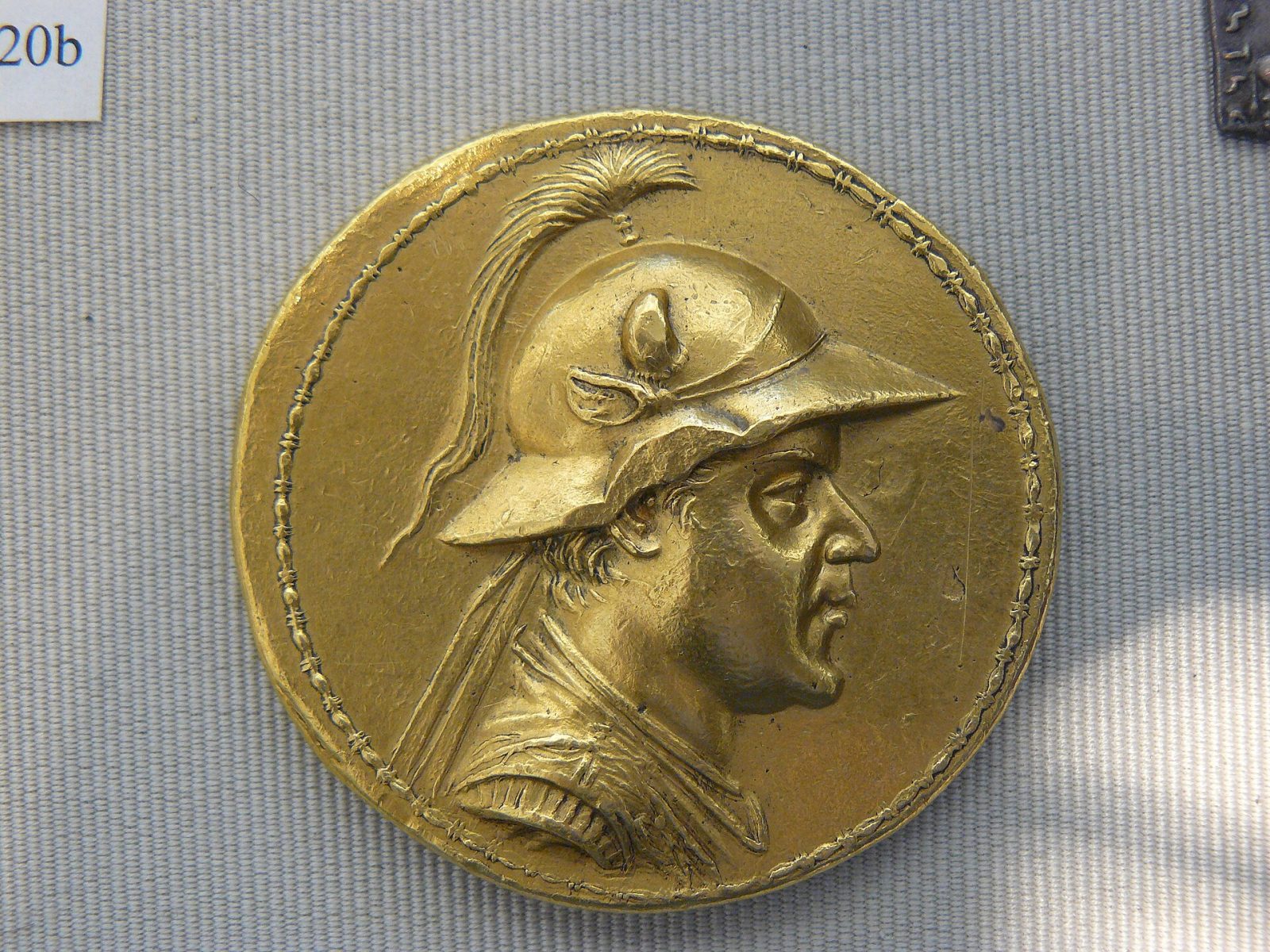
The largest gold coin to survive from the ancient world, 169 grams, was struck for the Greek king Eucratides of Bactria around 150 BC. Dug up near Bukhara before 1837, it was smuggled to London, rejected as a fake, and bought for the French national collection in 1867.
According to the Bibliothèque nationale de France, which owns it, the coin was dug up near Bukhara, in what is now Uzbekistan, some time before 1837, by seven peasants. They fought over it, and five of them were killed. One of the survivors carried it all the way to London, hidden in a leather pouch under his armpit, but the museums and collectors there turned it down as a fake. A French expert living in London bought it and offered it to the imperial library in Paris, and in 1867 the emperor Napoleon III granted 30,000 francs for its purchase. The curator, Anatole Chabouillet, called it a numismatic monster.
It is a gold coin of 20 staters, 58 millimetres across and weighing 169.2 grams, about twenty times an ordinary gold stater, and it is the largest gold coin known from the ancient world. No other example exists. It was struck for Eucratides I, a Greek king who ruled Bactria, the land around the Oxus river in Central Asia, from about 170 to 145 BC, two centuries after Alexander the Great's conquests brought Greek rulers there. On the front is the king's portrait, wearing a crested helmet decorated with a bull's horn and ear; on the back the twin horsemen Castor and Pollux charge with spears and palm branches, around the words "of the great king Eucratides".
The library believes it was not meant for everyday use but was a special presentation piece, struck perhaps to celebrate a victory. Eucratides fought wars on several fronts and, according to ancient writers, was murdered by his own son. A few people have questioned whether so extraordinary a coin can be genuine, and a scientific study of its metal has been under way.
The coin is on display in the museum of the Bibliothèque nationale de France in Paris, at its Richelieu site.
Written for Global Finds from the Bibliothèque nationale de France (J. Olivier, 2018), the Encyclopaedia Iranica and the British Institute of Persian Studies. Photo: the gold 20-stater of Eucratides in the Cabinet des Médailles, Paris, Siren-Com, Wikimedia Commons, CC BY-SA 4.0.