The Amsterdam: a Dutch East Indiaman wrecked on Hastings beach in 1749, dug into by a digger in 1969
Famous find Wrecked on 26 January 1749 · Found in 1969 See it on the timeline →
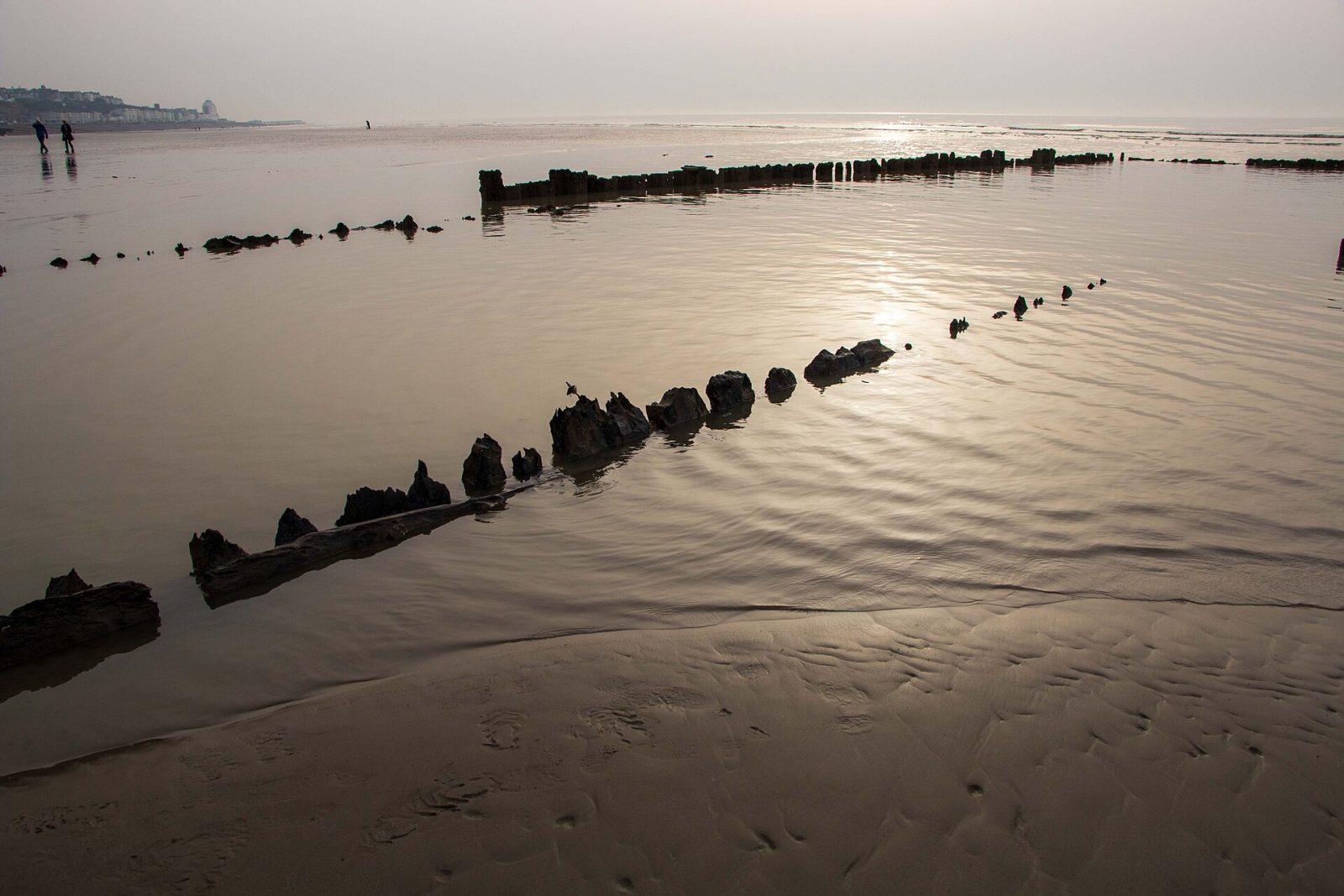
In January 1749 the new Dutch East Indiaman Amsterdam ran aground at Bulverhythe near Hastings and sank into the sand. In 1969 workmen laying a sewage pipe tore into her with excavators, and the damage helped bring in the law that protects Britain's historic wrecks.
The Amsterdam was brand new: built in 1748 for the Dutch East India Company, 42.5 metres long and armed with 54 guns. Under Captain Willem Klump she left Texel on 8 January 1749, bound for Batavia, now Jakarta, with about 330 people aboard and chests of silver to buy goods in Asia. Disease killed about fifty of them in the first weeks. In a storm in Pevensey Bay she lost her rudder, discipline broke down and the crew broke into the wine, and on Sunday 26 January 1749 she was run ashore on the beach at Bulverhythe, just west of Hastings. Everyone on board got ashore.
Dutch records say that 28 chests of money were saved, but local smugglers made off with some of the silver. A man was shot on the beach, and the Hastings coroner ruled that he had died at sea. The company gave up salvage in March 1749, and within months the ship had sunk about eight metres into the beach.
There she stayed. In 1969 contractors building a sewage outfall dug into the wreck with mechanical excavators and pulled out bronze cannon dated 1748, rigging, pewter, wine bottles and personal belongings. No law protected the site. The archaeologist Peter Marsden surveyed it in 1969 and 1970, and his campaign helped bring about the Protection of Wrecks Act 1973; the Amsterdam was designated under it in 1974.
Between 1984 and 1986 a Dutch foundation excavated part of the hull from inside a ring of steel piling. Divers recovered a lady's shoe, embroidered textiles, brass pins, a lead-sealed barrel of Irish butter, pewter spoons, candlesticks, a smoothing iron and a flute. About two-thirds of the hull survives, with its hold and cargo still in place, making her the most complete East Indiaman known anywhere.
The timbers show at very low tides, and storms in February 2026 exposed the deck beams after two years under the sand. The Shipwreck Museum in Hastings displays cannon, an anchor and finds from the ship, and many more finds are kept in the Netherlands.
Written for Global Finds from the Shipwreck Museum, Hastings, the Dutch Cultural Heritage Agency's MaSS database and Rye News (2023). Photo: the timbers of the Amsterdam exposed on the beach at Bulverhythe in March 2026, Andrew Diack, Wikimedia Commons, CC BY-SA 2.0.
Source: The Shipwreck Museum, Hastings