The Æthelberht Penny: found sheltering from a hailstorm, the coin of a king beheaded on Offa's orders
Famous find Struck about AD 779 to 794 · Found in 2014 See it on the timeline →
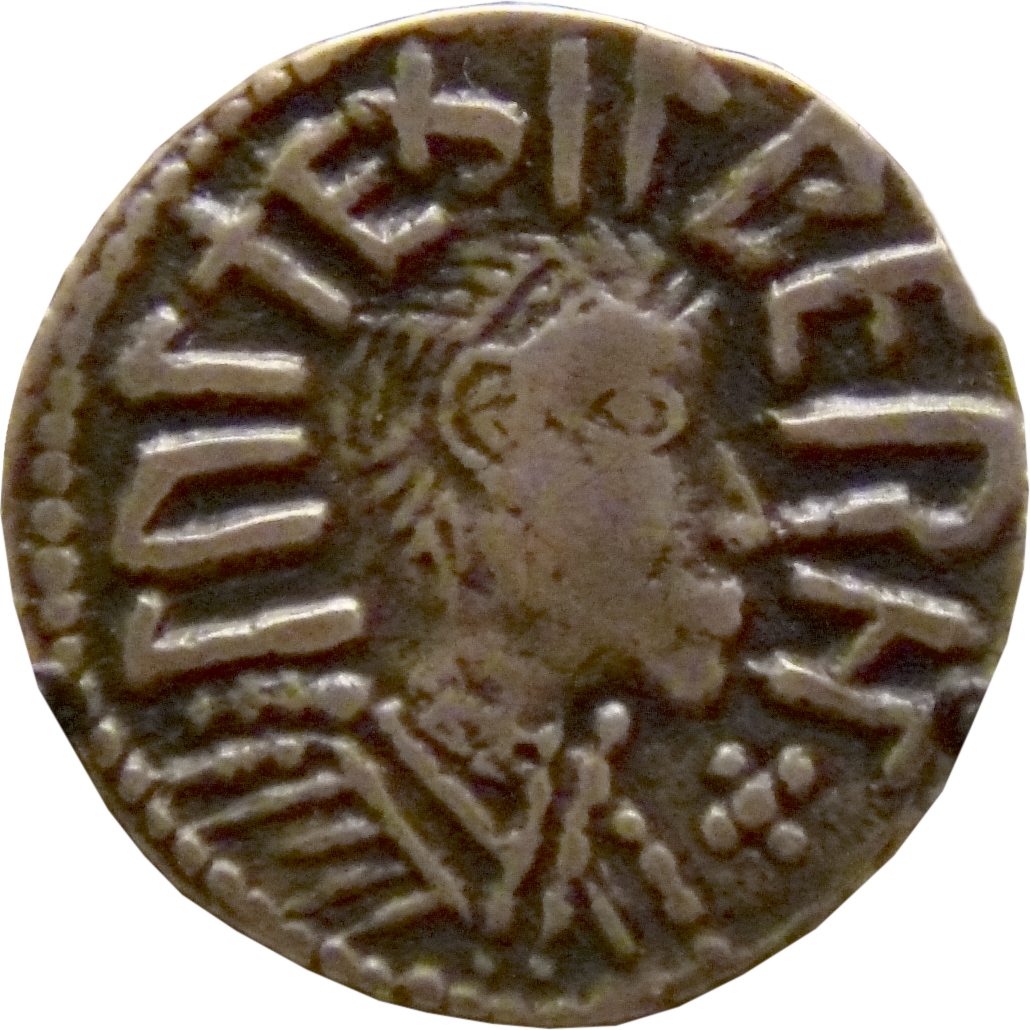
In March 2014 detectorist Darrin Simpson, hurrying to shelter from a hailstorm in a Sussex field, dug a silver penny of Æthelberht II of East Anglia, the king Offa of Mercia had executed in 794. Only the fourth coin of the king known, it sold for £78,000.
In early March 2014, Darrin Simpson, a pest-control specialist from Eastbourne who had been metal detecting for twelve years, was out in a field in East Sussex, in the Pevensey area, when a hailstorm blew in. As he hurried for shelter his detector gave a signal that sounded like the Second World War .303 cartridges he often dug up there. Six to eight inches down was a small silver coin.
It was a penny of Æthelberht II, king of East Anglia in the late 8th century, and only the fourth of his coins known. It weighs 1.30 grams, and around a lobed cross it reads EÐILBERHT RE, the king's name and his title, rex, on the same side. That had not been seen before on his coins. The other side names the moneyer, Lul, who may have worked at Ipswich. It is the only known example of its type.
Æthelberht's story is a grim one. In 794 he travelled to the court of Offa, the powerful king of Mercia, at Sutton Walls in Herefordshire, by tradition to marry Offa's daughter. Instead Offa had him seized and beheaded. Æthelberht was later venerated as a saint, and Hereford Cathedral is dedicated to him. The auction house that sold the coin suggested that striking coins in his own name as king, at a time when Offa dominated southern England, may have been seen as defiance, and may help to explain his death. That is a theory, not an established fact, but the coin is a rare voice from a king Offa tried to silence.
As a single silver coin, it was not Treasure, and it was recorded with the Early Medieval Corpus of coin finds at the Fitzwilliam Museum. It was auctioned by Dix Noonan Webb in London on 11 June 2014 with an estimate of £15,000 to £20,000, and sold for £78,000 including the buyer's premium. Darrin shared the proceeds with the landowner and his detecting friends. The coin was later resold, and it is in a private collection.
Written for Global Finds from Dix Noonan Webb via The E-Sylum (2014), Coin World and Numismatic News. Photo: a different penny of Æthelberht II in the British Museum, not the Sussex coin, PHGCOM, Wikimedia Commons, public domain.