The Manda Island Coin: a Chinese emperor's coin dug up in Kenya on the first day of the dig
Famous find Cast in the Yongle reign, about 1408 to 1424 · Found in 2012 See it on the timeline →
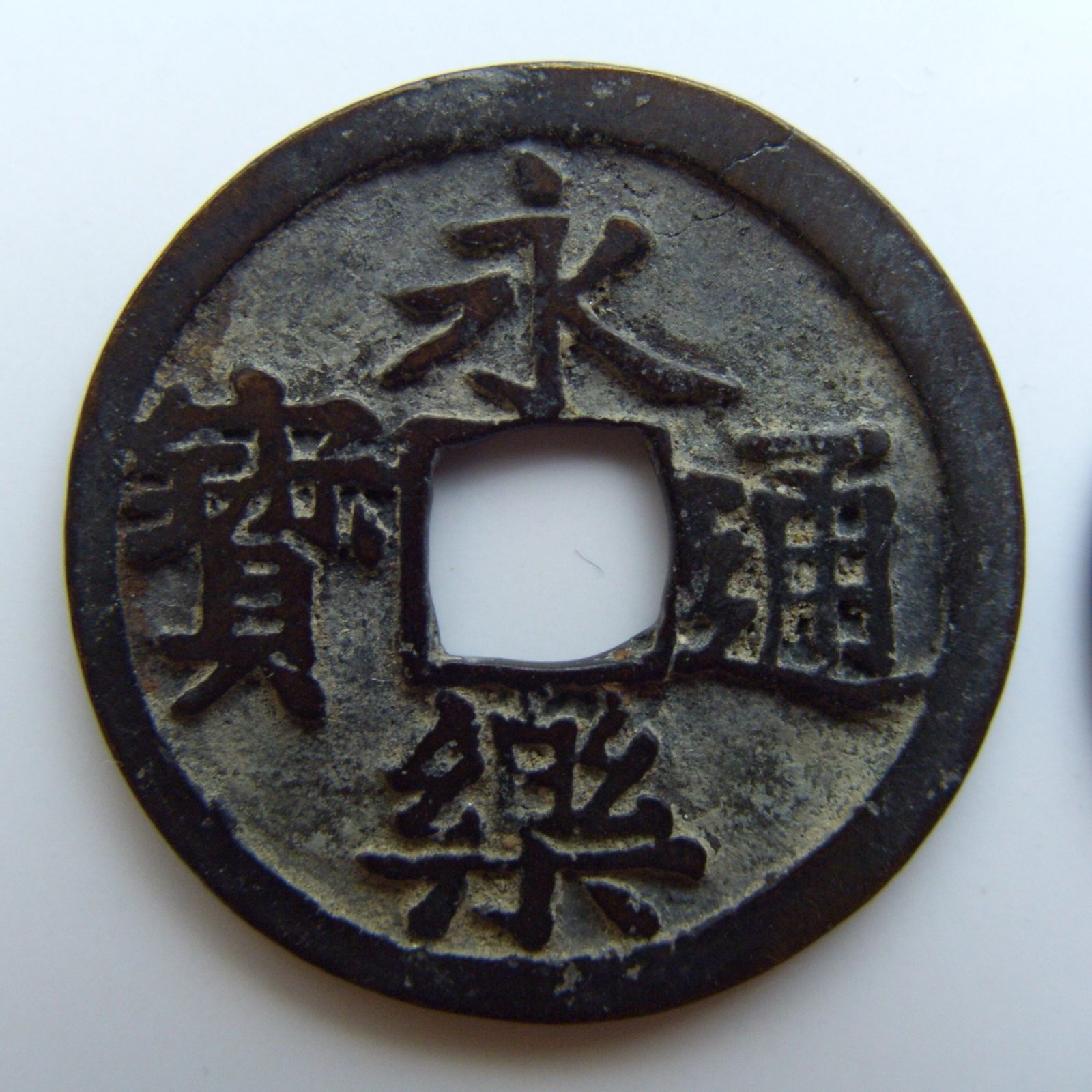
In December 2012, on the first day of excavation on Manda Island off the coast of Kenya, a Field Museum team found a Chinese coin of the Yongle Emperor. It shows that trade linked Ming China and the Swahili coast in the early 1400s.
In December 2012, an American and Kenyan team began excavating on Manda Island, in the Lamu archipelago off the northern coast of Kenya. It was led by Chapurukha Kusimba of the Field Museum in Chicago and Sloan Williams of the University of Illinois at Chicago, with colleagues from the National Museums of Kenya, and it had come to study the origins of the Swahili trading towns. On the very first day, the diggers found a small round coin with a square hole in the middle.
It was Chinese. Professor Tiequan Zhu of Sun Yat-sen University identified it as a Yongle Tongbao, a cash coin bearing the reign title of the Yongle Emperor, the third ruler of the Ming dynasty, who reigned from 1403 to 1424. Coins of this type were cast in large numbers and are often found outside China, around the trading ports of East and South-East Asia, Japan and India, because they were widely used in foreign trade.
What makes the Manda coin remarkable is its date. The Yongle Emperor sent the admiral Zheng He on great voyages across the Indian Ocean, and his fleets visited the East African coast in the 1410s and 1420s. The town on Manda had been occupied since about AD 200, but it was abandoned for good around 1430, so the coin must have arrived within a few decades of being made. Kusimba suggested it might help show that Zheng He's ships, or traders connected with them, reached this part of Kenya. That remains a possibility rather than a proof, since Chinese coins also passed from hand to hand through Indian and Arab merchants.
The Kenyan government gave permission for the coin to be taken to the Field Museum in Chicago for analysis, to check that it was a genuine government issue rather than a contemporary counterfeit. It was announced in March 2013. Where it is kept and whether it is on display today has not been published.
Written for Global Finds from the Field Museum (2013), the University of Illinois at Chicago (2013) and Live Science (2013). Photo: a Yongle Tongbao coin of the same type, not the Manda coin itself, Galopin, Wikimedia Commons, CC BY-SA 3.0.
Linked finds
Source: Field Museum (2013)