The Vyne Ring: a Roman gold ring ploughed up at Silchester, a curse on its thief, and a question for Tolkien
Famous find Made about AD 350 to 450 · Found in 1785 See it on the timeline →
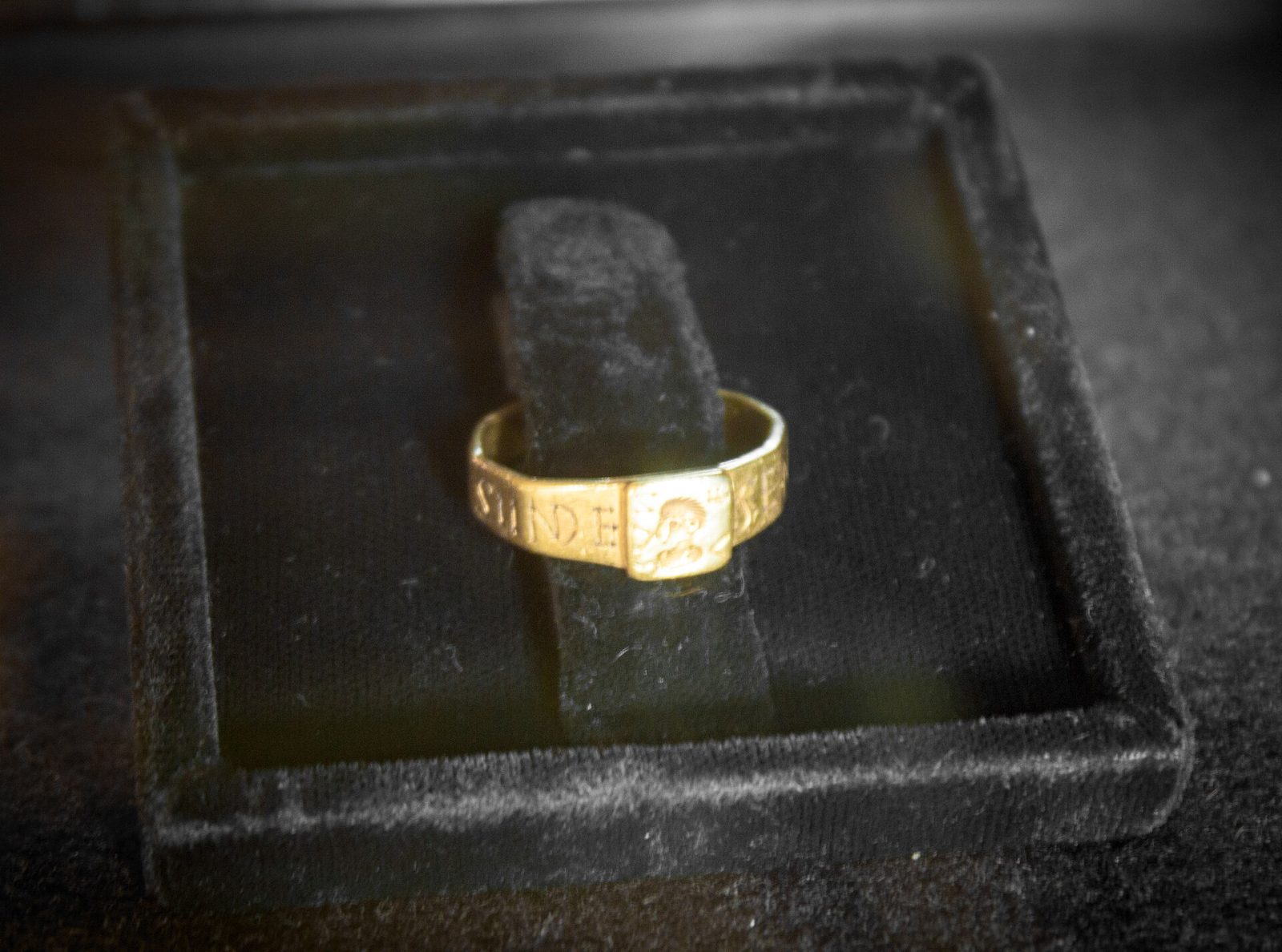
In about 1785 a farmer ploughing near the Roman town of Silchester in Hampshire turned up a heavy gold ring inscribed for a man called Senicianus. A curse tablet naming a Senicianus as a ring thief was later found at Lydney, and Tolkien worked on the site.
In about 1785, a farmer ploughing a field near Silchester in north Hampshire, where the walls of the Roman town of Calleva Atrebatum still stand, turned up a gold ring. Nobody recorded his name or the exact field, and the ring was described in the journal Archaeologia in 1787. It seems to have been bought by the Chute family of The Vyne, their Tudor house a few miles away near Basingstoke, where it stayed.
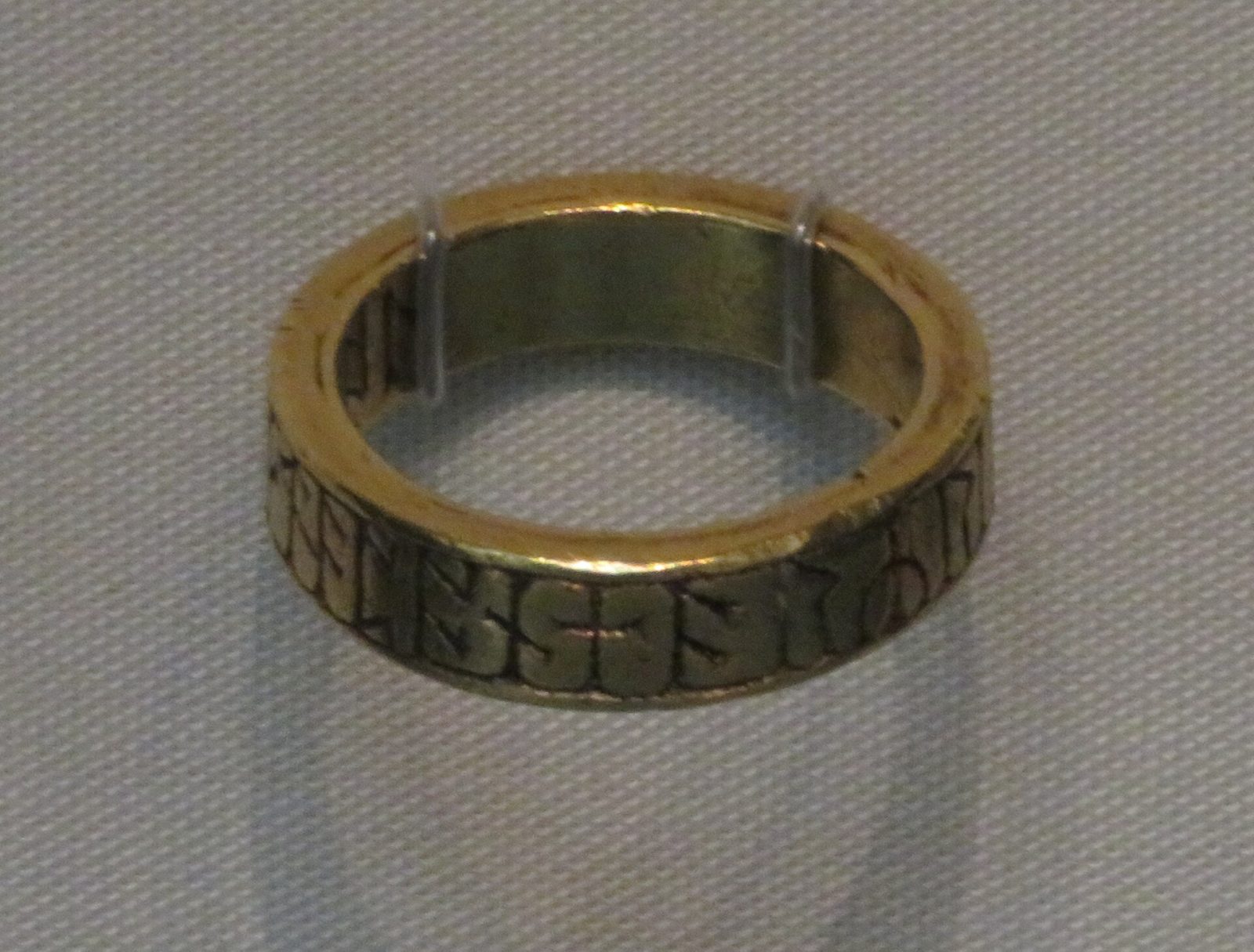
It is a big ring, about 25 millimetres across and weighing about 12 grams, so large it may have been worn on the thumb or over a glove. The hoop has ten flat sides, and the square bezel carries a head wearing a diadem, labelled VENVS, cut in reverse so that it reads correctly when pressed into wax as a seal. Around the hoop runs SENICIANE VIVAS IIN DE, a garbled form of "Senicianus, may you live in God", a Christian motto on a ring showing a pagan goddess. It is usually dated to the late Roman period, about AD 350 to 450.
At Lydney Park in Gloucestershire, about 80 miles away, a lead curse tablet was found at the temple of the god Nodens in the early 19th century. It reads, in translation: "Silvianus has lost his ring and given half its value to Nodens. Among those who are called Senicianus, do not allow health until he brings it to the temple of Nodens." Whether the Silchester ring is Silvianus's lost ring has been argued over for more than a century. Senicianus was not a rare name, and many scholars think the link is a coincidence.
In 1929 the archaeologist Mortimer Wheeler, excavating at Lydney, asked a young Oxford professor of Anglo-Saxon, J. R. R. Tolkien, about the name Nodens, and Tolkien's note was printed in the excavation report. There is no evidence he ever saw the ring, but a cursed gold ring and a professor who went on to write The Hobbit have made a good story ever since.
The Vyne passed to the National Trust in 1956. The ring, which had lain largely forgotten in the house's library, was shown in a special Ring Room with the Tolkien Society in 2013, and it is still held at The Vyne.
Written for Global Finds from the Roman Inscriptions of Britain (RIB 306), The Guardian (2013) and BBC News (2013). Photo: the Vyne Ring on display at The Vyne, Hampshire, Simon Q, Wikimedia Commons, CC BY 2.0.
Source: The Guardian (2013)