The Nebaj Jade: an American dig in the Guatemalan highlands found what was hailed as the finest Maya jade carving yet known
Famous find Late Classic Maya, about AD 600-800 · Found in 1947 See it on the timeline →
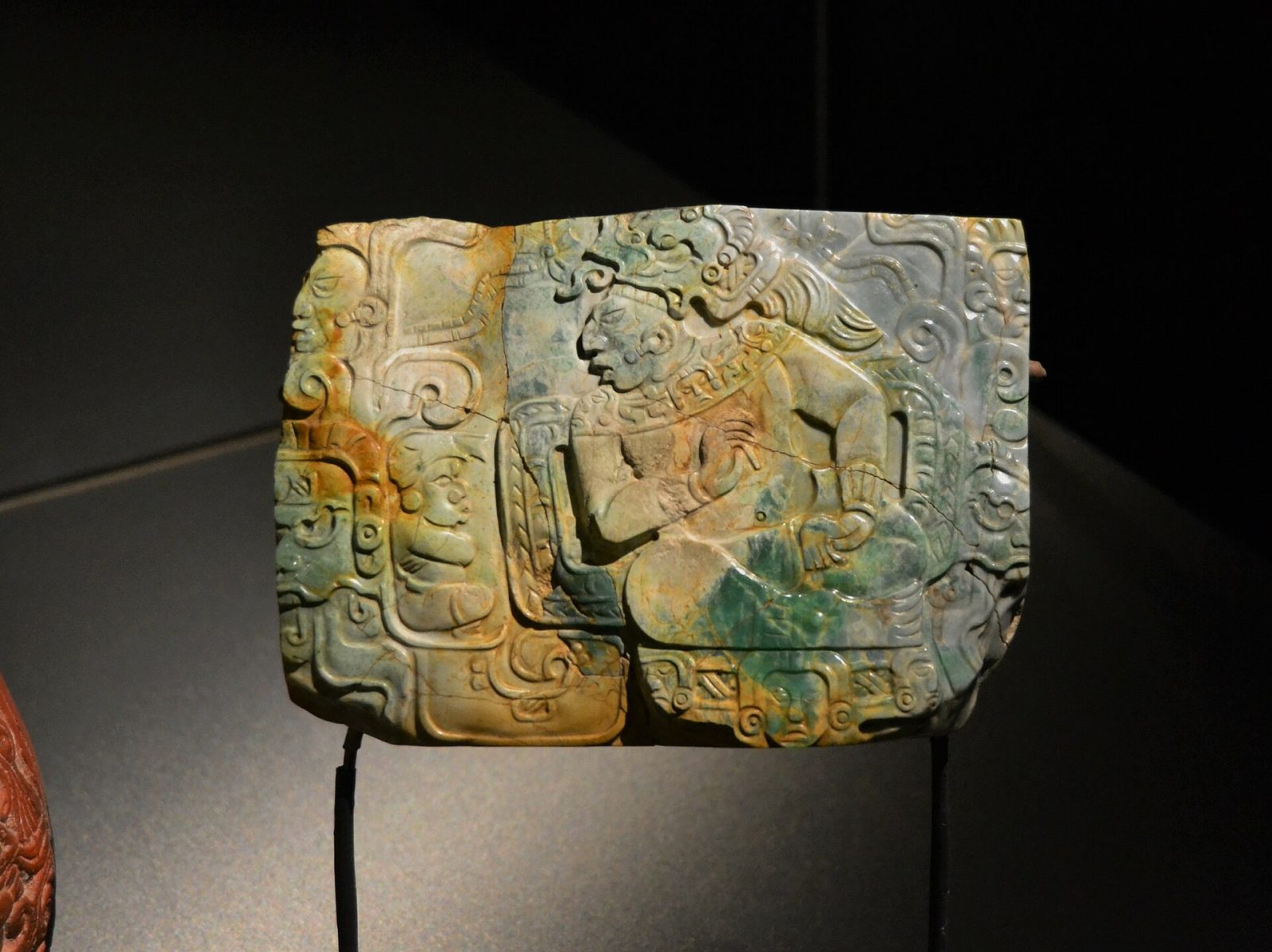
In 1947 a Carnegie Institution team led by A. Ledyard Smith, digging a deep pit into a mound at Nebaj in Guatemala's highlands, found a carved jade breast plaque showing a seated Maya ruler. It is now held by the national archaeology museum in Guatemala City.
In the spring of 1947, a team from the Carnegie Institution of Washington was working on the outskirts of Nebaj, a town in the mountains of Quiché in western Guatemala. Led by the archaeologist A. Ledyard Smith, with Tatiana Proskouriakoff among them, they cut a pit eight metres wide and twelve metres deep into the platform of a large mound. On the way down they found eight tombs and 21 offerings spanning some seven hundred years. Among them was a plaque of carved green jade.
It is a breast ornament about 13 to 15 centimetres across; the published sizes vary. On it a Maya lord sits cross-legged on a throne, turned to speak to a dwarf in front of him. Maize plants grow on either side, flanked by the heads of gods, perhaps standing for ancestors. Jade is harder than steel, and the Maya had no metal tools. The carving was done with bow drills, cords and abrasive sand, and polished for many hours. The Carnegie Institution's report for that year called it "the finest single piece of Maya jade carving that has yet come to light".
The same excavations produced gold and copper ornaments, alabaster and marble vessels, pyrite mirrors and the traces of a painted book. The Carnegie archaeologists thought the style showed links with the lowland Maya cities of the Usumacinta river rather than with Mexico. Their report dated the plaque to about the ninth century. Later scholars have placed it earlier, and the museum now gives it to the Late Classic period, about AD 600 to 800.
The excavation was published by Smith and Alfred Kidder in 1951, and the plaque stayed in Guatemala. It is held by the Museo Nacional de Arqueología y Etnología in Guatemala City, and in 2018 it travelled to Spain for the exhibition "Mayas: the enigma of the lost cities" at the MARQ museum in Alicante.
Written for Global Finds from the Carnegie Institution of Washington Year Book 46 (1947), TIME (1947), Smith and Kidder, Excavations at Nebaj (1951) and the MARQ exhibition label. Photo: the Nebaj jade plaque in the MARQ exhibition, Alicante, Joanbanjo, Wikimedia Commons, CC BY-SA 4.0.
Source: Carnegie Institution of Washington Year Book 46 (1947)