The Altun Ha Jade Head: a villager's jade led archaeologists to a Maya king buried with the sun god on his wrist
Famous find Buried about AD 600 to 650 · Found in 1968 See it on the timeline →
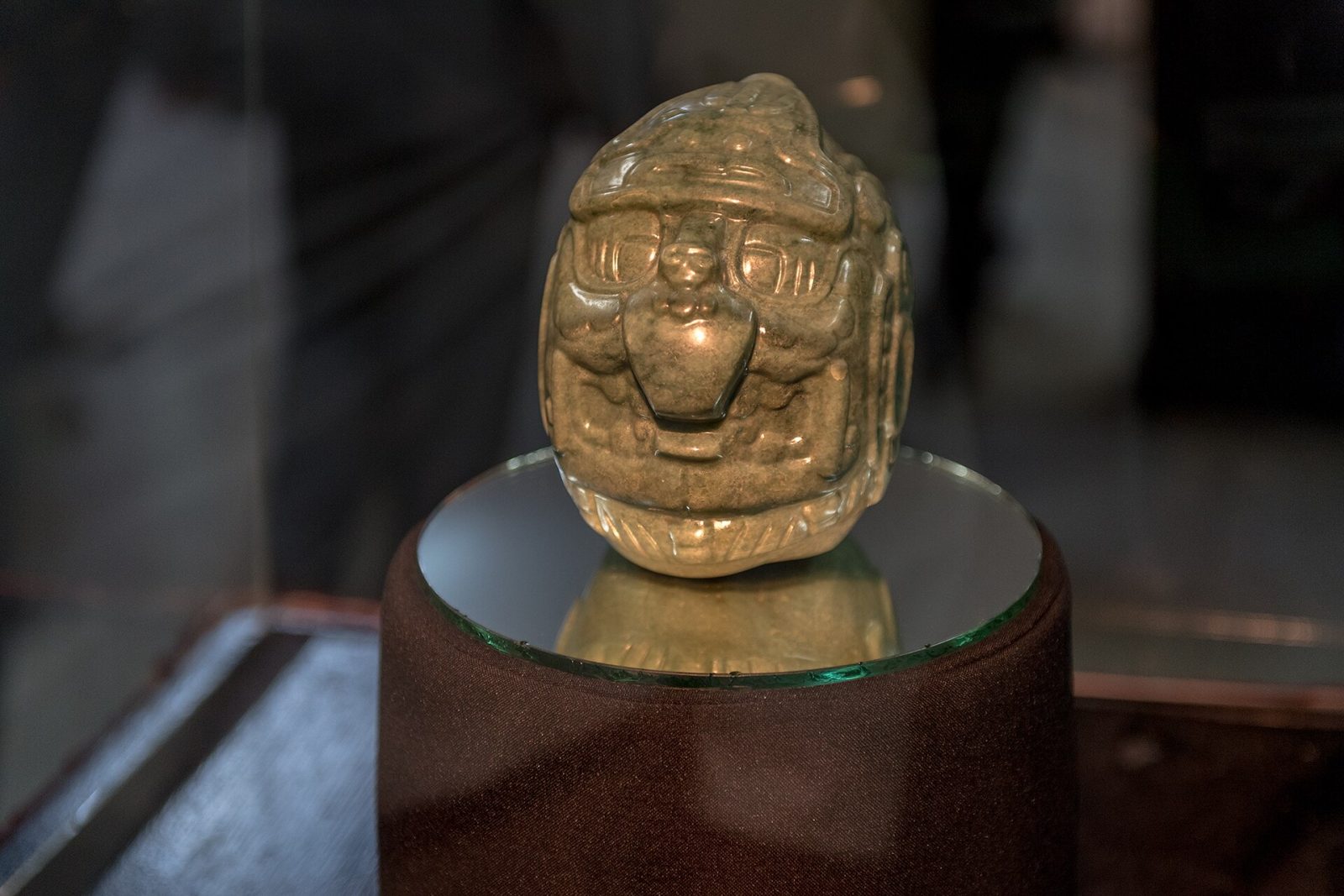
In 1968 the Royal Ontario Museum team excavating the Maya city of Altun Ha in Belize opened the earliest of seven royal tombs in a temple. On the dead ruler's right wrist lay a carved jade head of the sun god weighing 4.42 kg, now Belize's national symbol.
Early in 1963, a villager from Rockstone Pond, in what was then British Honduras, tried to sell tourists in Belize City a large carved jade pendant he had dug up at a ruined site in the forest north of the city. The colony's archaeological commissioner, A. H. Anderson, heard about it and called in the archaeologist David Pendergast. From 1964 to 1970 Pendergast led excavations there for the Royal Ontario Museum, at the site now known as Altun Ha. It was the largest and longest archaeological project yet carried out in Belize.
The 1968 season brought its most spectacular discovery. Deep under the great central stair of Structure B-4, the Temple of the Masonry Altars, the team reached the earliest of a series of seven royal tombs. A ruler lay on a wooden platform that had been lowered into the crypt with ropes, his body once covered with the skins of big cats and coloured with red pigment. Around him were jade beads and ornaments, large Spondylus shells and painted pottery. On his right wrist lay a carved head of jade, 14.9 centimetres high and weighing 4.42 kilograms.
The head is usually identified as Kinich Ahau, the Maya sun god, though some scholars now read it as a symbol of kingship. It was carved from a single boulder of jadeite, the most precious material in the Maya world, and is widely described as the largest carved jade object known from the Maya. The tomb dates to around AD 600 to 650, though the head itself may be older than the burial.
The jade head became famous almost from the day it was found. It has since become Belize's national symbol, and it appears on the country's banknotes. It is not normally on public view. It is kept in secure storage and brought out only for special exhibitions at the Museum of Belize in Belize City, such as the visit of Taiwan's president in 2018. Under Belizean law, all ancient monuments and antiquities belong to the State.
Written for Global Finds from the Lamanai Archaeological Project (lamanai.org.uk), drawing on Pendergast's excavation reports, and Channel 5 Belize (2006 and 2012). Photo: the Altun Ha jade head on display at the Museum of Belize in 2018, Office of the President of the Republic of China (Taiwan), Wikimedia Commons, CC BY 2.0.
Source: Lamanai Archaeological Project