The Tucker Cross: a Bermuda diver's gold and emerald cross from a Spanish wreck, swapped for a fake before the Queen arrived
Famous find Late 16th century, lost about 1594 · Found in 1955 See it on the timeline →
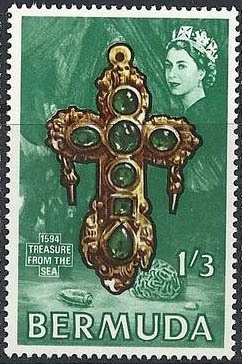
In September 1955 the Bermudian diver Teddy Tucker found a gold cross set with seven emeralds on a 16th-century Spanish wreck off Bermuda. In February 1975, hours before the Queen opened the island's new maritime museum, it was found to have been replaced by a fake. It has never been recovered.
On a Sunday in late September 1955, Teddy Tucker was diving on a wreck on the outer reefs of Bermuda, in about thirty feet of water. It was the seventh day he had worked the site. Lifting a wooden plank, he found a gold cross lying face down beneath it. By his own account, he first thought it looked rather crude, perhaps made locally.
It was not. The cross is gold, usually described as 22-carat, and set with seven emeralds which Tucker said were each "the size of a musket ball". Tiny gold nails hang from rings on its arms, and the back could be removed. The wreck is believed to be the Spanish ship San Pedro, lost in 1594, although sources differ on the ship and the year. The same site gave up gold and pearl buttons, coins and gold bars, and the cross was once called the most valuable single object ever found in a shipwreck.
Tucker sold it to the Bermuda Government in 1959 so that it would stay on the island, and it was shown at the Bermuda Aquarium. In 1969 it appeared on a set of Bermuda stamps. In February 1975 it was to be the centrepiece of the new Bermuda Maritime Museum, opened by Queen Elizabeth II on her visit to the island. Hours before the opening, it was discovered that the cross in the case was a fake, of plastic or plaster depending on the account. There was an international investigation, but nobody knows when the switch happened or who made it.
The cross is still missing. In 2024 the Bermuda jewellers Astwood Dickinson made a 22-carat replica set with Colombian emeralds, working with Tucker's daughter Wendy. Teddy Tucker died in 2014. His cross remains one of the great unsolved thefts of shipwreck treasure.
Written for Global Finds from Teddy Tucker's own account, The Royal Gazette (2001 and 2022), Bernews (2024) and the National Museum of Bermuda. Photo: the Tucker Cross on a 1969 Bermuda stamp, designed by K. Giles and Victor Whiteley, Wikimedia Commons, public domain.
Source: The Royal Gazette (2022)