The Ing'ombe Ilede Burials: workmen digging a water tank above the Zambezi found traders buried with gold, copper and glass
Famous find Buried between the mid-1400s and the 1600s, probably in the 1500s · Found in 1960 See it on the timeline →
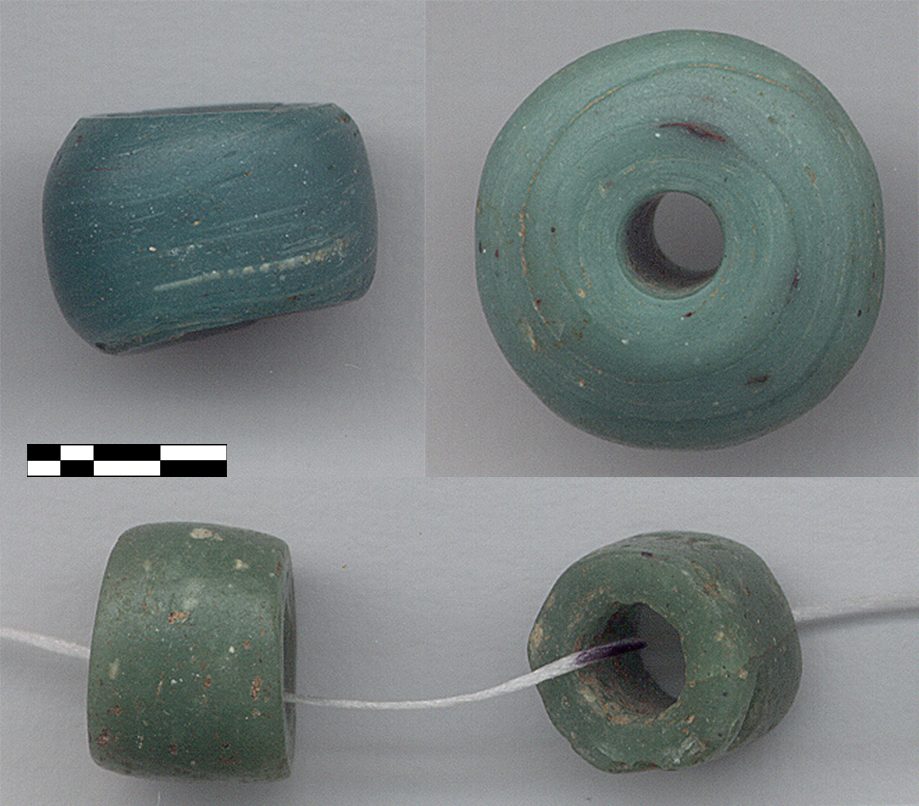
In 1960 a construction crew digging a water tank on a hill above the Zambezi in southern Zambia broke into a cemetery. The richest graves held gold, copper and imported glass beads, bangles, copper cross ingots and wire-drawing tools, the belongings of long-distance traders.
In 1960, a government construction crew digging a water tank on a low hill near the meeting of the Zambezi and Lusitu rivers, in what was then Northern Rhodesia and is now southern Zambia, disturbed a cemetery. The place is called Ing'ombe Ilede, "the sleeping cow", after a fallen baobab tree that looked like one. J. H. Chaplin of the Monuments Commission rescued 11 burials under great pressure of time, before building went on. The archaeologist Brian Fagan returned in 1961, and in 1962, when a second tank was dug, he excavated another cemetery to the south, mostly of young children.
The richest of the first graves held large quantities of strung gold, copper and imported glass beads, copper and iron bangles on the arms and legs, clay pots and sea shells from the Indian Ocean coast. There were X-shaped copper ingots, the cross-shaped money of the copper trade, along with flanged iron gongs, symbols of chiefly power in Central Africa, and fine cotton cloth. One burial held a coil of bronze wire about three millimetres thick and some 16 metres long, and the graves also contained draw-plates and tongs, the tools for pulling thick wire down into fine wire. The people buried here were not only wealthy; they were craftsmen and traders who made the jewellery they wore.
For decades the date of the cemetery was argued over, with early radiocarbon results placing it centuries too early for its glass beads. New dates on cloth and plant fibre preserved by the copper, published in 2017 and 2025, put the rich burials between the middle of the 15th and the 17th centuries, most probably in the 16th. That places them in the age of the Portuguese, who arrived on the East African coast after 1498 and within a few years were writing about inland peoples who traded in copper crosses. Yet there is nothing Portuguese in the graves: the glass beads were made in India and probably arrived through the Swahili trading towns of the coast.
Ing'ombe Ilede is a National Monument of Zambia. The finds are held by the Livingstone Museum.
Written for Global Finds from Killick and others in the Journal of World Prehistory (2025), McIntosh and Fagan in Antiquity (2017) and Robertshaw and Wood in Antiquity (2017). Photo: glass beads from the Ing'ombe Ilede graves, Marilee Wood, Wikimedia Commons, CC BY-SA 4.0.