The Domagnano Treasure: a Gothic noblewoman's gold eagles, dug up on a San Marino farm and scattered across three continents
Famous find Made about AD 500 · Found in 1893 See it on the timeline →
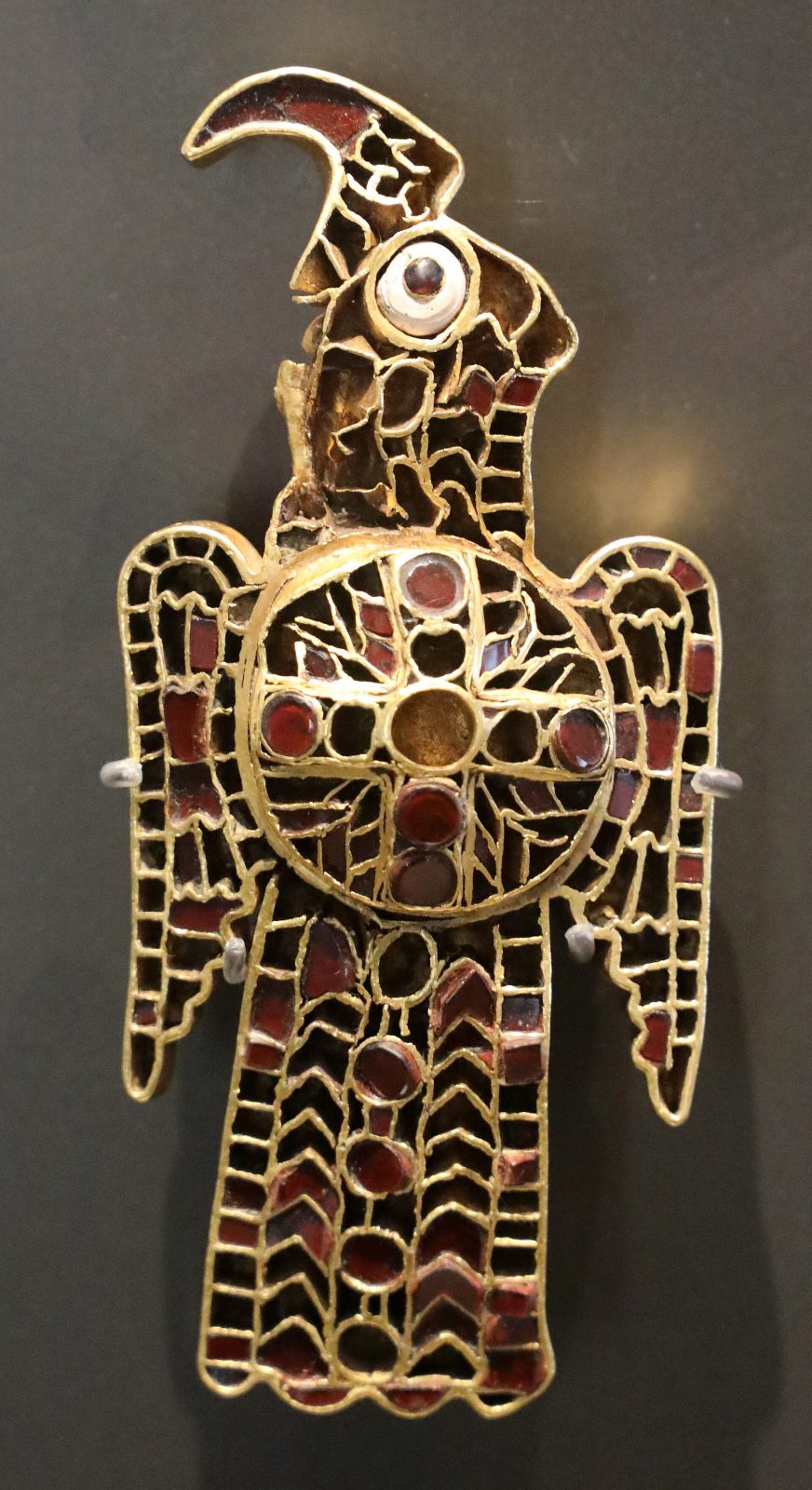
In October 1893 gold and garnet jewellery came out of the ground on Vito Serafini's land at Domagnano in San Marino. Made around AD 500 for a wealthy Ostrogothic woman, it was quickly sold to dealers and is now split between Nuremberg, London, Abu Dhabi and New York.
In October 1893 something remarkable came out of the ground near the farmhouse called Lagucci at Domagnano, one of the nine historic districts of the tiny republic of San Marino. The land belonged to Vito Serafini. The records do not say who actually dug the jewellery up, or exactly how, and nobody supervised the recovery. It was probably not a buried hoard at all but the contents of one or more rich graves.
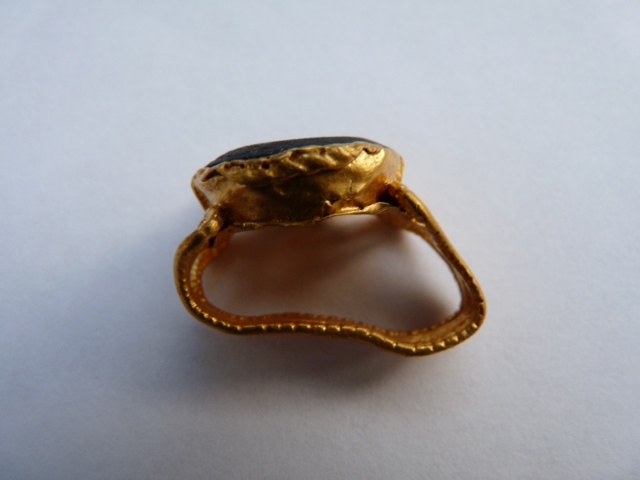
The Germanisches Nationalmuseum in Nuremberg counts 21 pieces of gold set with red almandine garnets and pearls. The finest are a pair of eagle-shaped brooches about 12 cm long. The one in Nuremberg is 22-carat gold, weighs 128.44 g, and was built from 246 tiny gold cells, 187 of which still hold their inlays. It has blue lapis lazuli at the wing tips and a cross on the breast. The Louvre Abu Dhabi, which owns the other eagle, says its garnets came from Gujarat in India. With them were earrings, necklace pendants, a brooch shaped like a cicada, a hairpin, a ring, fittings from a knife sheath, and two mounts with Christian symbols.
The jewellery dates to about AD 500, when the Ostrogoths ruled Italy under Theodoric the Great from Ravenna, some 70 km away. The owner is thought to have been a Gothic noblewoman from Theodoric's circle. The pair of eagles was probably worn at the shoulders, joined by a chain to fasten a cloak.
Within months, Serafini had sold most of the pieces to the Milan dealer G. Sambon, keeping a few for himself. The treasure was split up. Nuremberg bought its pieces through a Mainz dealer in 1898 and 1903, and the British Museum bought its group from Sambon in 1933 with help from the Art Fund. For decades the London pieces were labelled the "Cesena Treasure", until the archaeologist Volker Bierbrauer showed in 1973 that they came from Domagnano. Today the treasure is divided between Nuremberg, the British Museum, the Louvre Abu Dhabi and the Metropolitan Museum of Art in New York, which has one pendant.
Written for Global Finds from the Germanisches Nationalmuseum, the Louvre Abu Dhabi, the Metropolitan Museum of Art, the Art Fund and Bierbrauer in Germania (1973). Photo: the Domagnano eagle brooch at the Louvre Abu Dhabi, Francesco Bini (Sailko), Wikimedia Commons, CC BY-SA 4.0.