The Hoen Hoard: Norway's largest Viking gold treasure
Famous find Buried about AD 875 to 900 · Found in 1834 See it on the timeline →
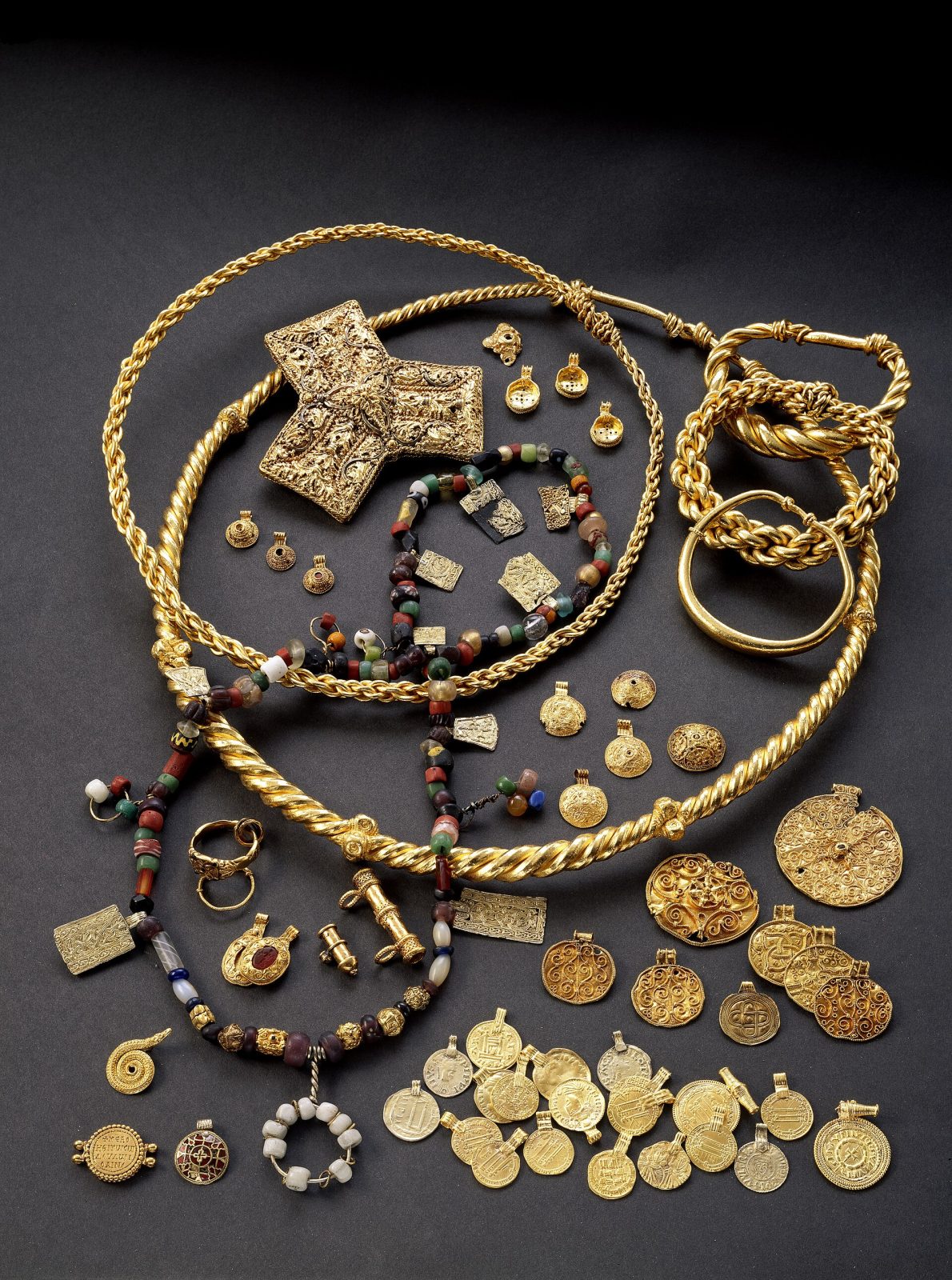
In 1834 a ditch being dug on a farm at Hoen in Øvre Eiker, Norway, cut into the largest Viking Age gold hoard ever found in Norway: about 2.5 kilograms of gold, with coins turned into pendants and jewellery from across Europe.
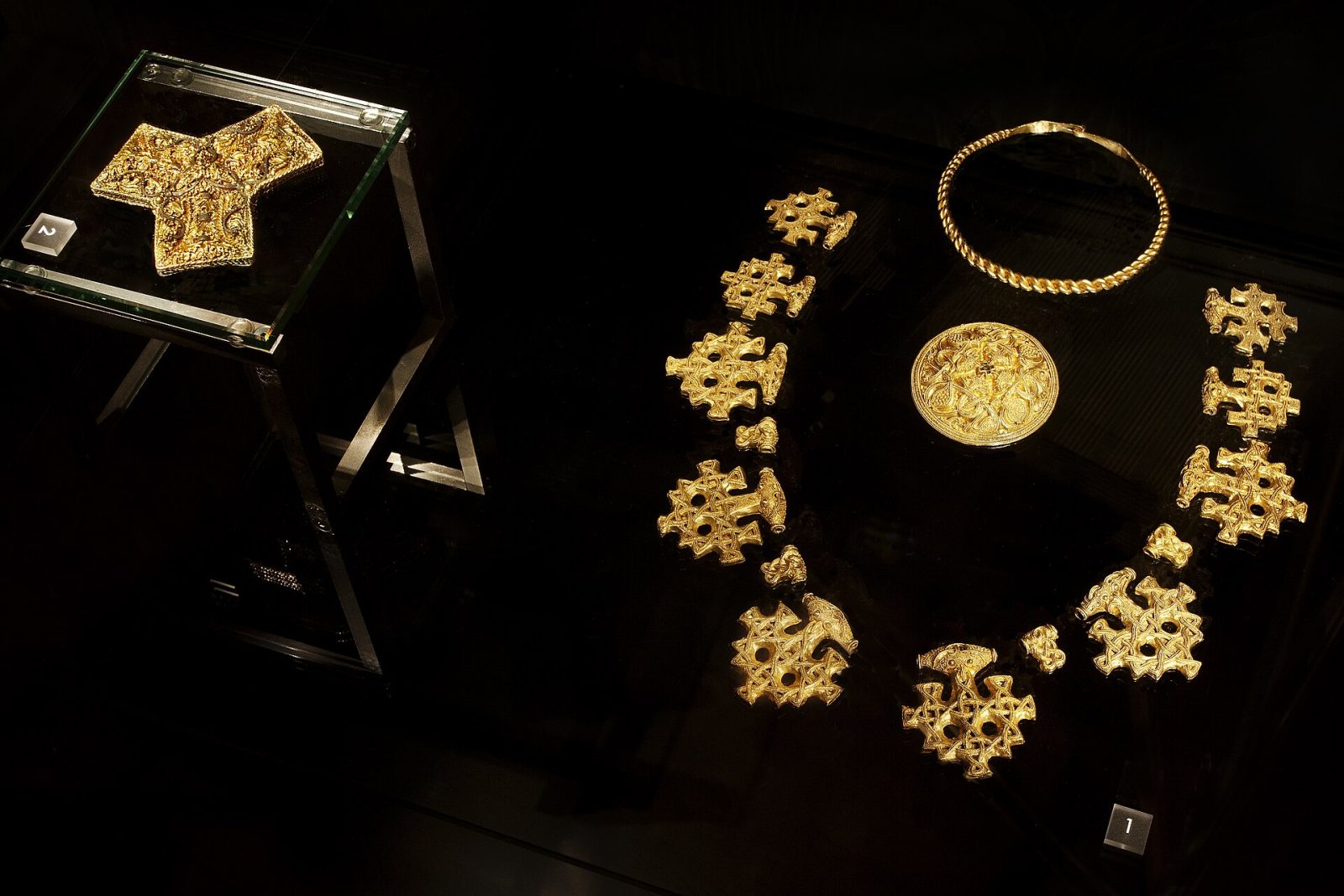
In 1834, workers digging a ditch on the farm of Nedre Hoen, just north-west of Hokksund in Øvre Eiker, south-eastern Norway, uncovered a hoard of gold. It is still the largest Viking Age gold hoard ever found in Norway.
There are about 2.5 kilograms of gold, with some silver, in around 200 pieces: neck rings, arm rings, brooches and pendants, 20 gold coins and well over a hundred beads of glass and semi-precious stone. One of the two gold neck rings weighs more than a kilogram on its own. The exact counts vary slightly between accounts.
What makes Hoen remarkable is how far its pieces had travelled. The largest is a three-lobed gold mount made in the Frankish empire, decorated with acanthus leaves in the style of the Carolingian court and probably made to join the straps of a sword belt or harness. There is a Byzantine disc with a Greek inscription, an Anglo-Saxon finger ring, and coins ranging from the Roman Empire to the Islamic caliphate, the latest struck in AD 848 or 849. All 20 coins had been fitted with loops so they could be worn as pendants, and ten carry scratched graffiti, nine of them in Arabic.
The latest coin shows that the hoard cannot have been buried before about 850, and the Norwegian national encyclopedia puts its burial between about 875 and 900. Who buried it, and why, is unknown.
The hoard was published in 1835 and went to the university collection in Christiania, now Oslo, in 1836. It became the centrepiece of the Viking Age displays and was taken to a bank vault in the countryside for safety in 1939. It is now in the Museum of Cultural History in Oslo, which still has the spade that was used to dig it up in 1834.
Written for Global Finds from the Norwegian encyclopedia Store norske leksikon, the University of Oslo's Museum of Cultural History and other published accounts. Photo: the Hoen Hoard, Ove Holst, Kulturhistorisk Museum, Wikimedia Commons, CC BY-SA 4.0.
Approximate location59.78, 9.89View on map
Source: Store norske leksikon