The 'Tara' Brooch: Ireland's finest brooch and the mystery of where it was found
Famous find Made about AD 700 · Found in 1850 See it on the timeline →
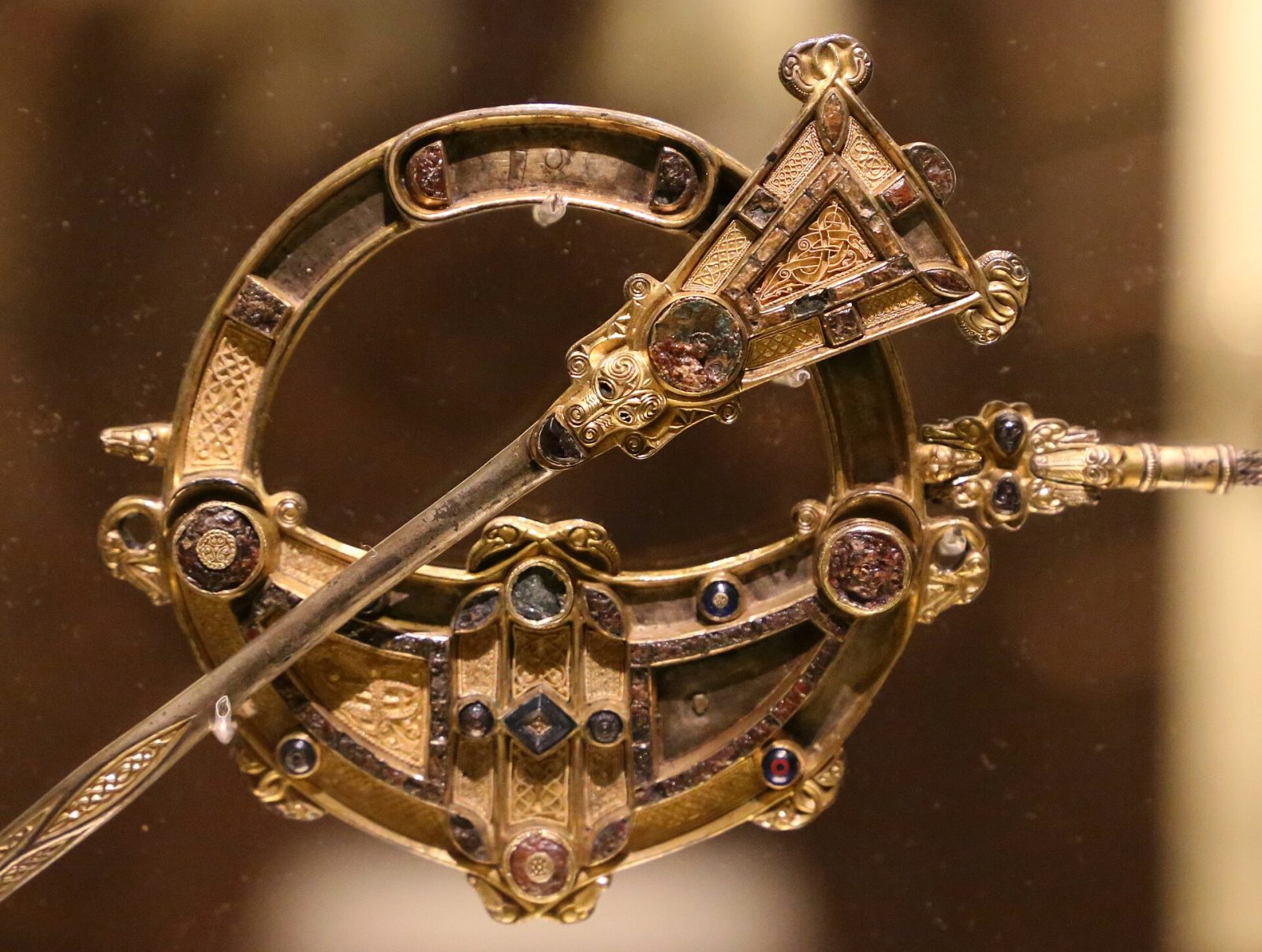
In 1850 a brooch of gilded silver, gold filigree, glass and amber came to light near Bettystown in County Meath. A Dublin jeweller named it after Tara to sell copies, and the true findspot is still uncertain.
In 1850 an elaborate brooch came to light near the sea at Bettystown, County Meath. The story told at the time was that a local woman's child had found it in a box in the sand on the beach. Many historians now think it was really found inland, and that the family changed the story to keep it from being claimed by the landowner. The finder's name is not recorded.
The brooch reportedly passed through dealers in Drogheda to the Dublin jewellers Waterhouse & Co., who called it the Tara Brooch. It had nothing to do with the Hill of Tara, seat of the ancient high kings, about 25 kilometres away: the name was chosen to sell the copies of it that the firm made. Waterhouse showed it at the Great Exhibition in London in 1851, in Dublin in 1853 and in Paris in 1855, and Queen Victoria bought copies. Scholars still often put the name in quotation marks.
It is made of cast and gilded silver and decorated on both faces. The front carries panels of extremely fine gold filigree, with animals and abstract patterns, separated by studs of glass, enamel and amber. The back, which would have been hidden against the wearer's cloak, is decorated almost as richly, with scrolls and spirals. A plaited silver chain hangs from a swivel framed by animal heads and two tiny cast-glass human heads. The National Museum of Ireland dates it to the 8th century AD, and scholars place it around 700, close in date to the Hunterston Brooch from Scotland and the Lindisfarne Gospels.
Some of the work is so fine that it can only be appreciated with magnification. Several of the small panels and studs have been lost since 1850.
The brooch was acquired by the Royal Irish Academy and passed to the National Museum of Ireland in 1890. It is on display in the Treasury at the museum on Kildare Street in Dublin.
Written for Global Finds from the National Museum of Ireland, the Victoria and Albert Museum and other published accounts. Photo: the 'Tara' Brooch in the National Museum of Ireland, Sailko, Wikimedia Commons, CC BY 3.0.
Approximate location53.70, -6.25View on map
Source: National Museum of Ireland