The Snartemo Sword: a gold-hilted sword from a Norwegian chieftain's grave
Famous find Buried about AD 500 · Found in 1933 See it on the timeline →
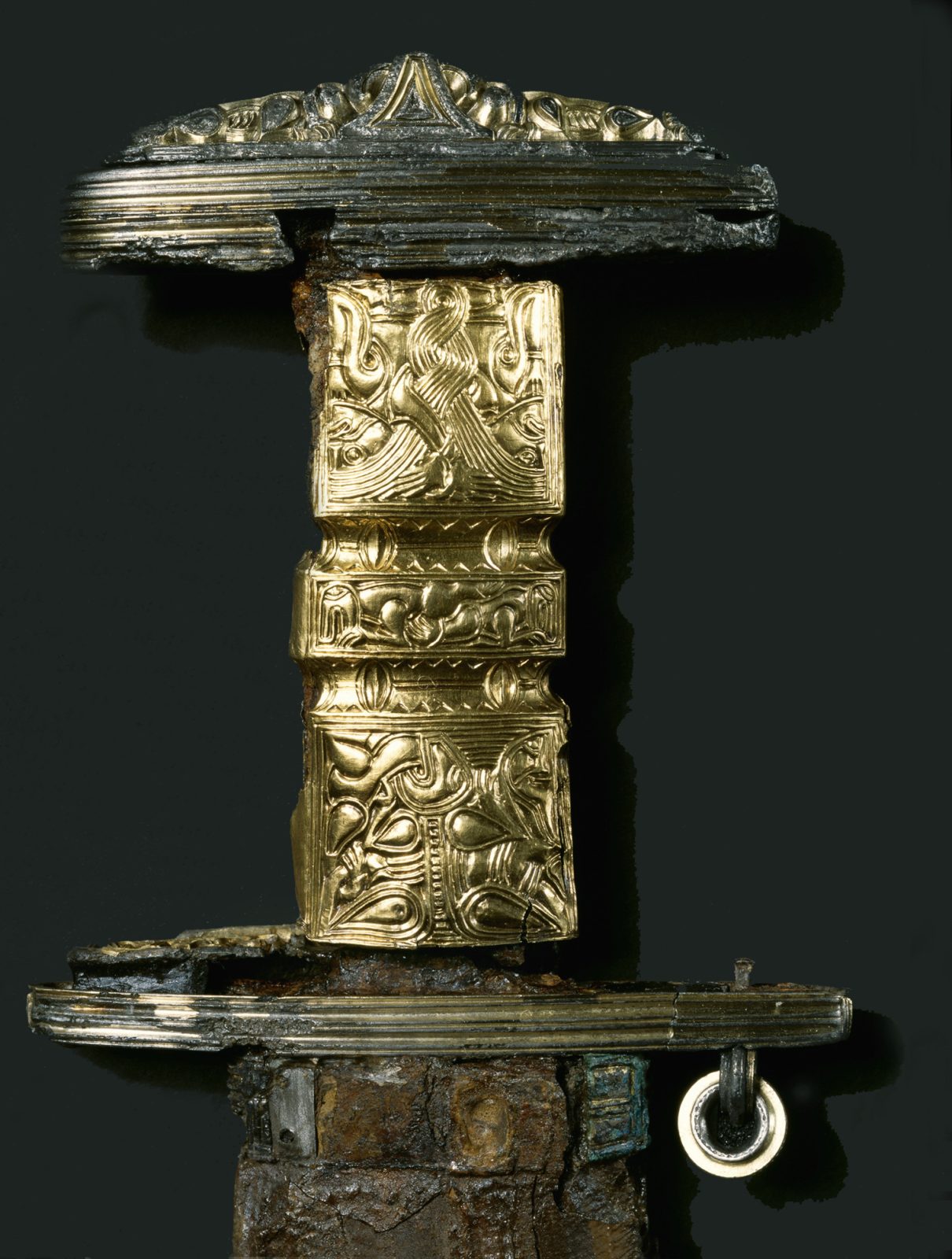
In October 1933 two brothers clearing land on a farm at Snartemo in southern Norway lifted a stone slab and found a chamber grave. In it lay a warrior with a sword whose hilt is covered in gold, one of the finest weapons of the Migration Period.
In the autumn of 1933, two brothers were clearing land on the farm of Øvre Snartemo, in Hægebostad in the hills of Agder in southern Norway. Beneath flat ground, with no mound to mark it, they struck a large stone slab. Underneath was a stone-lined burial chamber. They lifted out some of the objects inside, and then stopped and reported the find to the University's Collection of Antiquities in Oslo, whose conservator excavated the rest.
It was the grave of a man of high rank, buried around AD 500. He had been laid out with his weapons and possessions: knives, spearheads, a belt buckle, gold finger rings, local pottery, a glass vessel and a bronze cauldron made near the mouth of the Rhine, and fine textiles, including woven bands. Finest of all was a double-edged sword. It was found broken in three pieces, but complete, and its hilt is covered with gilded silver sheets decorated with interlaced animals and patterns in the style of the time. Some scholars think it was assembled from parts of different ages and origins, and its decoration resembles that on helmets from eastern Sweden.
The sword belongs to the Migration Period, the age of upheaval as the Western Roman Empire broke apart and peoples, goods and warriors moved across Europe. It has been described as a ring-sword, a type which, in Frankish sources, marked a sworn bond between a warrior and his lord. The historian Per Ditlef Fredriksen has suggested that the man buried at Snartemo may have been a chieftain who had served a ruler on the Continent before returning home, bringing with him the glass and bronze from the Rhineland that lay in his grave.
The Snartemo finds are in the Museum of Cultural History in Oslo. A full-size replica of the sword is shown at Tingvatn Fornminnepark in Hægebostad, and a standing stone marks the place where the grave was found.
Written for Global Finds from Norgeshistorie (University of Oslo), the Store norske leksikon and Lokalhistoriewiki. Photo: the gilded hilt of the Snartemo sword, Eirik Irgens Johnsen, Museum of Cultural History, University of Oslo, Wikimedia Commons, CC BY-SA 4.0.
Approximate location58.33, 7.21View on map