The Gleninsheen Gorget: Bronze Age gold hidden in the rocks of the Burren
Famous find Made about 800 to 700 BC · Found in 1932 See it on the timeline →
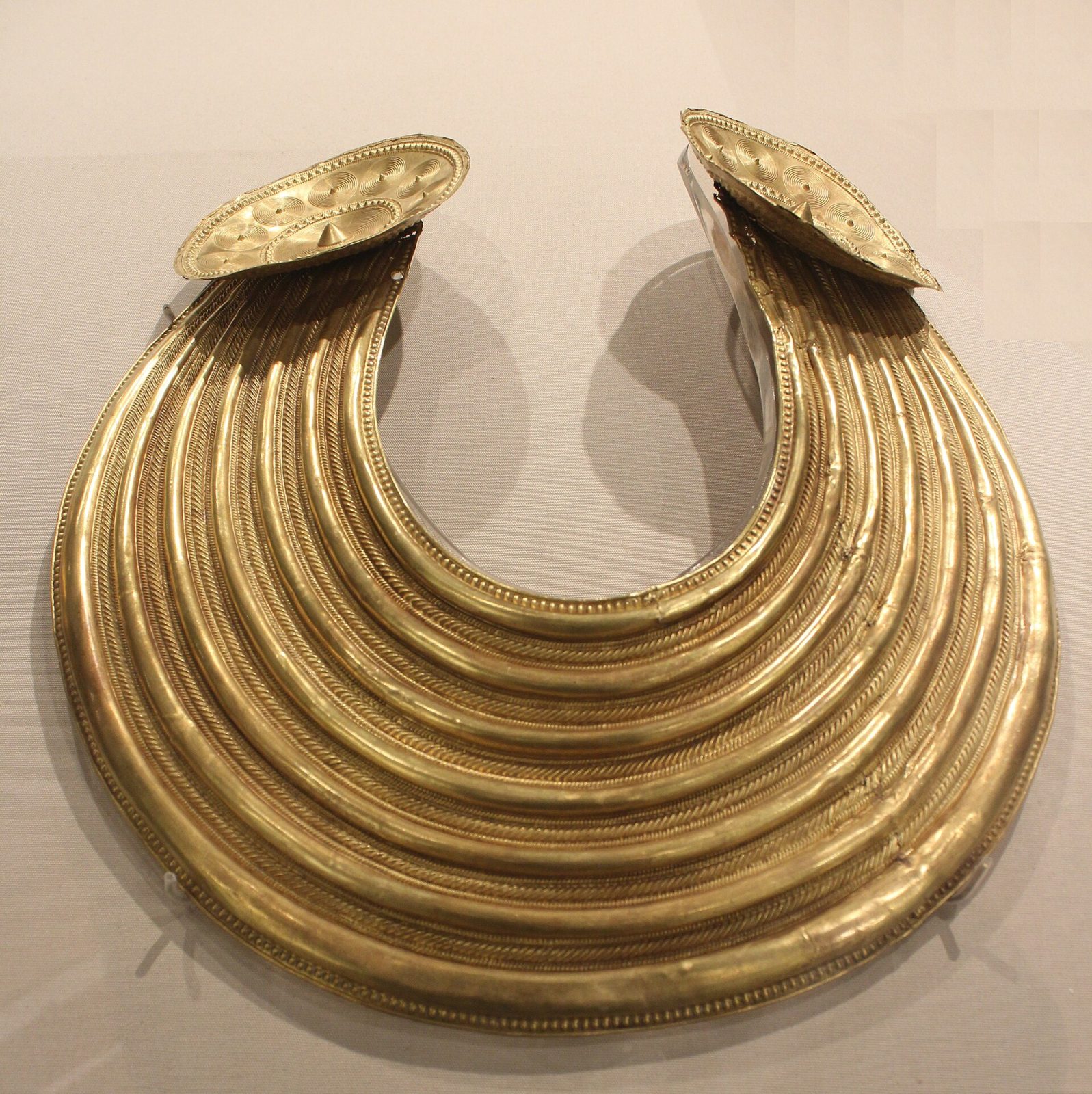
In the early 1930s a young man out rabbiting in the Burren, County Clare, found a gold collar folded in two and pushed into a crack in the limestone. It is one of the finest pieces of Bronze Age goldwork from Ireland.
The usual account is that in the early 1930s, most often given as 1932, a young local man, Patrick Nolan, was out rabbit shooting at Gleninsheen in the Burren, County Clare, when his dog chased a rabbit into a crevice in the limestone. Inside it he found a gold collar, folded in two. Nothing else was found with it.
As the story is told locally, his uncle took it for an old coffin fitting and would not have it in the house. In 1934 a local historian, Dermot Gleeson, recognised what it was, and the National Museum of Ireland claimed it as treasure trove.
The gorget is a U-shaped collar of sheet gold, about 31 centimetres wide, with seven raised ribs separated by rope-like mouldings, and a gold disc at each end decorated with a large central cone and rings of tiny bosses. The goldsmith used hammering, chasing, stamping, twisting and stitching to make it. It dates from the Late Bronze Age, about 800 to 700 BC.
Bend marks across its ribs show that it had been deliberately folded in half before it was pushed into the rock, perhaps to put it out of use for ever as an offering. Only a handful of Irish gold gorgets survive, and this is one of the finest.
The Gleninsheen Gorget is on display in the National Museum of Ireland on Kildare Street in Dublin, and was chosen as one of the objects in A History of Ireland in 100 Objects.
Written for Global Finds from The Irish Times' A History of Ireland in 100 Objects, Clare County Library's heritage pages and other published accounts. Photo: the Gleninsheen Gorget in the National Museum of Ireland, Martinvl, Wikimedia Commons, CC BY-SA 4.0.
Approximate location53.07, -9.14View on map
Source: The Irish Times: A History of Ireland in 100 Objects