The Alfred Jewel: 'Alfred ordered me to be made'
Famous find Made AD 871 to 899, in the reign of Alfred · Found in 1693 See it on the timeline →
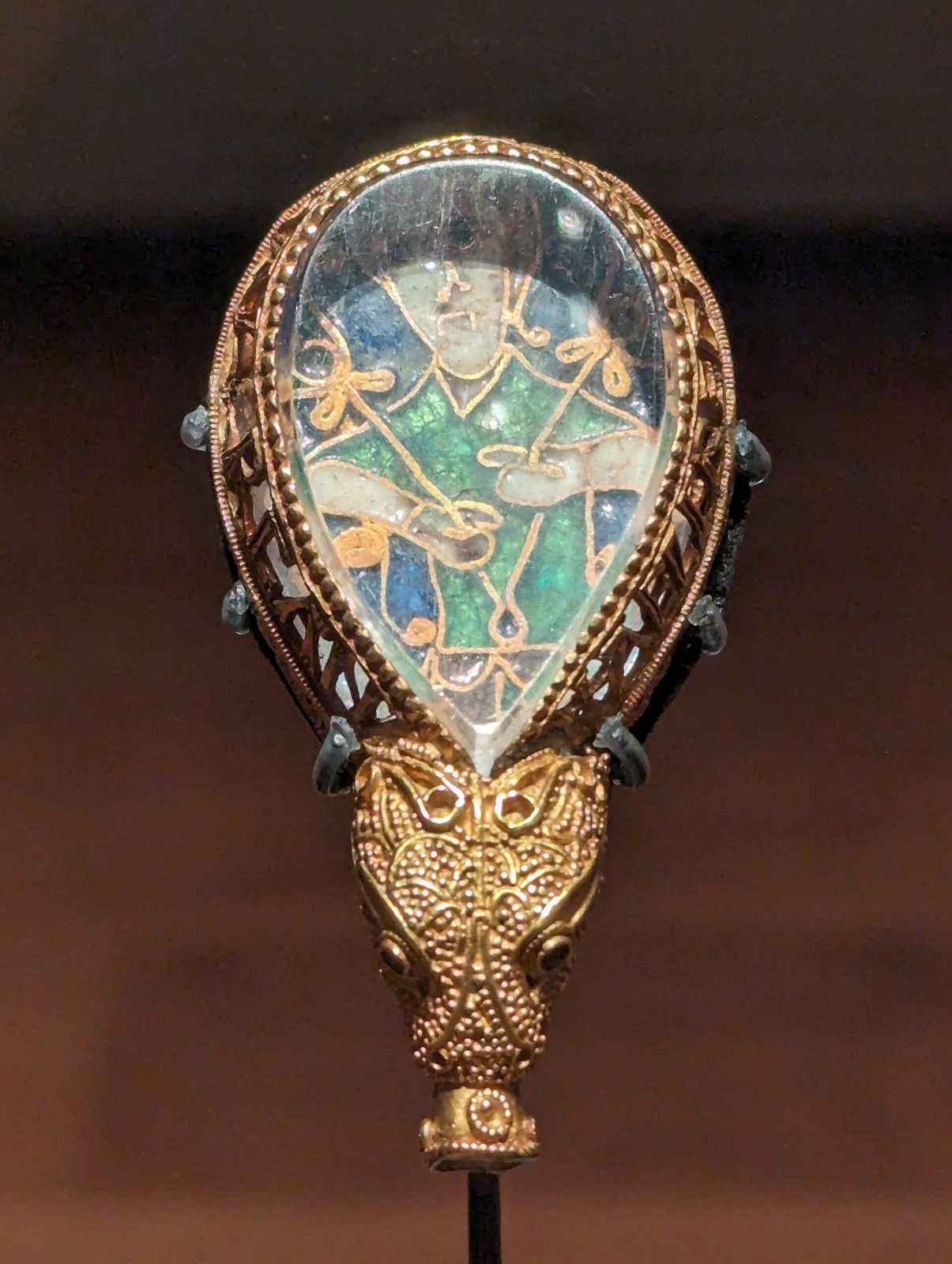
Ploughed up in a Somerset field in 1693, this jewel of gold, enamel and rock crystal carries the words 'Alfred ordered me to be made'. It was found a few miles from Athelney, where Alfred the Great took refuge from the Vikings.
In 1693 a gold jewel was ploughed up in a field at North Petherton in Somerset, on land belonging to Sir Thomas Wroth. The name of the person who actually found it is not recorded. The field lay a few miles from Athelney, the island in the Somerset marshes where Alfred, king of Wessex, took refuge in 878 before the victory over the Vikings at Edington that saved his kingdom.
The jewel is about 6 centimetres long. A teardrop of polished rock crystal covers a plaque of cloisonné enamel showing a man holding two flowering stems, all held in a gold frame decorated with filigree and granulation. At the narrow end, the head of a beast grips a hollow socket, and a small rivet is still in place where something was once fixed into it. Around the edge, in openwork gold letters, runs the inscription AELFRED MEC HEHT GEWYRCAN: Alfred ordered me to be made.
The Ashmolean Museum dates it to Alfred's reign, AD 871 to 899. Most scholars think it was the handle of an aestel, a pointer used to follow the lines when reading. In the preface to his translation of Pope Gregory's Pastoral Care, written around 890, Alfred said he would send an aestel worth 50 mancuses, a gold coin, with each copy to every bishopric in his kingdom. Who the figure shows is debated, and the Ashmolean now favours a personification of Sight. The rock crystal may be a reused Roman piece.
The jewel was first published in 1698. In 1718 Colonel Nathaniel Palmer gave it to the University of Oxford, and it has been in the Ashmolean Museum ever since. In 2015 it went back to Somerset for the first time in nearly 300 years, on loan to the Museum of Somerset in Taunton. Several smaller aestel ends have been found since, some of them by metal detectorists, and the Minster Lovell Jewel is thought to come from the same workshop.
Written for Global Finds from the Ashmolean Museum and other published accounts. Photo: the Alfred Jewel in the Ashmolean Museum, William M. Connolley, Wikimedia Commons, CC0.
Approximate location51.08, -2.99View on map
Source: Ashmolean Museum