The Fuller Brooch: the 'fake' that turned out to be an Anglo-Saxon masterpiece
Famous find Made in the late 9th century AD See it on the timeline →
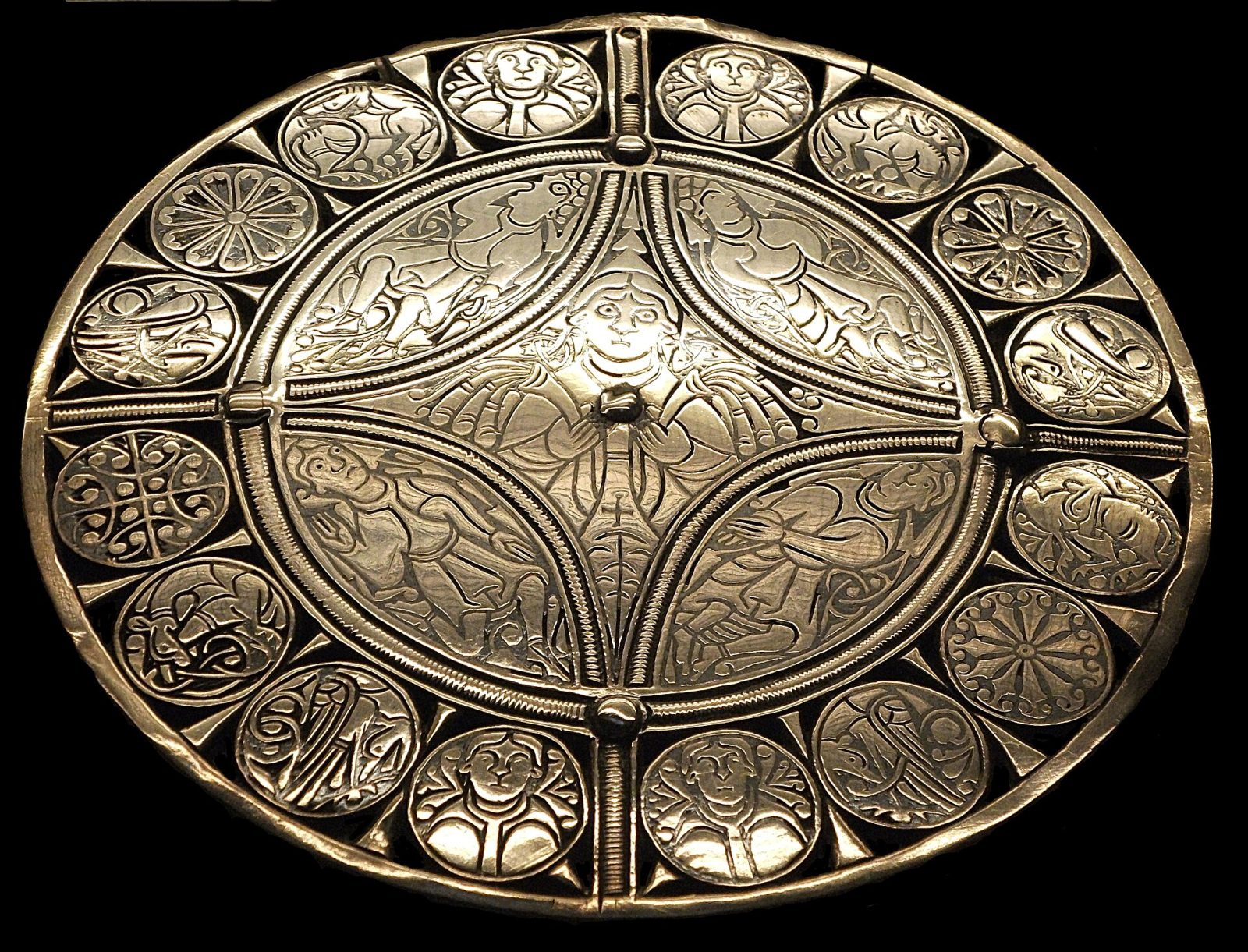
A silver disc brooch showing the Five Senses was once dismissed by experts as a forgery and nearly sold for the value of its silver. It is now recognised as one of the finest pieces of late Anglo-Saxon art, though where it was found is unknown.
Unlike most famous finds, the Fuller Brooch has no findspot. It first appears in the hands of a London dealer in curiosities, who sold it to a buyer with no idea where it had come from. Nobody knows who dug it up, or where, or when.
It is a disc of hammered silver, 11.4 centimetres across, inlaid with black niello. In the centre is a figure with huge staring eyes, Sight, and around him four more figures stand for the other senses: Taste with a hand in his mouth, Smell with his hands behind his back between tall plants, Touch rubbing his hands together, and Hearing with a hand cupped to his ear. A border of sixteen small roundels holds people, birds, animals and plants. It is the earliest known picture of the Five Senses. The British Museum dates it to the late 9th century and has suggested it may have been made in the circle of Alfred the Great's court.
Its history after it surfaced is a cautionary tale. The brooch passed to the collector Sir Charles Robinson, and later to his son-in-law, who lent it to the Ashmolean Museum in Oxford. But Sir Charles Hercules Read of the British Museum declared it a fake, largely because it was in such remarkably good condition, and it was taken off display. The collector Captain A. W. F. Fuller then bought it, reportedly for little more than the value of the silver.
Later, at the British Museum, Sir Thomas Kendrick had it examined again. Scientific analysis, together with the appearance of a closely similar brooch, the Strickland Brooch, convinced the experts that it was genuine. Its niello, made mainly of silver sulphide, is of a kind that went out of use long ago and would be hard for a modern forger to reproduce. In 1952 Fuller gave it to the British Museum on condition that it bear his name, and it is on display there.
Written for Global Finds from the British Museum's own text on the brooch, Rupert Bruce-Mitford's 1952 study in the British Museum Quarterly and other published accounts. Photo: the Fuller Brooch in the British Museum, Johnbod, Wikimedia Commons, CC BY-SA 3.0.