The Tillya Tepe gold: the Bactrian treasure that survived Afghanistan's wars
Famous find Buried in the 1st century BC to 1st century AD · Found in 1978 See it on the timeline →
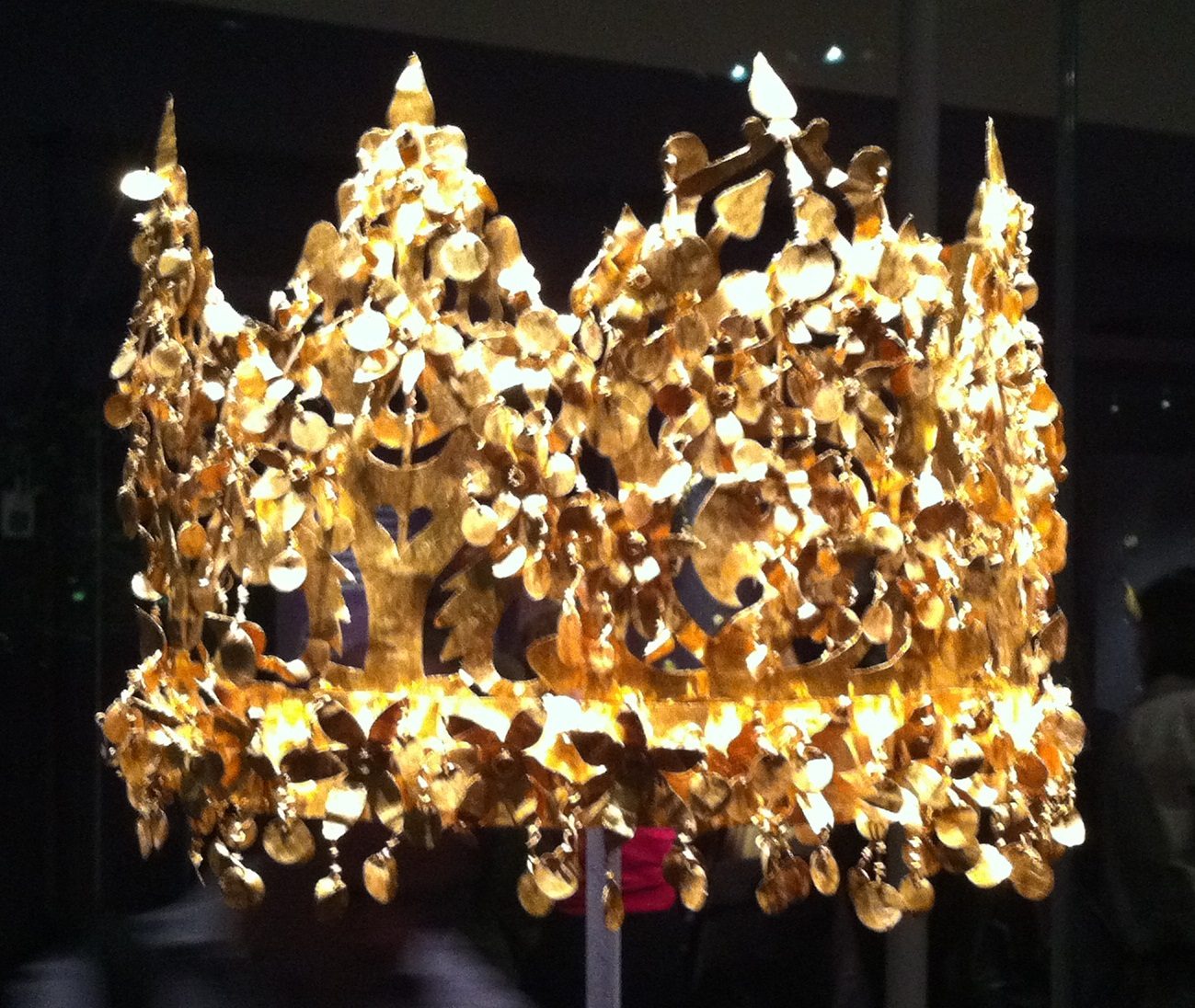
In 1978 archaeologists in northern Afghanistan opened six nomad graves filled with more than 20,000 gold objects. Hidden in a bank vault through years of war, the treasure was found intact in 2003.
In 1978 and 1979, a Soviet and Afghan team led by the archaeologist Viktor Sarianidi excavated a mound called Tillya Tepe, the Hill of Gold, about 5 kilometres north-east of Sheberghan in northern Afghanistan, shortly before the Soviet invasion.
They uncovered six graves, of a man and five women, wealthy members of a nomadic people, probably the Yuezhi, who were then settling in ancient Bactria. Between them the graves held more than 20,000 gold objects: thousands of tiny ornaments once sewn on to clothes, jewellery, weapons and a gold crown of thin gold leaves that could be taken apart for travel. The jewellery mixes Greek, Iranian, Indian and steppe styles, and one grave held a gold coin of the Roman emperor Tiberius, struck at Lyon in France between AD 16 and 21. The burials date from the 1st century BC to the 1st century AD.
As Afghanistan descended into war, the gold was secretly moved in the late 1980s into a vault beneath the Central Bank in Kabul, and the keys were shared between trusted officials. Through the years of civil war and Taliban rule its fate was unknown, and many feared it had been looted or melted down.
In 2003 the vault was opened and the gold was found intact. In 2004 Sarianidi helped check it against his original records, and some pieces were still in the plastic bags he had packed them in 25 years earlier.
From 2006 the treasure toured museums around the world, including the Musée Guimet in Paris, the National Gallery of Art in Washington, the Metropolitan Museum of Art in New York and the British Museum. It belongs to the National Museum of Afghanistan in Kabul. Since the Taliban returned to power in 2021, its present condition has not been publicly confirmed.
Written for Global Finds from the National Endowment for the Humanities, the Archaeological Institute of America and other published accounts. Photo: the gold crown from Tillya Tepe, photographed at the British Museum in 2011, Artacoana, Wikimedia Commons, CC BY-SA 3.0.
Approximate location36.69, 65.79View on map