The Caergwrle Bowl: a Bronze Age boat of shale, tin and gold
Famous find Made about 1300 to 1000 BC · Found in 1823 See it on the timeline →
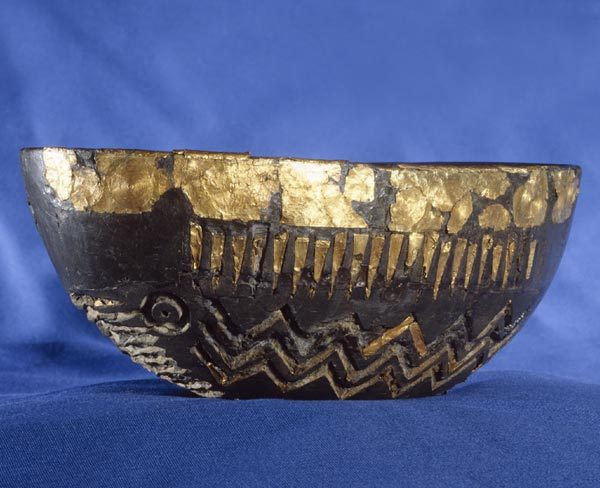
In about 1823 a workman digging a drain below Caergwrle Castle in Flintshire found a small shale bowl decorated in tin and gold to look like a boat, with oars, waves and an eye on its prow.
In about 1823, a workman digging a drain in a boggy field below Caergwrle Castle, near the River Alun in Flintshire, north-east Wales, found a small oval bowl. Nobody recorded his name.
The bowl is about 18 centimetres long and is carved from shale, a soft black stone. It is shaped and decorated like a boat. Grooves cut into it were filled with tin and covered with gold leaf to show oars along its sides, waves beneath them, a row of round shields or suns along the rail, and an eye at the prow and the stern, like the eyes painted on the ships of the ancient Mediterranean. It dates from the Bronze Age, about 1300 to 1000 BC.
Its materials came from far apart: the National Museum suggests the shale may come from Dorset, the tin from Cornwall and the gold from Ireland or Wales. Found in wet ground by a river that flows to the Dee and the Irish Sea, it is thought to have been an offering, perhaps for a safe journey by water.
The bowl was badly broken, and only about half of it survives, the rest being restoration. It was given to the National Museum of Wales in 1912 and restored at the British Museum soon afterwards with wax and adhesives. Those repairs became unstable, and in 2007 the bowl was conserved again, work that also revealed how it had been made. It is now kept in store at National Museum Cardiff.
Written for Global Finds from Amgueddfa Cymru – Museum Wales and other published accounts. Photo: the Caergwrle Bowl, National Museum Wales, Wikimedia Commons, CC BY-SA 3.0.
Approximate location53.11, -3.04View on map
Source: Amgueddfa Cymru – Museum Wales