The Derveni Krater: a golden-looking bronze masterpiece hit by a road-building machine
Famous find Made about 370 to 320 BC · Found in 1962 See it on the timeline →
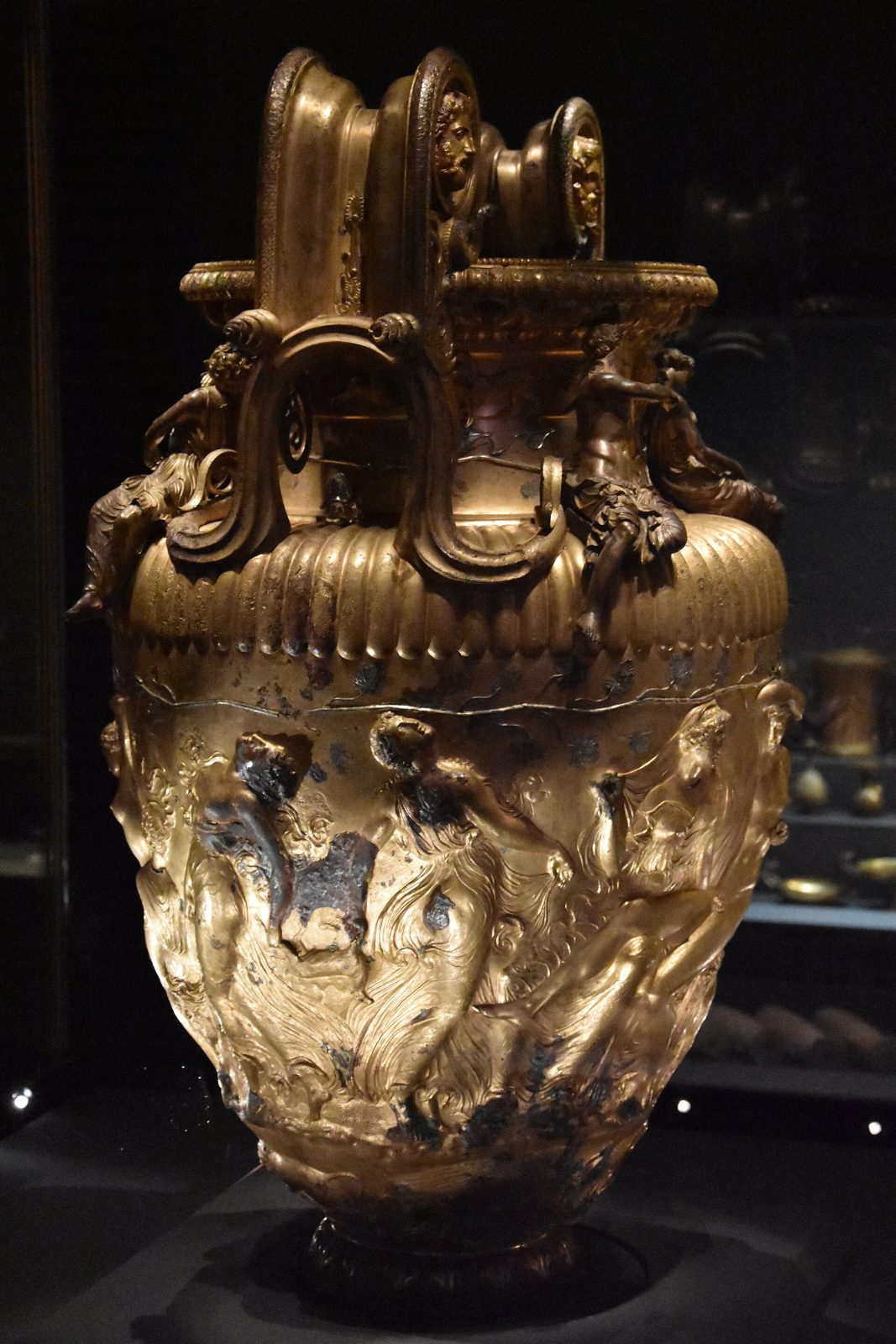
In January 1962 a machine widening a road near Thessaloniki in Greece broke into ancient graves. One held a huge bronze mixing bowl that gleams like gold, covered with figures of Dionysus and his followers, used as the urn for a Macedonian couple's ashes.
On 15 January 1962, a machine widening the main road from Thessaloniki to Kavala, at Derveni about ten kilometres north of Thessaloniki in northern Greece, broke into an untouched stone grave. The next day, just four and a half metres away, a second, larger grave was found. Over the following months archaeologists of the Greek Archaeological Service excavated seven burials in what had been the cemetery of the ancient town of Lete.
The second grave held one of the masterpieces of ancient Greek metalwork: a bronze krater, a great vessel for mixing wine and water, about 90 centimetres tall and weighing around 40 kilograms. It gleams like gold, but contains no gold at all; its colour comes from a high proportion of tin in the bronze. It was built from dozens of cast and hammered parts. Around its body runs a frieze showing the wine god Dionysus with his bride Ariadne, surrounded by dancing maenads and satyrs; its handles end in masks, and four figures in the round sit on its shoulders. An inscription inlaid on the rim names its owner: Astiouneios, son of Anaxagoras, of Larissa.
The krater had been used as an urn. It held the burnt bones of a man and a woman, buried with a gold wreath and jewellery, silver vessels, weapons and armour, a folding game board, and a gold coin of Philip II of Macedon, the father of Alexander the Great. The krater itself was probably made around 370 to 320 BC, perhaps in Athens, and was already precious and perhaps old when it was placed in the grave late in the 4th century BC.
The first grave produced another treasure: the charred remains of a papyrus scroll, found among the remains of the funeral pyre. The Derveni Papyrus is the oldest surviving book in Europe. Both the krater and the papyrus are displayed in the Archaeological Museum of Thessaloniki.
Written for Global Finds from the Archaeological Museum of Thessaloniki, Y. Ignatiadou's study in Histoire, médecine et santé (2015), G. Betegh's The Derveni Papyrus (2004) and Bryn Mawr Classical Review. Photo: the Derveni Krater in the Archaeological Museum of Thessaloniki, Phyrexian, Wikimedia Commons, CC BY-SA 4.0.
Approximate location40.72, 22.96View on map