The Ring of Minos: a boy's find near Knossos, turned away as a fake, then hidden in a priest's house for 70 years
Famous find Made about 1500 to 1400 BC · Found in 1928 See it on the timeline →
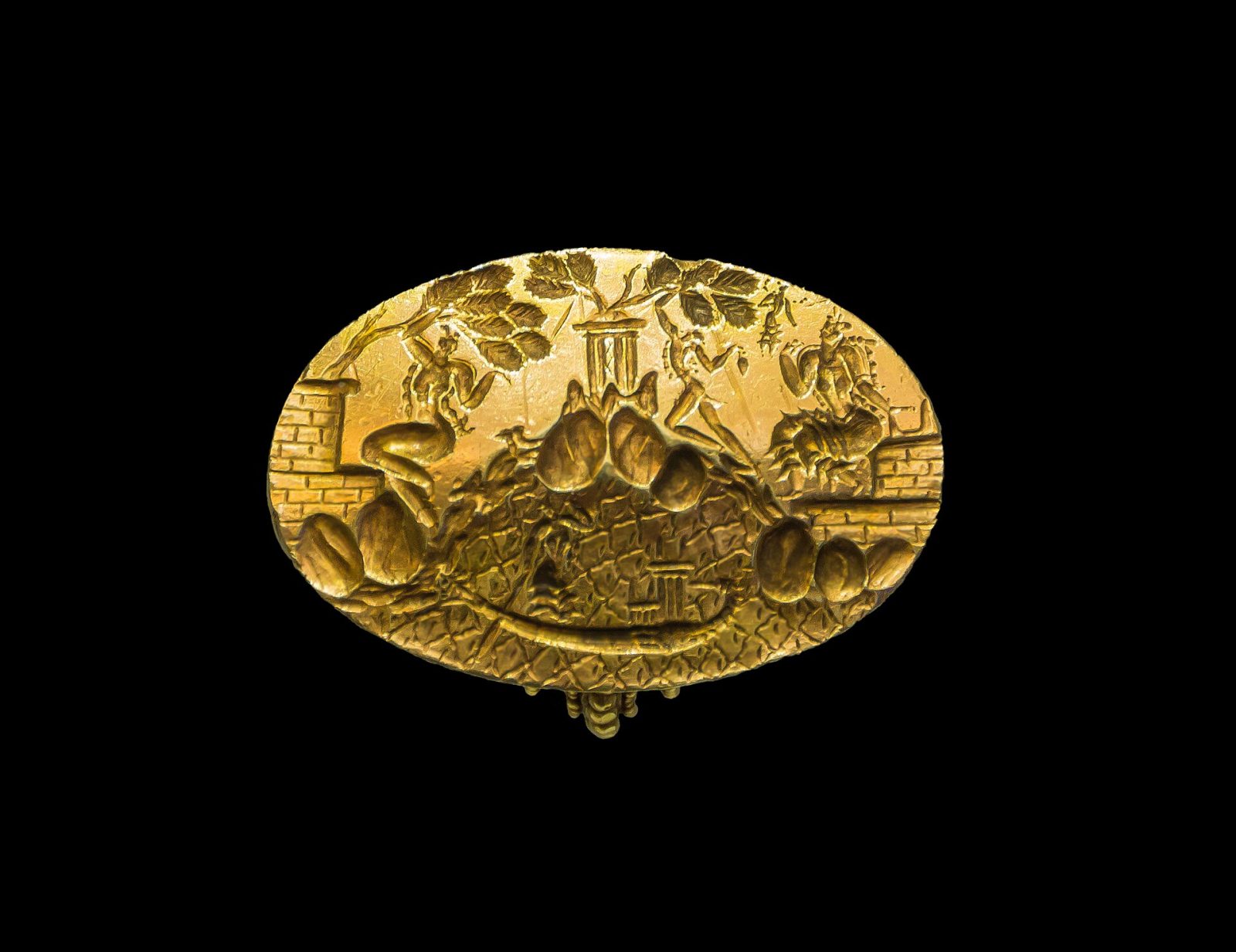
In 1928 a boy reportedly found a gold Minoan signet ring near Knossos on Crete. It passed to a village priest, was rejected by experts and copied for Arthur Evans, then vanished. In 2001 or 2002 it was found hidden in the priest's old house and declared genuine.
In 1928, according to later accounts, a young boy found a small gold ring in a field on Gypsades hill, near the Minoan palace of Knossos on Crete. Press reports name him as Michalis Papadakis. His father is said to have kept it hidden for some time and then given it to the village priest, Father Nikolaos Polakis, after cutting a mark into it with his knife. No exact findspot was ever recorded.
It is a gold signet ring with a large oval bezel carved with one of the most detailed scenes in Minoan art. A goddess descends from the sky, there are shrines and sacred trees, and a goddess sits in a boat. The archaeologist Nikolaos Platon saw in it the themes of sea power, tree worship and divine epiphany. It dates from the late Neopalatial period, around 1500 to 1400 BC. The ring is tiny: the curator Nota Dimopoulou could fit it only on her little finger, and suggested such rings may have been worn on chains.
What happened next is told differently in different sources. The priest is said to have offered it to Sir Arthur Evans, the excavator of Knossos, but they could not agree a price. In the 1930s it was shown to the Heraklion Museum, where Platon thought it genuine but Spyridon Marinatos thought it a fake, and it went back to the priest. Gold copies made from an impression of it by the artist Émile Gilliéron ended up with Evans and are now in the Ashmolean Museum in Oxford, while the original disappeared. For decades the Ring of Minos was known only from those copies.
In 2001 or 2002 it resurfaced, hidden in the old family house. Accounts differ on whether it was found by the priest's grandson under a slab in the fireplace or by a later owner in a jar in the wall during renovation. It was handed to the Greek Ministry of Culture, examined, and declared the original. Dimopoulou said it had been proved genuine.
The Ring of Minos is in the Heraklion Archaeological Museum on Crete.
Written for Global Finds from Stars and Stripes (2003), the Ashmolean Museum and Greek Reporter (2025). Photo: the Ring of Minos in the Heraklion Archaeological Museum, Jebulon, Wikimedia Commons, CC0.
Linked finds
Source: Stars and Stripes (2003)