The Mask of Agamemnon: a gold face from Mycenae, and an argument that never ends
Famous find Made about 1550 to 1500 BC · Found in 1876 See it on the timeline →
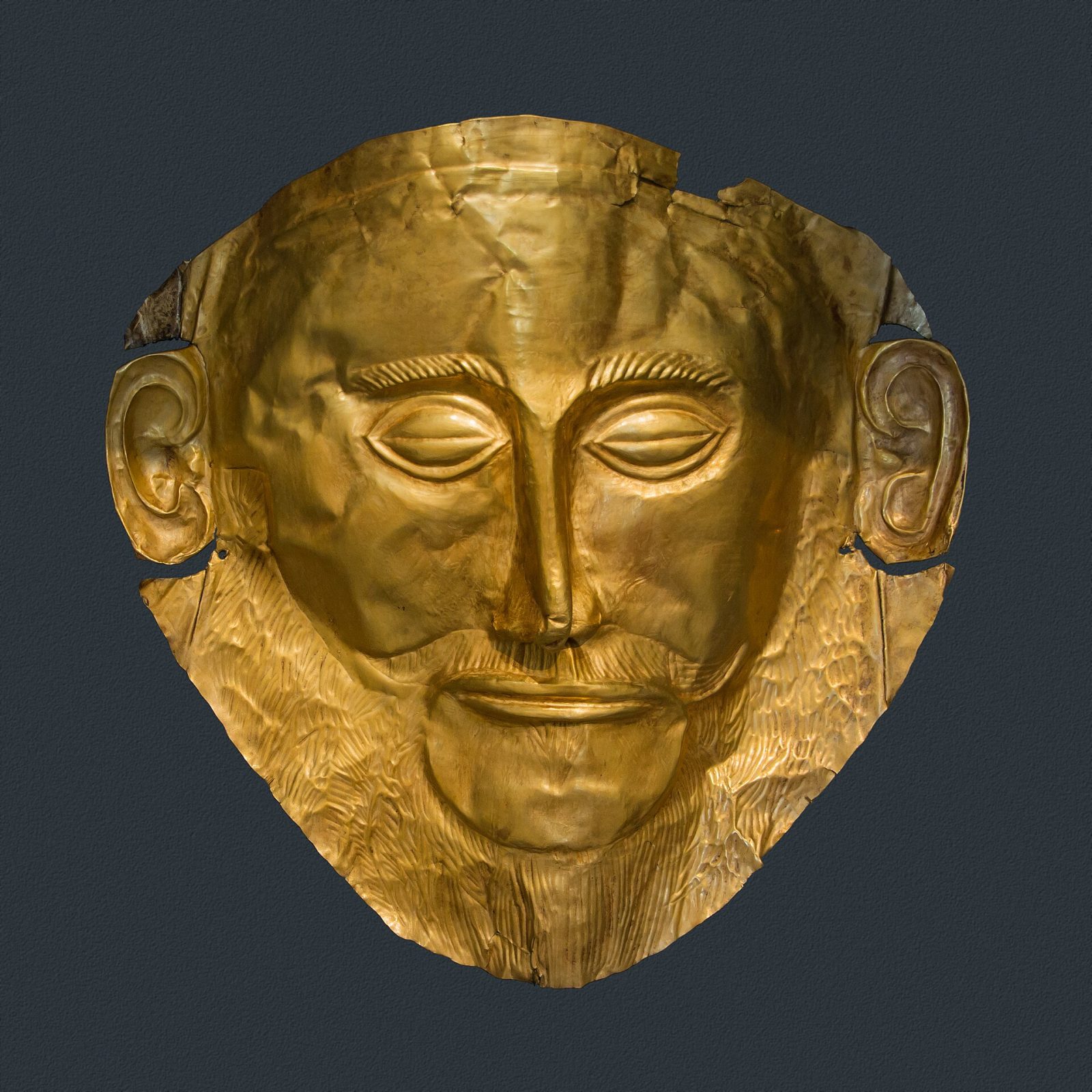
In November 1876 Heinrich Schliemann found a gold funeral mask in a royal shaft grave at Mycenae in Greece. It became one of the most famous objects of the ancient world, though it is centuries too old to be Agamemnon's, and some scholars have even questioned whether it is genuine.
In the autumn of 1876, the German businessman turned archaeologist Heinrich Schliemann was digging inside the walls of Mycenae, in the Peloponnese, the city that Homer described as the home of King Agamemnon, leader of the Greeks at Troy. Watched over by Panagiotis Stamatakis, the official sent by the Greek Archaeological Society, his workmen uncovered a circle of deep shaft graves, now known as Grave Circle A. They were full of gold: cups, jewellery, weapons, and masks of gold placed over the faces of the dead.
On 30 November 1876, in the grave now numbered Shaft Grave V, they found the most famous of them all: a mask of a bearded man with a moustache and a narrow face, hammered from a single sheet of gold, with small holes beside the ears so that it could be tied in place. It is in the National Archaeological Museum in Athens.
Schliemann is said to have sent a telegram announcing that he had gazed on the face of Agamemnon. The story is almost certainly a later invention; Schliemann himself never identified this mask as Agamemnon's, and the name was given to it by others. In any case, the grave is far too early. The museum dates the mask to about 1550 to 1500 BC, some three centuries before any Trojan War could have been fought.
The mask has also been the centre of a long argument. In 1999 the classical scholar William Calder and the historian David Traill argued that it might not be genuine. They pointed out that its style is unlike the other masks from the graves, with separate ears, a cut-out moustache and eyebrows, and they reminded readers that Schliemann had a record of embroidering the truth about his finds. Other scholars, including a former director of the Athens museum, replied that the excavation was closely supervised, and that details such as the treatment of the beard match other objects from the same graves. Some have suggested it may be a genuine mask altered after discovery. The museum has never allowed it to be tested, and most archaeologists accept it as authentic.
Whatever the truth, the Mask of Agamemnon remains the face of the Mycenaean world, and one of the most recognisable objects ever dug from the ground.
Written for Global Finds from Archaeology magazine's 1999 feature on the debate, Behind the Mask of Agamemnon, with W. M. Calder's article in the same issue, and World History Encyclopedia. Photo: the Mask of Agamemnon in the National Archaeological Museum, Athens, Jebulon, Wikimedia Commons, CC0.
Approximate location37.73, 22.76View on map
Source: Archaeology magazine