Norrie's Law: a Pictish silver hoard almost lost to the melting pot
Famous find Buried in the 6th or 7th century AD · Found in 1819 See it on the timeline →
Around 1819 a great hoard of silver came out of a cairn at Norrie's Law in Fife. Most of it was sold as scrap and melted down. What survives includes rare silver plaques engraved with Pictish symbols.
In about 1819, sand was being dug from the base of a prehistoric cairn on a natural mound at Norrie's Law, near Largo in Fife, when a large quantity of silver came to light. Accounts written twenty years later suggest there was a great deal of it, perhaps as much as 400 ounces, about 12 kilograms. Who found it is not recorded.
The silver did not stay together. It passed to a pedlar, named only as Forbes, who sold it as scrap. A jeweller in Cupar bought about £35 worth, a larger share went to an unknown buyer in Edinburgh, and most of it was melted down. The Cupar jeweller later insisted he had melted a set of silver armour, with a shield showing a horseman, a helmet and a sword hilt. Modern scholars think these were probably crushed Roman silver vessels.
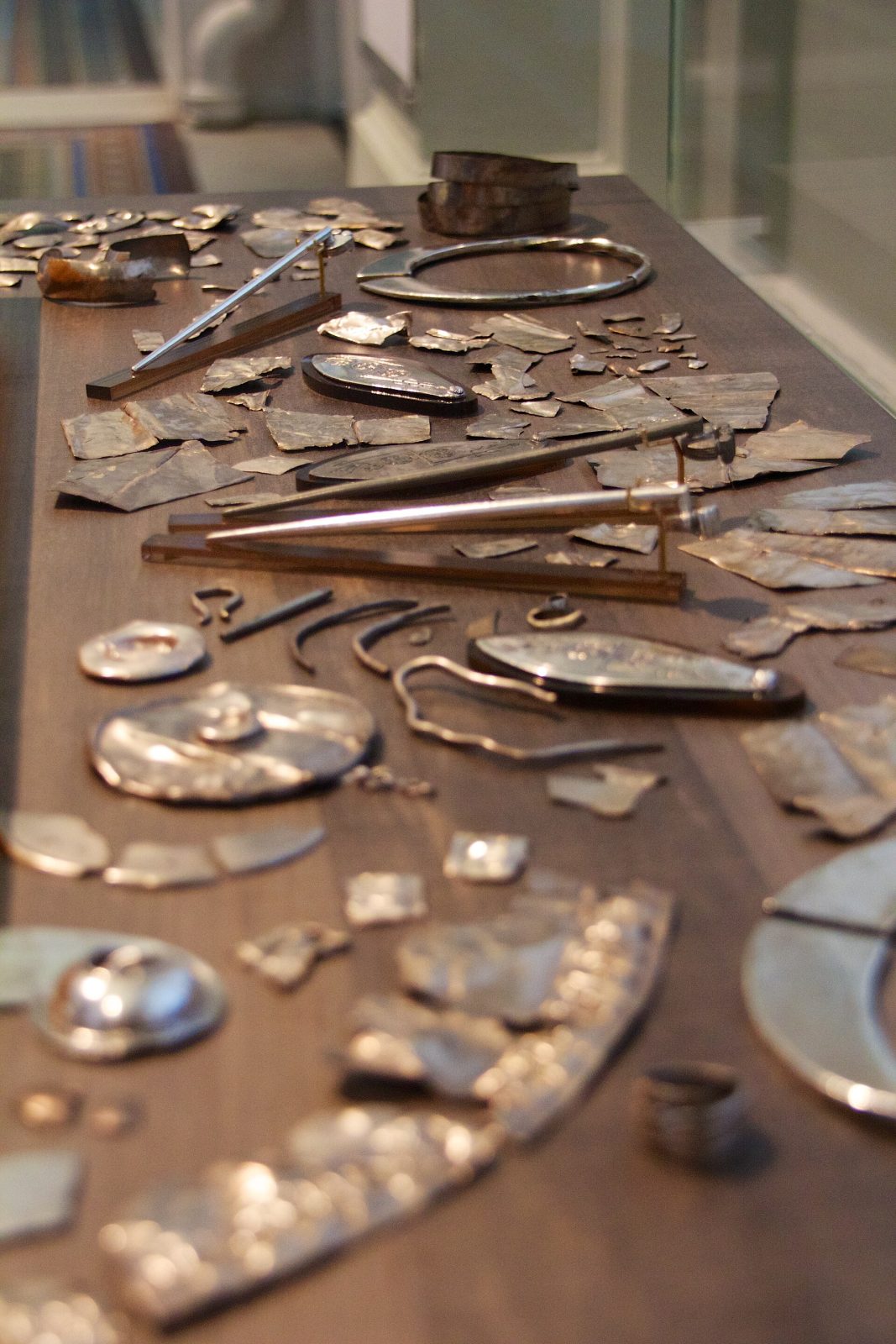
Some leftover pieces were gathered up and brought to the landowner, General Philip Durham, who kept the find quiet, and in 1839 an inquiry by George Buist rescued a few more pieces from the crucible. What survives is perhaps a seventeenth of the original hoard: two brooches, three hand-pins, a spiral finger ring, pieces of cut-up Roman silver, and two leaf-shaped plaques engraved with Pictish symbols and once enamelled red. The hoard was buried in the 6th or 7th century AD.
The Durham family gave the surviving pieces to the Society of Antiquaries of Scotland in 1864 and 1883, and they are now in the National Museum of Scotland in Edinburgh. There was a twist in the story in the 2010s: analysis showed that one plaque and one pin, long thought genuine, are Victorian copies made of modern refined silver, apparently around 1839.
Written for Global Finds from James Graham-Campbell's study in the Proceedings of the Society of Antiquaries of Scotland, research by National Museums Scotland and the University of Stirling, and other published accounts. Photo: part of the Norrie's Law Hoard in the National Museum of Scotland, Mike Peel, Wikimedia Commons, CC BY-SA 4.0.
Approximate location56.25, -2.95View on map