The Vindelev Hoard: a beginner's detector, Danish gold and the oldest mention of Odin
Famous find Made about AD 335 to 550, buried in the 6th century · Found in 2020 See it on the timeline →
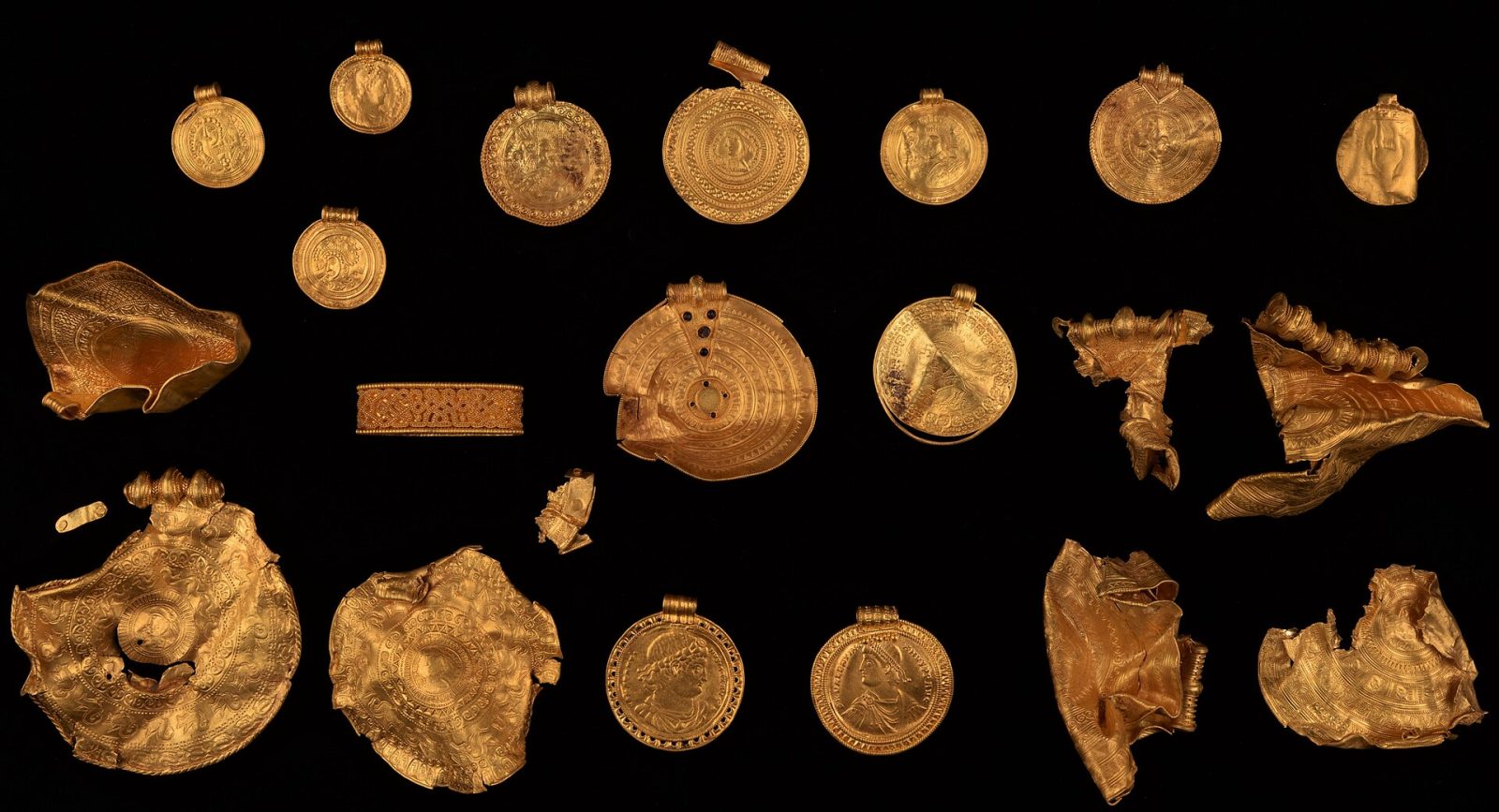
Just before Christmas 2020 a man with a newly bought metal detector found a hoard of gold in a friend's field near Jelling in Denmark: Roman medallions and the largest gold bracteate ever found. One pendant carries the oldest known written mention of the god Odin.
On 21 December 2020, Ole Ginnerup Schytz was trying out a new metal detector on a field belonging to his old school friend Jørgen Antonsen at Vindelev, about eight kilometres north-east of Jelling in Jutland. According to press reports he had been detecting for only a few hours when he found gold. He called Vejle Museums, and the archaeologist Mads Ravn later said he almost fell off his chair when he saw the photograph.
The hoard is made up of 23 pieces of gold weighing just under 800 grams. There are four Roman gold medallions, the oldest struck for the emperor Constantine the Great at Trier around AD 335, the others for later emperors including Constans, Valentinian I and Gratian. There are 13 bracteates, thin gold pendants stamped with images, including the largest bracteate ever found, 13.8 centimetres across. There is also a round gold pendant, the gold mouthpiece of a sword scabbard, and small gold rivets and patches. Several pieces had been deliberately folded or bent before they were buried, and the great bracteate had a centimetre trimmed from its entire edge.
The biggest surprise came from one of the smaller bracteates. In March 2023 the runologists Lisbeth Imer of the National Museum of Denmark and Krister Vasshus announced that its runic inscription reads, in part, "He is Odin's man", referring to a man called Jagaz, probably a king or chieftain. Made around AD 450 to 490, it is the oldest known written reference to Odin, about 150 years earlier than the previous record. Another bracteate is the first ever found to show a drinking horn.
Vejle Museums and the National Museum excavated the site and found that the gold had been buried inside a longhouse. The objects span about AD 335 to 550, and a recent study puts the burial in the 6th century. Why it was buried is debated: some have linked it to the volcanic winter of 536, which brought famine across northern Europe, but the excavators think a later crisis, or the death of the head of the household, is more likely.
The hoard was declared danefæ, treasure belonging to the Danish state. It has been shown at Vejle, at the National Museum in Copenhagen and at the museum in Jelling.
Written for Global Finds from M. Ravn and others' study of the hoard in the journal Kuml (2024), Live Science and The Past. Photo: the Vindelev hoard, Vejle Museums and Konserveringscenter Vejle, Wikimedia Commons, CC BY-SA 4.0.
Approximate location55.79, 9.49View on map
Source: Kuml