Bush Barrow: the gold of a Bronze Age chief buried within sight of Stonehenge
Famous find Buried about 1950 BC · Found in 1808 See it on the timeline →
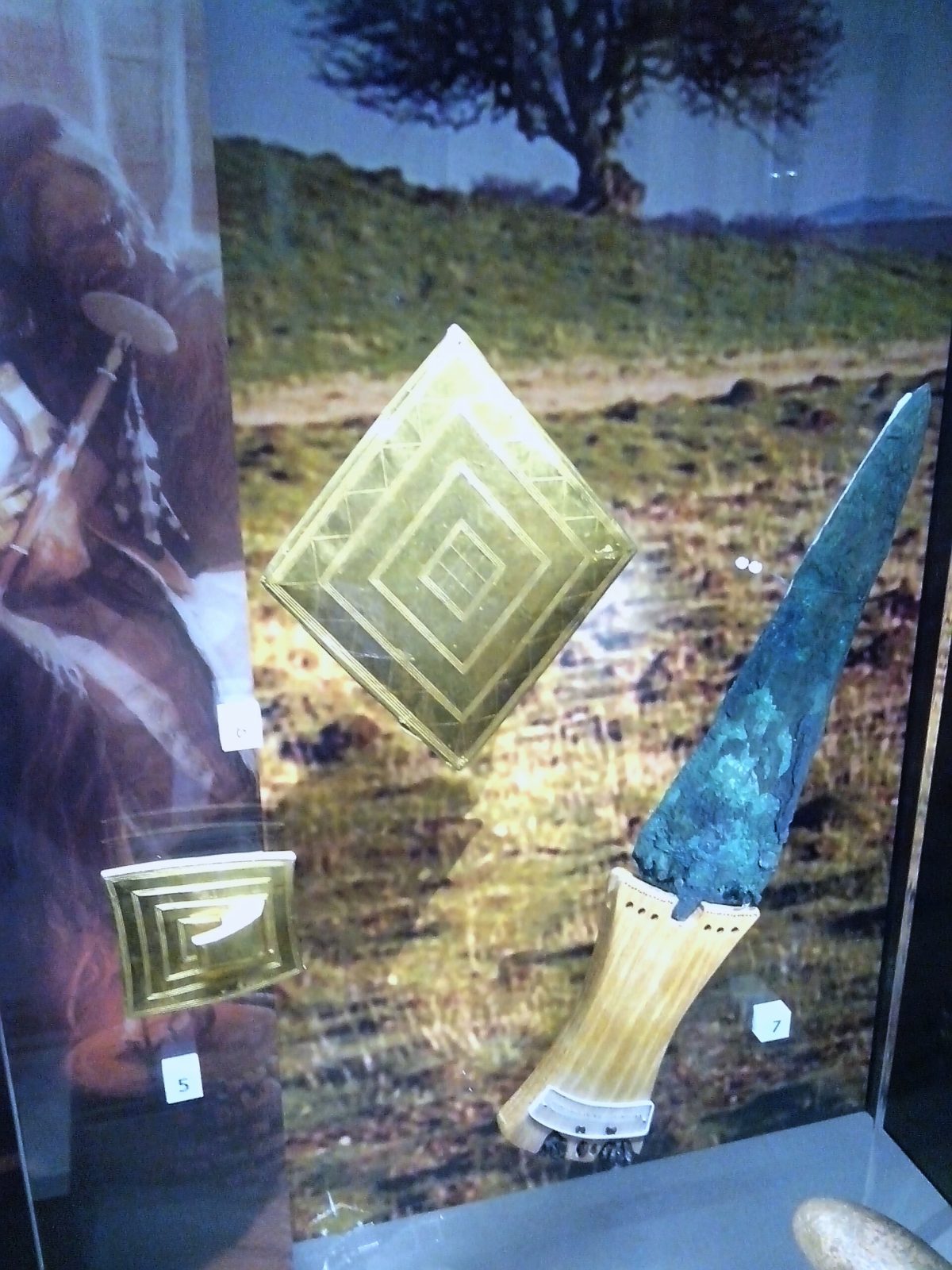
In 1808 an antiquarian digging a burial mound near Stonehenge found a man buried with a gold lozenge, three daggers and a stone mace. One dagger handle had been decorated with around 140,000 tiny gold studs, each thinner than a hair.
In July 1808, the antiquarian William Cunnington began digging into a large burial mound on Normanton Down, about a kilometre south-west of Stonehenge in Wiltshire, for his patron, Sir Richard Colt Hoare. His first attempt found nothing. He went back that September and this time reached the burial: the body of a man, with some of the richest grave goods ever found in Bronze Age Britain.
On the man's chest lay a large lozenge of sheet gold, about 18 centimetres long, finely engraved with lines and zigzags. A smaller gold lozenge and a gold belt hook were also found. Beside him were three daggers, one of copper and two of bronze, the largest of their kind; a bronze axe; and a stone macehead, made from a fossil stone from Devon or Cornwall and fitted with zig-zag mounts of bone. Bronze rivets may come from a shield or helmet that has rotted away. The man was buried around 1950 BC, in the Early Bronze Age, when Stonehenge was already ancient and still in use.
The most astonishing detail is on one of the daggers. Its wooden handle had been decorated with a zigzag pattern made of tiny gold studs, each about a millimetre long and thinner than a human hair. When the conservator Mike Corfield studied surviving fragments under the microscope, he worked out that there were more than a thousand studs in every square centimetre, around 140,000 on the handle. In 2014 researchers suggested that work this fine may have been done by children or young people, whose eyes can focus on tiny objects at very close range. Some of the studs had their own adventure: lent to an archaeologist in the 1960s, they were forgotten in a film canister in a university desk until they were rediscovered decades later and returned.
A study of the excavation records published in 2010 showed that the man had been buried crouched, not lying flat as had long been believed.
The Bush Barrow finds are in the Wiltshire Museum in Devizes. Replicas can be seen at the Stonehenge visitor centre.
Written for Global Finds from S. Needham, A. Lawson and A. Woodward's study in the Antiquaries Journal (2010), I. Kinnes and others in Antiquity (1988), Archaeology magazine (2014) and Leslie Grinsell's Stonehenge Barrow Groups (1979). Photo: the large gold lozenge, belt hook and a dagger from Bush Barrow in the Wiltshire Museum, Pasicles, Wikimedia Commons, CC0.
Approximate location51.17, -1.83View on map
Source: Antiquaries Journal