The Colmar Treasure: a Jewish family's jewels hidden in a wall before the Black Death
Famous find Hidden by 1349 · Found in 1863 See it on the timeline →
In 1863 builders renovating a shop in the old Jewish street of Colmar, in Alsace, broke through a wall and found a pot of medieval coins and jewellery. Hidden as the Black Death swept Europe in 1348–49, it includes one of the finest Jewish wedding rings known.
In May 1863, builders renovating a confectioner's shop in Colmar, in Alsace, in what had once been the town's Jewish street, broke through a mortared wall and found a pottery jar packed with treasure. It had been hidden there for more than five hundred years.
The jar held 384 coins and a collection of medieval jewellery: 14 finger rings set with sapphires, rubies, garnets and turquoise, a richly jewelled brooch, women's dress fastenings, an enamelled belt, gilded buttons, and a tiny silver key. The coins run from about 1180 to the 1340s; among them is a single gold florin of King Louis I of Hungary, perhaps set aside to pay the special tax that the Jews of the empire were made to pay from 1342.
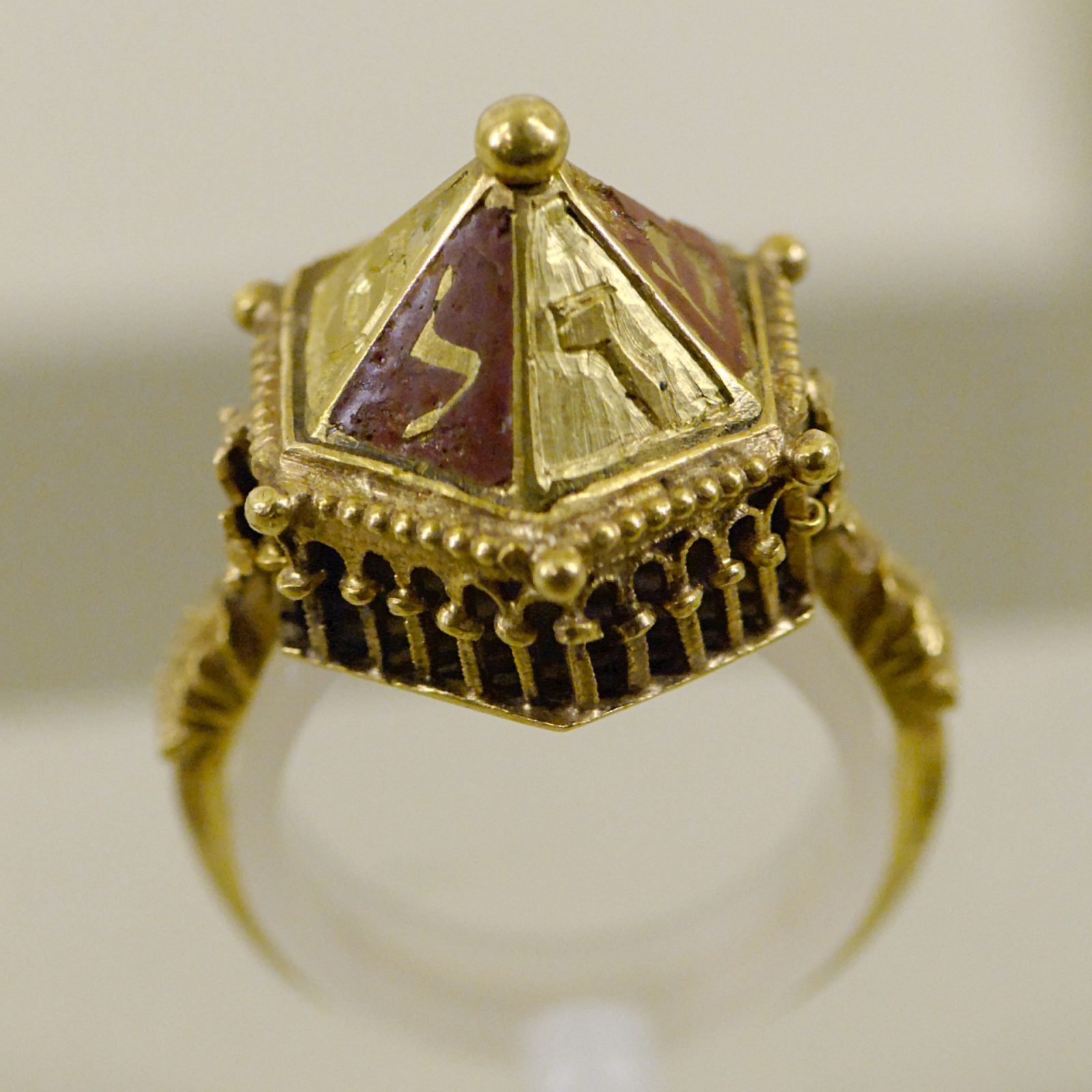
The most famous piece is a Jewish wedding ring of gold and enamel, crowned with a tiny model of a building with an open arcade of columns, a symbol of the Temple in Jerusalem or of the couple's new home, and inscribed in Hebrew with the words mazel tov, good luck. Rings like this were used in the wedding ceremony and kept by the family.
The date of the hoard tells its story. In 1348 and 1349 the Black Death swept across Europe, and in many towns Jews were falsely accused of causing it by poisoning wells. In Colmar, as in Strasbourg and many other towns along the Rhine, the Jewish community was massacred early in 1349. The family who hid their savings and jewellery in the wall never came back for them.
After the discovery, the shop owner sold a few pieces and his family kept the rest. In 1923 his heirs placed the treasure in the Musée de Cluny, the national museum of the Middle Ages in Paris, where it remains; a few pieces are in the Musée Unterlinden in Colmar. Only in the 1940s, from the Hebrew inscriptions, was it recognised as the treasure of a Jewish family. In 2019 it travelled to New York for an exhibition at the Metropolitan Museum's Cloisters.
Written for Global Finds from The Art Newspaper (2019), the Jewish Telegraphic Agency (2019) and Medievalists.net. Photo: the Jewish wedding ring from the Colmar Treasure in the Musée de Cluny, Paris, Marie-Lan Nguyen, Wikimedia Commons, CC BY 2.5.
Approximate location48.08, 7.36View on map
Source: The Art Newspaper