The Agris Helmet: a Celtic helmet of gold and coral dug out of a cave by a badger
Famous find Made about 350 BC · Found in 1981 See it on the timeline →
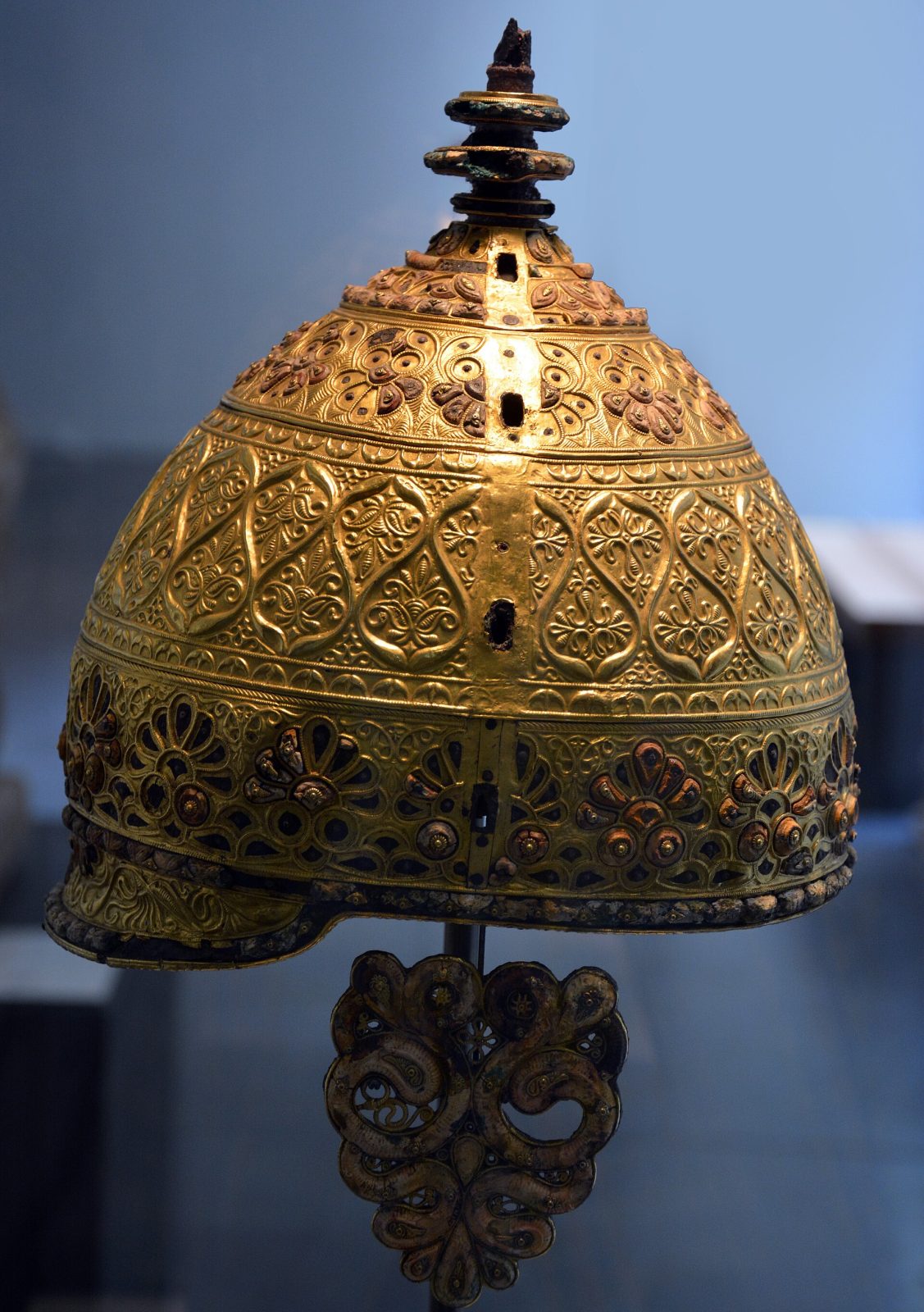
In May 1981 cavers exploring a newly found cave at Agris in western France spotted pieces of gold-covered metal on the spoil of a badger's burrow. They were part of a Celtic parade helmet of about 350 BC, covered in pure gold leaf and studded with coral.
In May 1981, a group of local cavers was exploring the Grotte des Perrats, a cave near the village of Agris in the Charente, western France, that had been discovered only a week or so earlier. On a heap of earth thrown out by a badger digging its burrow, they noticed two pieces of metal shining with gold. They had found the front of a Celtic helmet.
Archaeologists led by José Gomez de Soto of the French national research centre, the CNRS, carried out a rescue excavation that year and then excavated the cave for more than a decade, from 1982 to 1994. More pieces came to light over several years: a cheek guard and ornamental fragments in 1983, and the base of the crest, several metres away, in 1986. The second cheek guard has never been found. The pieces were restored at the Römisch-Germanisches Zentralmuseum in Mainz, Germany.
The helmet has an iron cap, entirely covered in bands of bronze, which are themselves covered in gold leaf. The gold is remarkably pure, about 99 per cent. The bronze is decorated with flowing plant patterns typical of early Celtic art, and studded with pieces of red coral fixed with silver rivets. The helmet is about 21 centimetres high. It was made around 350 BC, and is one of the finest pieces of Celtic metalwork ever found.
So fine a helmet was surely never meant for battle. It was a parade or ceremonial piece, and the cave seems to have been a sacred place, where the helmet may have been left as an offering.
The original Agris Helmet is displayed at the Musée d'Angoulême, the main museum of the Charente, where it was found.
Written for Global Finds from the Musée d'Angoulême, C. Éluère, J. Gomez de Soto and A. Duval in the Bulletin de la Société préhistorique française (1987) and J. Gomez de Soto and S. Verger (2010). Photo: the Agris Helmet in the Musée d'Angoulême, Lamiot, Wikimedia Commons, CC BY-SA 4.0.
Approximate location45.80, 0.37View on map
Source: Musée d'Angoulême