The Lismore Crozier: a bishop's staff hidden in a castle wall with a lost Irish book
Famous find Made about AD 1100, before 1113 · Found in 1814 See it on the timeline →
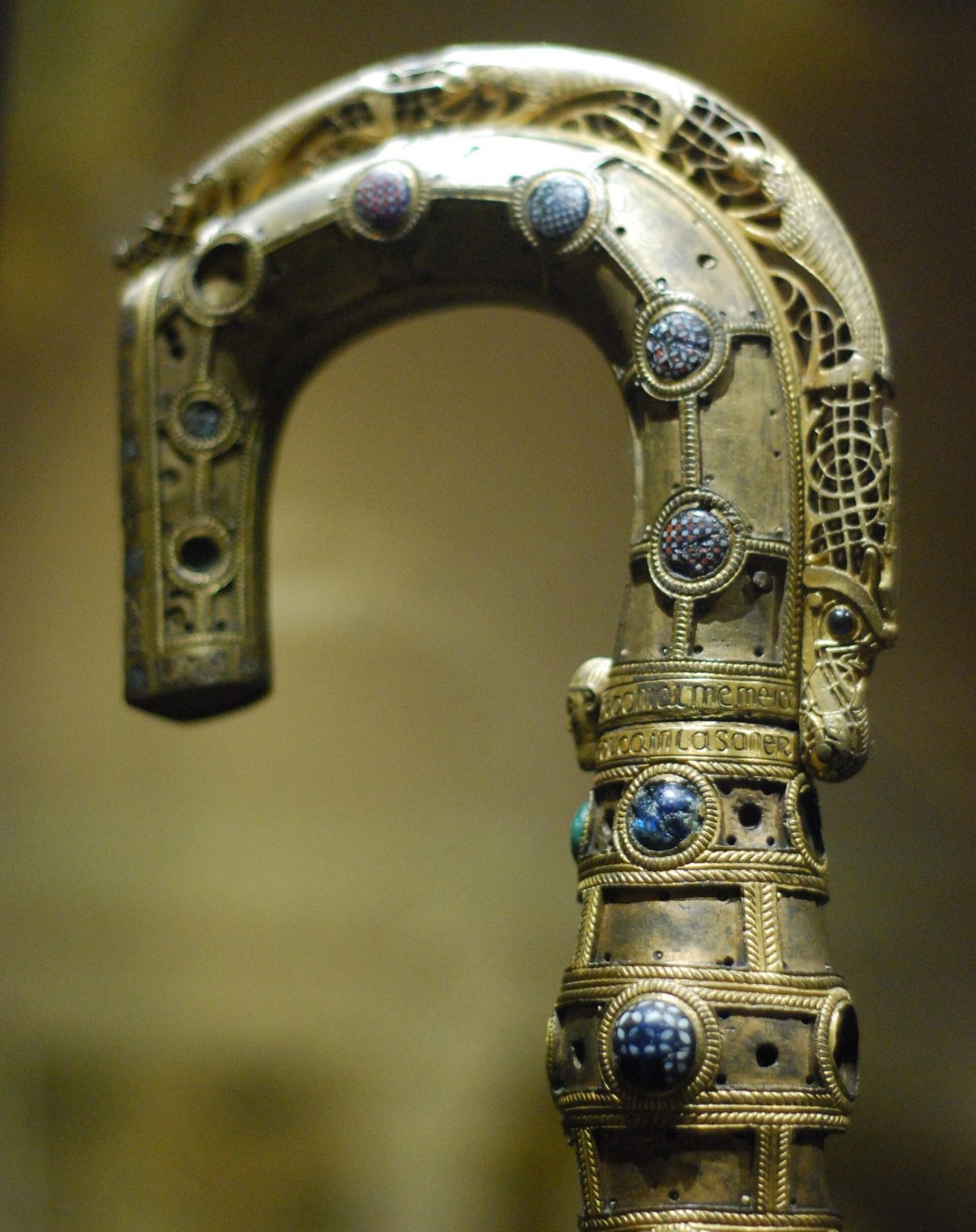
In 1814 workmen rebuilding Lismore Castle in County Waterford opened a blocked doorway and found a wooden box. Inside were a medieval Irish manuscript, the Book of Lismore, and a magnificent bishop's crozier made around 1100 and signed by its maker.
In 1814, workmen were rebuilding Lismore Castle in County Waterford, in the south of Ireland, for the Duke of Devonshire. While reopening a doorway that had been filled with masonry, they found a wooden box hidden inside the wall. In it were two treasures: a great medieval Irish manuscript, now known as the Book of Lismore, and what the 19th-century scholar Eugene O'Curry described as a superb old crozier, a bishop's staff of office.
The Lismore Crozier is about 116 centimetres tall. An oak staff, encased in bronze and divided by three decorative knobs, carries a hollow crook of cast copper alloy. It is decorated with silver, niello and glass: blue glass studs set with tiny pieces of red, white and blue millefiori glass, and a crest of three open-jawed animals running over the top of the crook, ending in an animal head with blue glass eyes. Panels of gold filigree that once decorated it have been lost.
What makes the crozier unique is that it is signed. An inscription in Irish on the upper knob asks for prayers for Niall mac Meic Áeducáin, for whom the work was made, and for Nechtan, the craftsman who made it. Niall was bishop of Lismore and died in 1113, so the crozier was made around 1100. It is the only Irish crozier of its kind to carry an inscription naming both its owner and its maker. According to later accounts, small relic containers were found hidden inside it when it was refurbished in the 1960s.
Lismore was one of the great monastic centres of early medieval Ireland, and the crozier would have been carried by its bishops as a symbol of their authority and of the saint who founded the monastery. Why it was hidden in the castle wall, and when, is not known; it may have been concealed to protect it during one of the many upheavals in the castle's history.
The crozier is on display in the National Museum of Ireland, Archaeology, on Kildare Street in Dublin. The Book of Lismore stayed with the Dukes of Devonshire at Chatsworth until 2020, when it was given to University College Cork.
Written for Global Finds from the National Museum of Ireland, Eugene O'Curry's account of the discovery (published by CELT, University College Cork) and other published sources. Photo: the Lismore Crozier in the National Museum of Ireland, jemartin03, Wikimedia Commons, CC BY 2.0.
Approximate location52.14, -7.93View on map
Source: National Museum of Ireland