The Strettweg Cult Wagon: a bronze procession from an Iron Age chieftain's grave
Famous find Buried about 600 BC · Found in 1851 See it on the timeline →
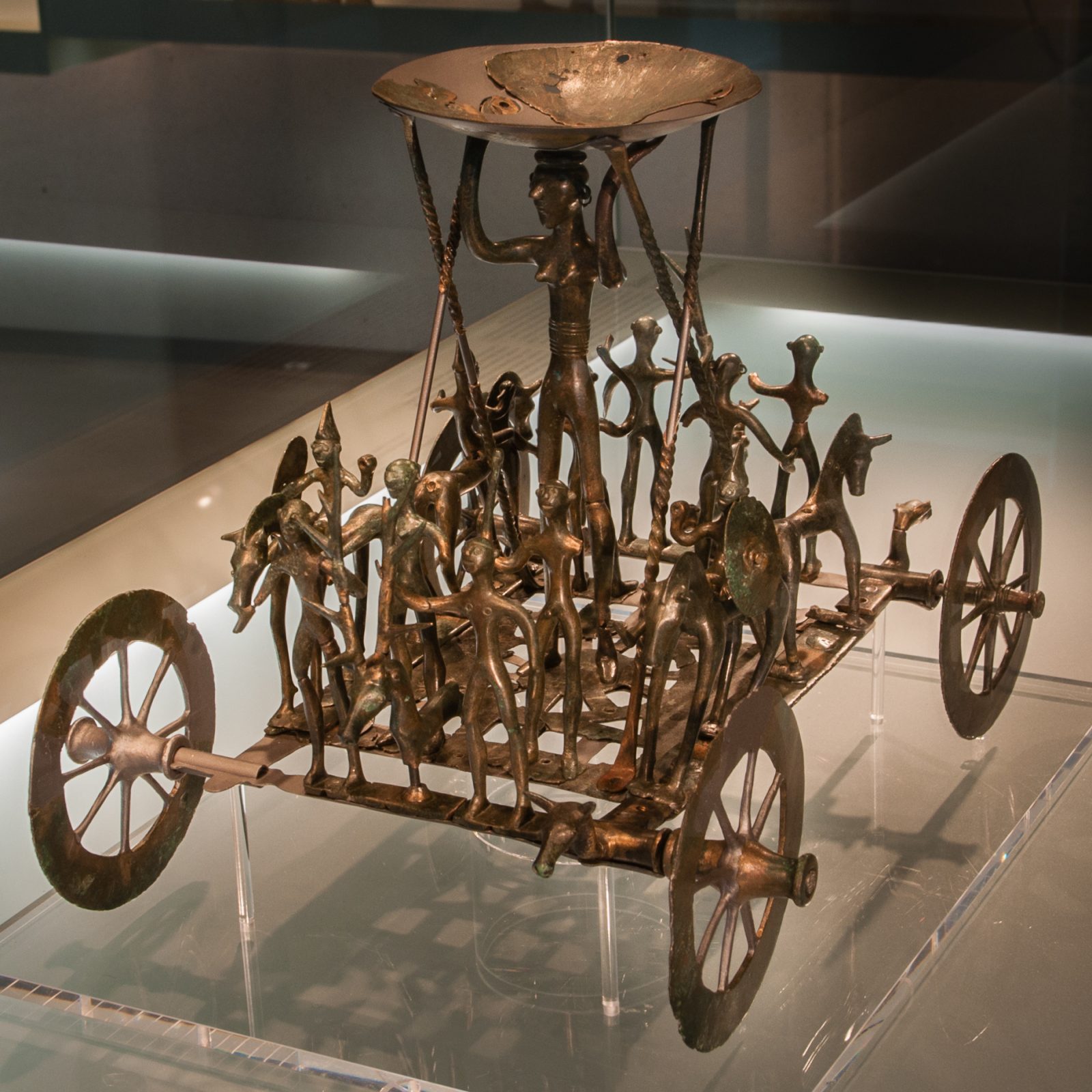
In 1851 a farmer working his field near Judenburg in Austria hit the stone chamber of an Iron Age burial mound. Inside was a small bronze wagon carrying a goddess or priestess, warriors and a stag, one of the masterpieces of early European art.
In 1851, the farmer Ferdinand Pfeffer was working his field north of the village of Strettweg, near Judenburg in Styria, in central Austria, when he struck a mass of stones. They were the walls of a burial chamber inside an ancient mound. Among the bronze and iron objects he found were the pieces of a remarkable small bronze wagon.
The find was not handled well at first. Passers-by took pieces away, and Pfeffer stored the rest in his attic until a local priest noticed what he had. Further digging took place in 1852 and in later years, and the finds reached the Joanneum museum in Graz in 1853.
The wagon is a flat bronze platform on four spoked wheels, which really turn, about 42 centimetres long and 33 centimetres high. In the centre stands a tall, naked female figure, wearing only a belt, earrings and a headdress, who holds a shallow bowl above her head. Almost certainly a bronze cauldron once rested in it. Around her are smaller figures: mounted warriors with spears and shields, men with axes, women, and at each end two figures leading a stag by its antlers. It is usually read as a sacrificial procession, with the central figure a goddess or a priestess.
The grave was that of a chieftain of the Hallstatt culture, the Early Iron Age culture of central Europe, and the museum dates it to the end of the 7th century BC, around 600 BC. With the wagon were weapons, jewellery, bronze vessels including a cauldron and an amphora, iron roasting spits and horse harness. When archaeologists re-excavated the site in 2012 and examined the grave goods, they suggested that more than one person had been buried there, including women with very rich jewellery and hundreds of amber beads, and that the main burial may have been that of a priestess.
The wagon has been restored many times; around 1900 its ancient rivets were even replaced with screws. A major restoration was completed in 2009. It is the most treasured object in the Archaeology Museum at Schloss Eggenberg in Graz, part of the Universalmuseum Joanneum. A replica is on show at Museum Murtal in Judenburg.
Written for Global Finds from the Universalmuseum Joanneum's pages on the cult wagon and Spektrum der Wissenschaft. Photo: the Strettweg cult wagon in the Archaeology Museum, Schloss Eggenberg, Graz, Thilo Parg, Wikimedia Commons, CC BY-SA 3.0.
Approximate location47.18, 14.66View on map
Source: Universalmuseum Joanneum