The Moylough Belt Shrine: a saint's belt in a bronze case, dug from a Sligo bog
Famous find 8th century AD · Found in 1945 See it on the timeline →
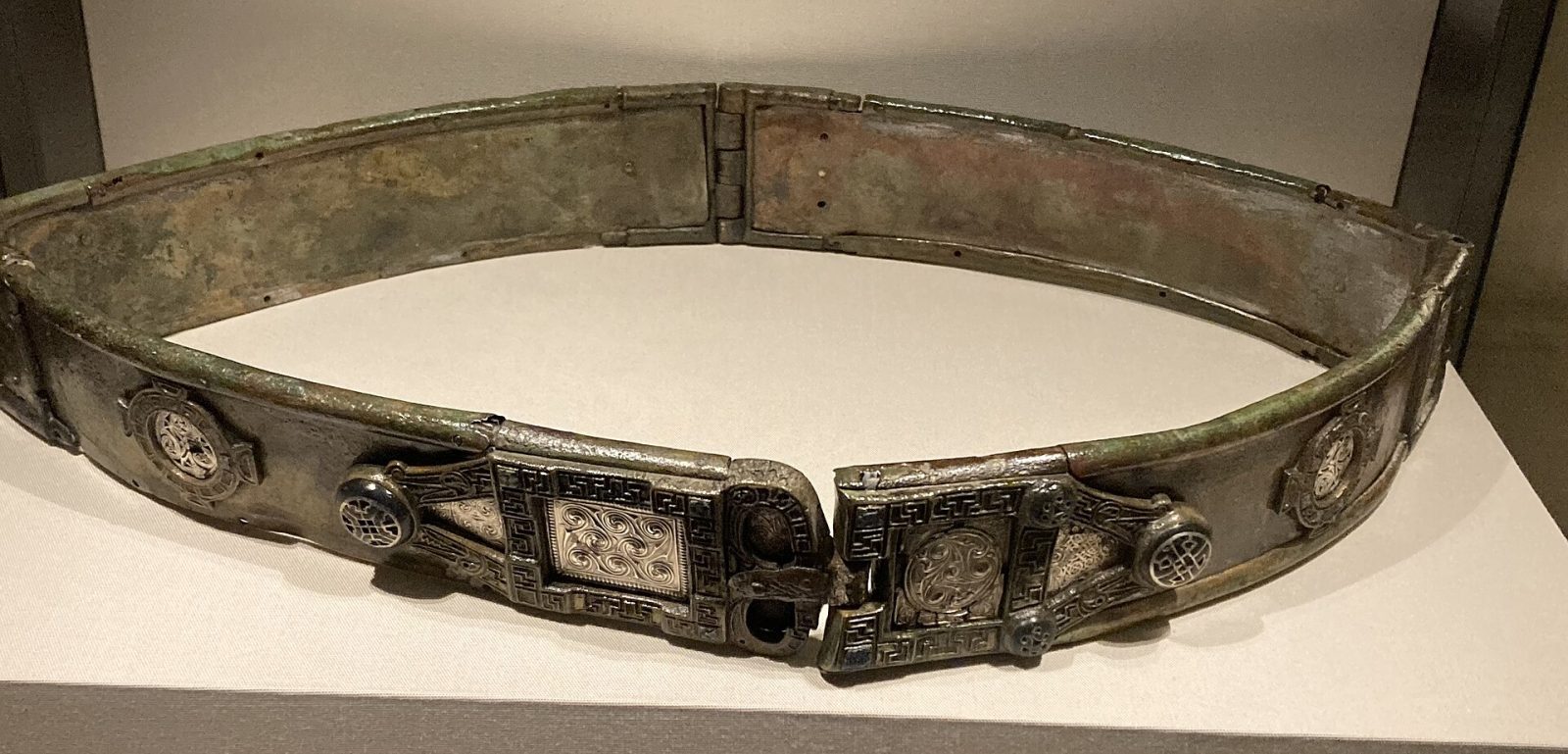
In the spring of 1945 a young man cutting turf on his father's land in County Sligo struck what he thought was a stone. It was an early medieval reliquary made to hold a saint's leather belt, the only one of its kind ever found in Ireland.
In April or May 1945, John Towey, a 21-year-old cutting turf on his father's land at Moylough, on the edge of Tubbercurry in County Sligo, struck something hard about a metre down in the bog. He took it for a stone. It was a belt, made of hinged metal segments, standing upright in the peat and slightly open, its hinges still moving. He took it home and kept it for about a month, until his postman, John Nicholson, told him to contact the National Museum of Ireland. Towey wrote to the museum describing a belt that seemed to be made of iron. The museum's keeper, Joseph Raftery, later called it one of the finest acquisitions the museum had made in fifty years.
The Moylough Belt Shrine is a reliquary, a container made to hold a holy relic. Inside are strips of plain leather, believed to be the girdle of an Irish saint. Around them is a case of four hinged copper-alloy segments, each made from two sheets riveted together, so that the shrine still takes the shape of a belt about 90 centimetres long and 5 centimetres wide, complete with a false buckle and counter-plate decorated with the heads of birds and animals. It is richly decorated with die-stamped silver panels, red and yellow enamel, blue and white glass and large glass studs, and there is even a small window of mica, perhaps so that the relic inside could be seen.
It was made around AD 700, in the 8th century, the great age of Irish metalwork that also produced the Ardagh Chalice, whose glass studs are closely matched on the belt. It had been worn and repaired before it went into the bog. Belts of saints were treasured in early Ireland; they were placed around the sick in the hope of a cure, and oaths were sworn on them.
After it reached Dublin, the shrine was sent to the British Museum for conservation in 1945 and returned to the National Museum in 1947. It is the only belt shrine known from Ireland. It is on display in the Treasury of the National Museum of Ireland, Archaeology, on Kildare Street in Dublin. A plaque marks the place where it was found.
Written for Global Finds from M. J. O'Kelly's study of the shrine in the Journal of the Royal Society of Antiquaries of Ireland (1965), as summarised in published accounts, and the National Museum of Ireland. Photo: the Moylough Belt Shrine in the National Museum of Ireland, Ceoil, Wikimedia Commons, CC BY-SA 4.0.
Approximate location54.03, -8.70View on map
Source: Wikipedia (Moylough Belt-Shrine)