The Tully Lough Cross: an early Irish cross raised by divers and offered to the Getty
Famous find 8th or 9th century AD · Found in 1986 See it on the timeline →
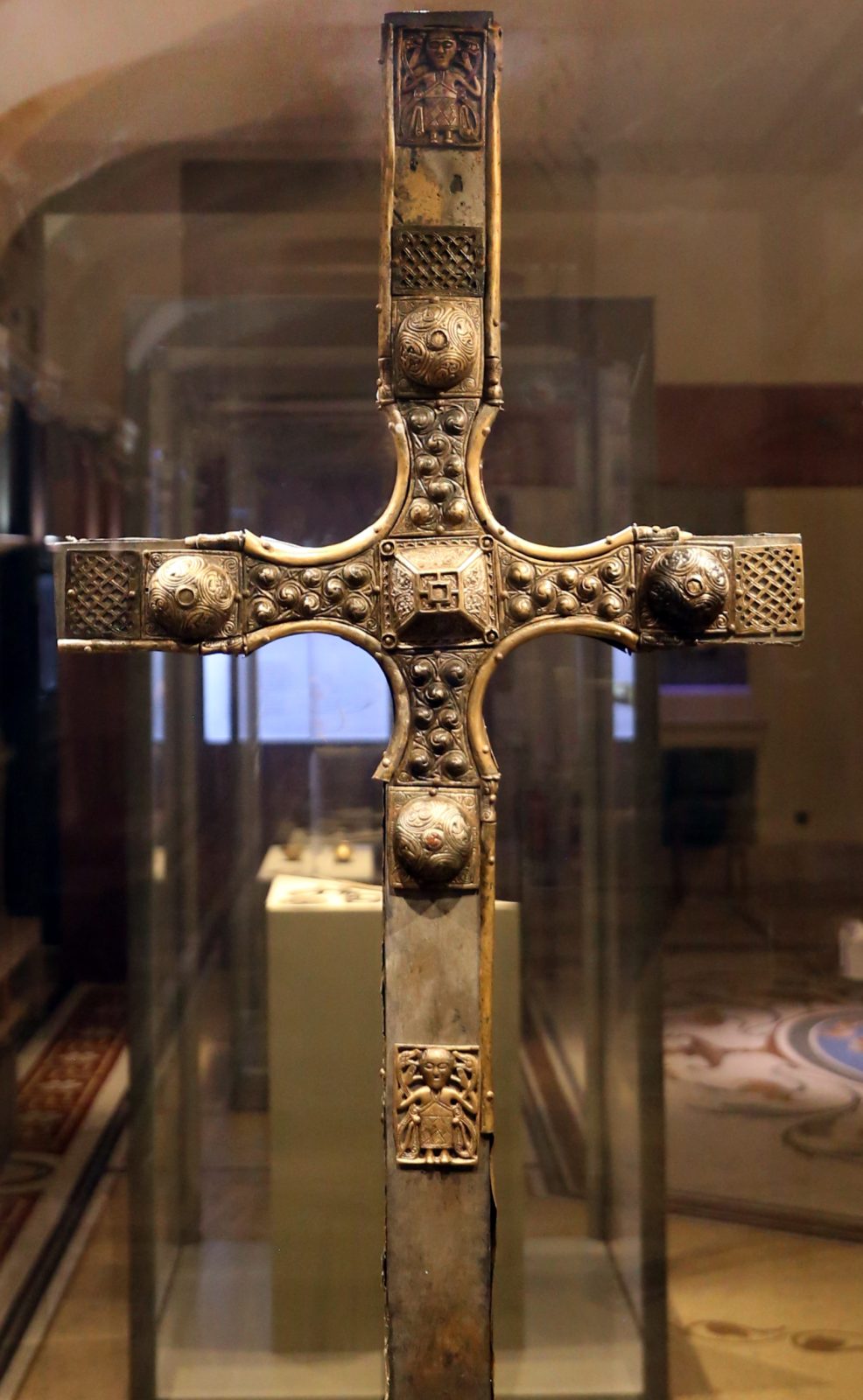
In 1986 divers found the pieces of an 8th or 9th-century bronze-covered processional cross on the bed of Tully Lough in County Roscommon. Instead of reporting it, they tried to sell it, and a few months later it was offered to the Getty Museum for 1.75 million dollars.
In July 1986, divers exploring Tully Lough, a small lake in County Roscommon in the west of Ireland, found the broken pieces of a large decorated cross lying on the lake bed beside a crannóg, a man-made island dwelling. They did not report it. In February 1987, the J. Paul Getty Museum in California contacted the National Museum of Ireland: a woman in Massachusetts was offering it an early Irish cross for 1.75 million dollars. The museum's Michael Ryan replied that the cross had been illicitly excavated.
The National Museum went to court and recovered the cross, and acquired it formally in 1990. One of the finders was eventually fined in 1991, by most accounts just ten pounds, a penalty so small that it became an argument for tougher heritage laws in Ireland.
The Tully Lough Cross is a standing processional cross, carried in church ceremonies. It has a core of oak, about 1.27 metres tall, covered with sheets of tinned bronze, of which about twenty decorated panels survive. They are decorated with spirals and interlace in the Irish style, and set with gilt bosses and studs of glass and amber. Two openwork panels show a man standing between two beasts, perhaps Daniel among the lions. The cross was made in the 8th or 9th century AD and is one of very few early Irish crosses of its kind to survive; it is a cousin of the later Cross of Cong. It had been damaged before it went into the water, and archaeologists think it may have been hidden in the lake, perhaps from the nearby church at Kilmore, around the 12th century. Some plain pieces were lost by the finders.
After an underwater investigation of the findspot in 1998, the cross was conserved and reconstructed. It is on display in the Treasury of the National Museum of Ireland, Archaeology, on Kildare Street in Dublin.
Written for Global Finds from the Irish Examiner (2002), RTÉ's report on the 1987 State Papers, and E. P. Kelly's account in the Irish Arts Review (2003). Photo: the Tully Lough Cross in the National Museum of Ireland, Sailko, Wikimedia Commons, CC BY 3.0.
Approximate location53.88, -8.02View on map
Source: Irish Examiner