The Egtved Girl: a Bronze Age burial in an oak coffin, dated to a summer in 1370 BC
Famous find Buried in the summer of 1370 BC · Found in 1921 See it on the timeline →
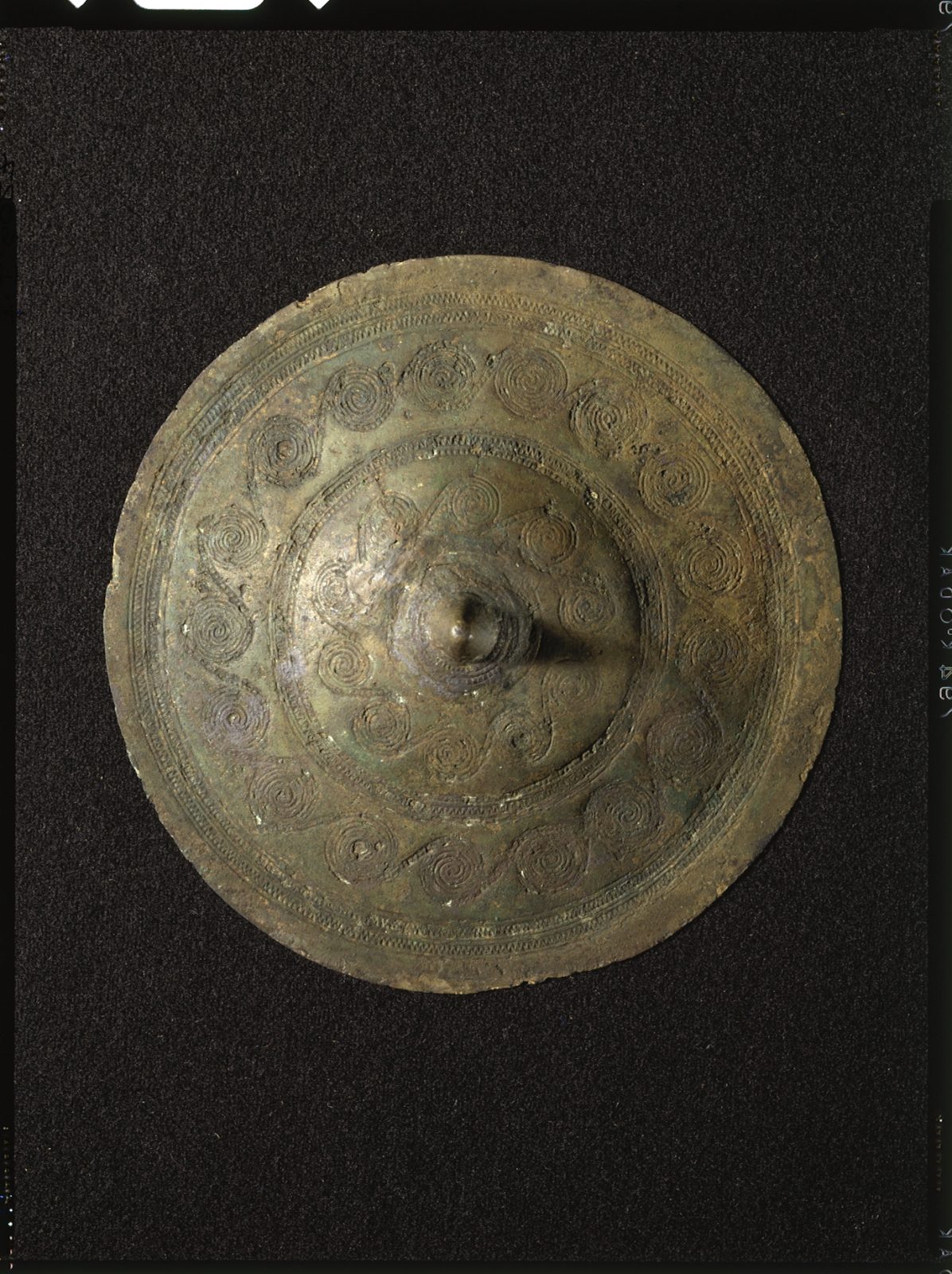
In February 1921 a Danish farmer clearing a burial mound at Egtved hit a carved oak coffin. Inside lay a young woman of the Bronze Age in her clothes, with a bronze belt disc and a pail of fermented drink. Tree rings show she was buried in the summer of 1370 BC.
On 24 February 1921, Peter Platz, a farmer at Egtved, west of Vejle in Jutland, Denmark, was clearing away the last of a large burial mound on his land when he struck a coffin made from a hollowed-out oak trunk. The National Museum of Denmark took the whole coffin to Copenhagen and opened it there.
Inside, on a cowhide, lay a girl aged about 16 to 18, covered with a woollen blanket. Her skeleton had almost completely dissolved in the acidic, waterlogged conditions, but her hair, nails, teeth and traces of skin survived, and so did her clothes: a short-sleeved woollen blouse and a skirt made of wool cords, worn low on the hips. At her waist was a large bronze belt plate decorated with spirals. She wore two bronze arm rings and a small earring, and had a horn comb. A little box of bark held a bronze awl and a hairnet. By her feet stood a birch-bark pail that had held a drink fermented from wheat, honey and berries, and beside her were the cremated bones of a child of about five or six. A yarrow flower had been placed on the edge of the coffin.
The tree rings of the oak coffin show that it was cut in the summer of 1370 BC, during the Nordic Bronze Age, so the girl was buried at the height of summer, when yarrow is in flower.
Where she came from has become a long-running scientific argument. In 2015 researchers analysed strontium isotopes in her teeth, hair and nails and concluded that she had grown up far away, perhaps in the Black Forest in southern Germany, and travelled back and forth over long distances. In 2019 other scientists showed that the local comparison samples had been contaminated by modern farm lime, and argued that her values fitted Denmark after all. The original team has defended its conclusions, and the question remains open.
The Egtved Girl's grave and clothing are displayed at the National Museum of Denmark in Copenhagen. At Egtved, a small museum beside the rebuilt mound tells her story.
Written for Global Finds from the National Museum of Denmark, Lex.dk, K. M. Frei and others in Scientific Reports (2015) and E. Thomsen and R. Andreasen in Science Advances (2019). Photo: the bronze belt plate of the Egtved Girl, Lennart Larsen, Danmarks Oldtid, National Museum of Denmark, Wikimedia Commons, CC BY-SA 2.5.
Approximate location55.63, 9.28View on map
Source: National Museum of Denmark