The Golden Hat of Schifferstadt: a Bronze Age gold cone found standing upright in a field
Famous find 14th century BC · Found in 1835 See it on the timeline →
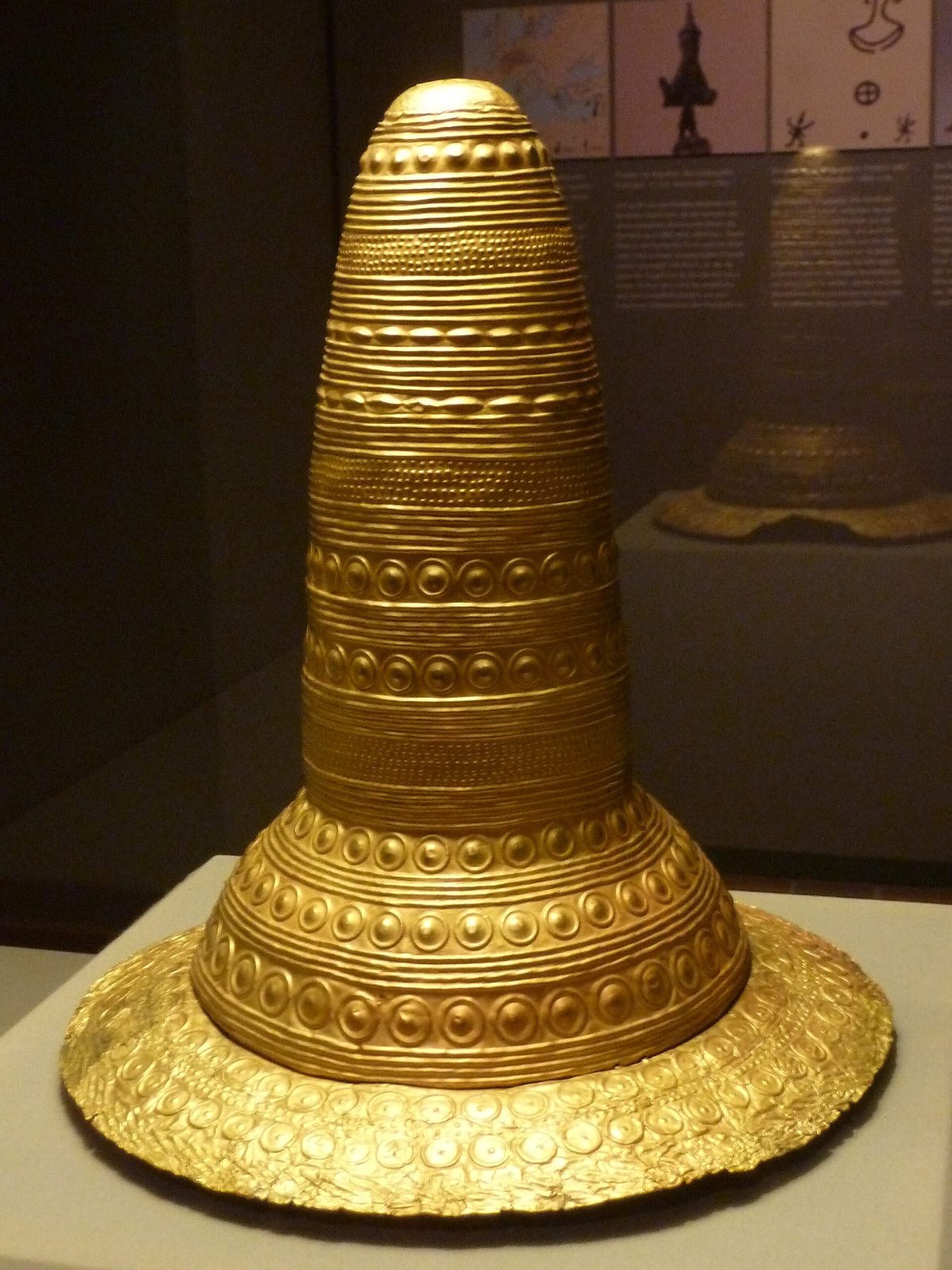
On 29 April 1835 a labourer working a field outside Schifferstadt in south-west Germany struck a tall cone of thin gold, buried upright with three bronze axes leaning against it. It was the first of the Bronze Age golden hats ever found.
On 29 April 1835, the day labourer Jakob Geimer was working in a field called the Reuschlache, about a kilometre north of Schifferstadt in the Palatinate, on land belonging to the farmer and glazier Joseph Eckrich. Just below the surface he struck something metal. When it was lifted, it turned out to be a tall cone of sheet gold, buried upright about 60 centimetres deep, with its tip just under the soil. It stood on a slab of fired clay laid on sand, and three bronze axes had been leaned against it. The find was handed over to the authorities in Speyer the next day.
The Golden Hat of Schifferstadt is about 30 centimetres tall and weighs about 350 grams. It was hammered from a single piece of gold into a seamless cone, with a rounded tip and a flat brim, from metal only a fifth to a quarter of a millimetre thick; the brim is thinner still. Its surface is covered in rows of raised bosses, circles and eye-like motifs, punched into the gold from inside. The museum dates it, from the axes found with it, to the 14th century BC.
It was the first of four golden hats to be found. The others, from Avanton in France, Ezelsdorf-Buch in Germany and an unknown findspot (now in Berlin), are all later, and Schifferstadt is thought to be the oldest. They were not hats for everyday wear. Archaeologists think they were ceremonial objects, linked to the worship of the sun, which may have been worn by priests or displayed on poles. One theory, developed by the archaeologist Wilfried Menghin mainly from the Berlin hat, suggests the numbers of motifs on the hats may record a calendar linking the cycles of the sun and the moon. That remains a theory.
The hat belongs to the Historisches Museum der Pfalz in Speyer. Its prehistory gallery has been closed for rebuilding since 2019, and in 2022 the hat travelled to London for the British Museum's exhibition The World of Stonehenge, its first visit to Britain. Copies can be seen in Schifferstadt's local museum and town hall, and a memorial stone marks the findspot.
Written for Global Finds from the Historisches Museum der Pfalz's online catalogue, the town of Schifferstadt's history of the find and the museum's 2008 publication Der Goldene Hut von Schifferstadt. Photo: the Golden Hat of Schifferstadt in the Historisches Museum der Pfalz, Speyer, Kmtextor, Wikimedia Commons, CC BY-SA 4.0.
Approximate location49.40, 8.37View on map