The Golden Stag of Tápiószentmárton: Scythian art found folded beside an ancient hearth
Famous find 6th century BC · Found in 1923 See it on the timeline →
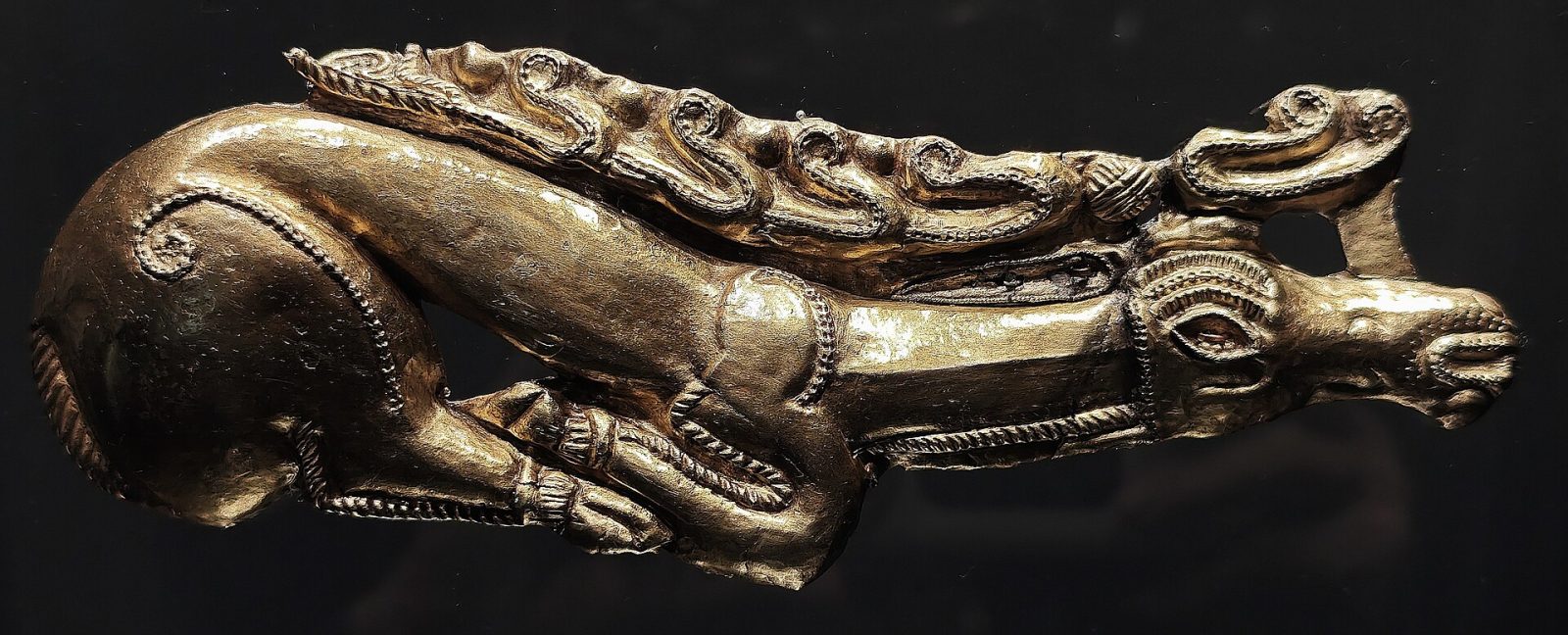
In 1923 an archaeologist digging on a Hungarian estate found a crouching stag of thin gold and silver alloy, folded up and hidden beside a hearth. It is one of the finest pieces of Scythian art in central Europe, and a symbol of the Hungarian National Museum.
In 1923, the archaeologist Lajos Bella was digging on land belonging to Aladár Blaskovits at Tápiószentmárton, a village on the Great Hungarian Plain east of Budapest. On a long, low hill, one to two metres down, close to the edge of an ancient hearth, he found a crumpled sheet of precious metal. When it was carefully opened out, it proved to be a stag, its legs folded beneath it and its great antlers sweeping along its back. Beside it lay a thick, square gold wire with a cut end. Blaskovits readily gave the stag to the Hungarian National Museum.
The stag is 23 centimetres long and 9 centimetres high, and weighs just 99 grams. It was hammered from the back into shape, and its antlers and haunches are outlined with beaded lines ending in spirals. An analysis made in 1924 showed that it is not pure gold but electrum, an alloy of gold and silver, with slightly more silver than gold. Small loops on the back show that it was once tied onto something, probably a shield or the cover of a quiver.
The crouching stag is one of the great images of Scythian art. The Scythians were nomadic horse-riding peoples of the steppes north of the Black Sea, and their warriors and princes decorated their weapons, armour and horse gear with gold animals, especially stags. Finds like this one show that Scythian culture, or people strongly influenced by it, reached the Carpathian Basin in the early Iron Age. The Hungarian National Museum dates the stag to the 6th century BC; Bella himself thought it was later, and other experts date it as early as 700 BC.
Bella had his own theory about how it came to be folded and hidden beside the hearth: that raiders had torn the ornament from a shield, folded their share of the loot and buried it in the ashes, intending to come back. A further dig in 1924 found nothing more. Some scholars think it may instead have come from a burial mound, and the exact circumstances of the find are still debated.
The Golden Stag of Tápiószentmárton is on display in the Hungarian National Museum in Budapest.
Written for Global Finds from Lajos Bella's own report of the find (1927), the Hungarian National Museum and the University of California, Los Angeles First Kings of Europe catalogue. Photo: the golden stag of Tápiószentmárton, Elekes Andor, Wikimedia Commons, CC BY 4.0.
Approximate location47.34, 19.75View on map