The Dendra Panoply: the oldest full suit of armour in Europe, saved from tomb robbers
Famous find About 1400 BC · Found in 1960 See it on the timeline →
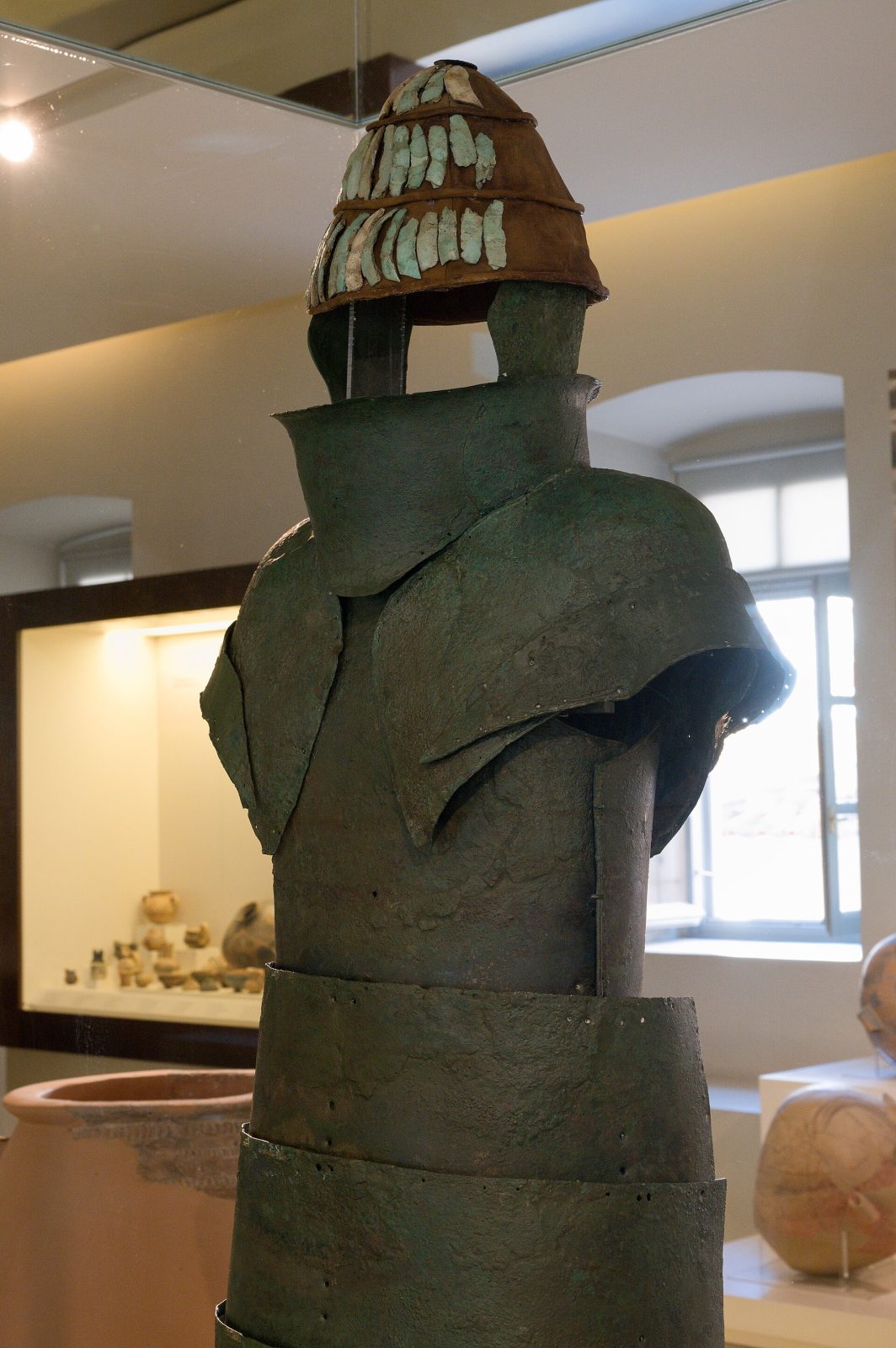
In 1960 Greek and Swedish archaeologists excavated a collapsed Mycenaean tomb at Dendra in southern Greece, part-robbed only months before. Inside was a full suit of bronze armour from about 1400 BC, the oldest in Europe. In 2024 an experiment showed it could be worn in battle.
In 1959, the roof of an ancient chamber tomb collapsed at Dendra, near the Mycenaean citadel of Midea in the Argolid, southern Greece, leaving a crack in the ground. Tomb robbers got there first and took some objects, but their attempt was stopped. In May 1960 a joint Greek and Swedish team, led by Paul Åström and Nikolaos Verdelis of the Greek Archaeological Service, excavated the tomb, now known as Chamber Tomb 12 or the Cuirass Tomb.
Lying with the disturbed burial of a man was a complete suit of bronze armour. It is made of fifteen pieces of sheet bronze, once laced together with leather. A cuirass in two halves, front and back, protected the body; a high collar guarded the neck; there were shoulder guards, plates under the arms, and three pairs of curved plates hanging from the waist to protect the hips and thighs, with fragments of guards for the shins and forearms. With it were the bronze cheekpieces of a helmet made of plates cut from boar's tusks, a famous type of Mycenaean helmet described by Homer. The man had been buried with swords with gold and ivory fittings and silver cups. He was tall for his time, more than 1.77 metres.
The armour dates from around 1400 BC, the height of the Mycenaean age, which makes it the oldest complete suit of body armour ever found in Europe. Its surviving parts are estimated to weigh about 18 kilograms with the helmet.
For decades many scholars thought it was too stiff and heavy for real fighting and must have been ceremonial. In 2024 a team led by Andreas Flouris published a test in the journal PLOS ONE. Thirteen Greek marines wore a replica through an 11-hour simulated battle, based on fighting described in the Iliad, with their heart rate, temperature and energy use measured. The researchers concluded that the armour was entirely suitable for extended combat.
The Dendra Panoply is displayed in the Archaeological Museum of Nafplio, in a Venetian building on the town's main square.
Written for Global Finds from A. Flouris and others in PLOS ONE (2024), the Swedish Institute at Athens, the Ephorate of Antiquities of Argolida and J. Brouwers in Ancient World Magazine. Photo: the Dendra armour in the Archaeological Museum of Nafplio, shown with a reconstructed boar's-tusk helmet, Zde, Wikimedia Commons, CC BY-SA 4.0.
Approximate location37.66, 22.83View on map