The Escrick Ring: a sapphire ring whose date experts disagreed on by 600 years
Famous find 5th to 6th century AD (date debated) · Found in 2009 See it on the timeline →
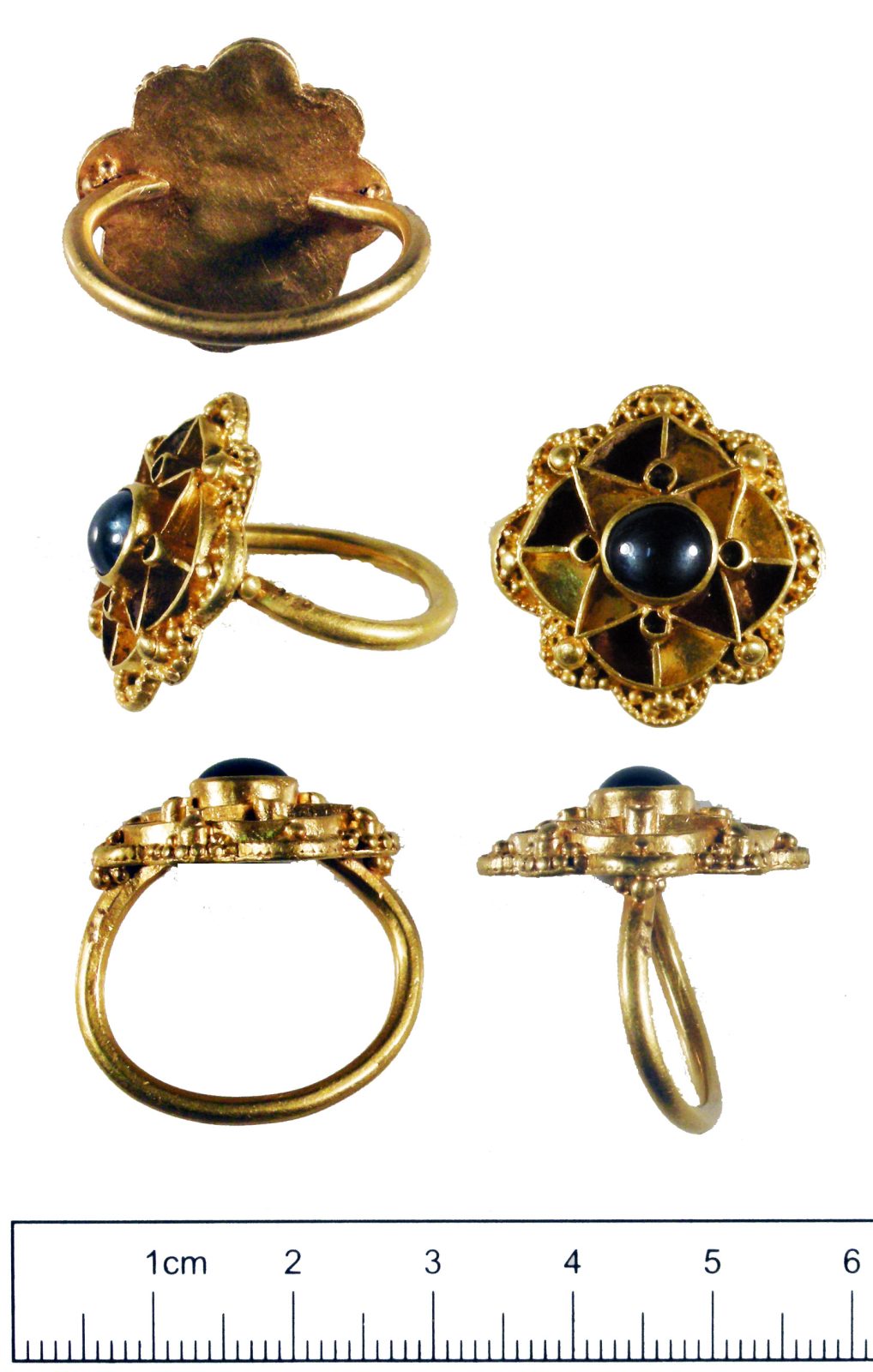
In 2009 a York detectorist found a gold ring set with a large sapphire in a field near Escrick. First thought to be a bishop's ring of around AD 1000, it is now believed to be centuries older, perhaps made for a king or queen of the 5th or 6th century.
In 2009, Michael Greenhorn, a member of the York and District Metal Detecting Club, was searching a field near the village of Escrick, about six miles south of York, when he found a gold ring with a large blue stone. He reported it, and it was declared Treasure.
The ring weighs 10.2 grams and is made of high-quality gold. Its bezel, more than two centimetres across, holds a large cabochon sapphire, a polished, rounded stone, surrounded by cells of red glass set in gold, a technique known as cloisonné, on a base shaped into eight lobes and decorated with tiny gold granules. Scientific tests confirmed that the stone is a genuine sapphire, which makes the ring very rare: it is only the second sapphire jewel known from early Britain.
Working out its date proved far harder. The first expert report suggested it was made in the late 10th or 11th century, and that it might have belonged to a bishop. In January 2013, the University of York and the Yorkshire Museum brought together more than 30 specialists to examine it. They concluded that it was much older, made in the 5th or 6th century, probably on the Continent, perhaps in France, and more likely for a king, a leader or a royal consort than for a churchman. The sapphire may be a Roman gem reused, and the ring shows signs of having been worn for at least 50 years before it was lost. Not everyone agrees, and the ring's date is still discussed.
The Yorkshire Museum bought the ring for £35,000, with grants from Art Fund, the V&A Purchase Grant Fund, the Headley Trust and the Yorkshire Philosophical Society. It is in the collection of the Yorkshire Museum in York.
Written for Global Finds from BBC News (January 2013), The Northern Echo (March 2013), the University of York and York Museums Trust. Photo: the Escrick Ring, York Museums Trust, Wikimedia Commons, CC BY-SA 4.0.
Approximate location53.88, -1.04View on map
Source: The Northern Echo