The Kingston Brooch: the finest Anglo-Saxon brooch, dug up while the vicar sat in his carriage
Famous find Late 6th or early 7th century AD · Found in 1771 See it on the timeline →
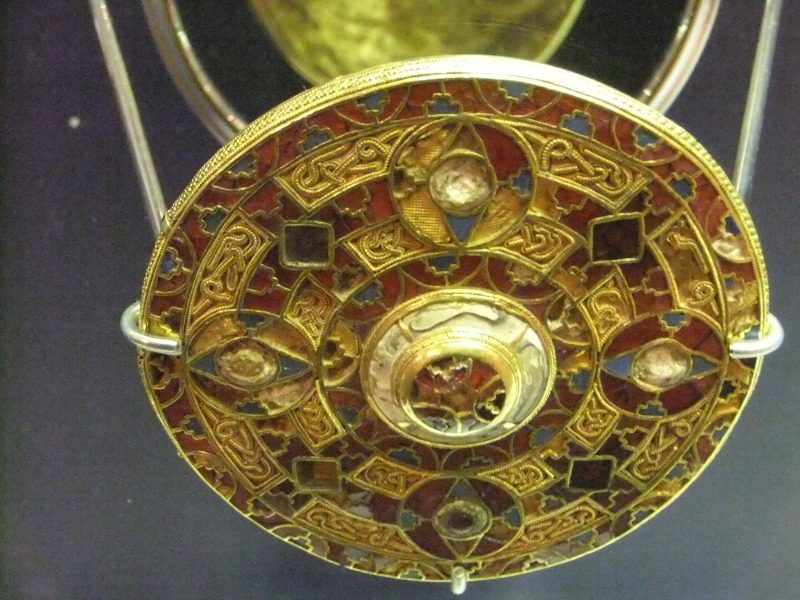
On 5 August 1771 the antiquarian Bryan Faussett's excavations on Kingston Down in Kent opened the grave of a woman buried with the largest and finest Anglo-Saxon gold brooch ever found, set with garnets, blue glass and shell.
In the 1760s and 1770s, the Reverend Bryan Faussett, a Kent clergyman and antiquarian, dug into hundreds of Anglo-Saxon graves in the burial mounds of east Kent. On 5 August 1771, his team opened grave 205 on Kingston Down, beside the old Roman road of Watling Street between Canterbury and Dover. According to the museum that now holds the find, Faussett was suffering from such a bad attack of gout that day that he stayed in his carriage, while his son Henry directed the digging.
The grave belonged to a woman, buried in a wooden coffin under a large mound. Among the many things buried with her were a gold pendant, two silver brooches, a glass cup, an iron chatelaine, a wooden box, a hanging bowl and two bronze pans, one inside the other. And on her body lay a great gold brooch.
The Kingston Brooch is 85 millimetres across and weighs 177 grams. It is a composite disc brooch, made from two gold plates joined by a band of beaded wire and packed with a white filling. Its face is divided into five rings of gold cloisonné cells, set with red garnets and blue glass, around a central boss and four smaller bosses inlaid with white shell. On the back are a catch shaped like an animal's head and a bronze pin with a jewelled head. Three small gold clips around the rim show that it was repaired in its owner's lifetime. It is the largest Anglo-Saxon composite brooch known, and it is usually dated to the late 6th or early 7th century, the time of the Kentish kingdom of Æthelberht, the first English king to become a Christian.
Faussett's collection stayed with his family after his death. In 1853 it was offered to the British Museum, which declined it, and two years later it was bought by the Liverpool collector Joseph Mayer, who published Faussett's excavation notes in 1856. In 1867 Mayer gave his collection to Liverpool. The Kingston Brooch is in World Museum Liverpool, where it is one of the treasures of the Anglo-Saxon collection.
Written for Global Finds from National Museums Liverpool's record of the brooch, the Kent Historic Environment Record and Kingston Parish Council. Photo: the Kingston Brooch in World Museum Liverpool, Reptonix, Wikimedia Commons, CC BY 3.0.
Approximate location51.22, 1.16View on map
Source: National Museums Liverpool